
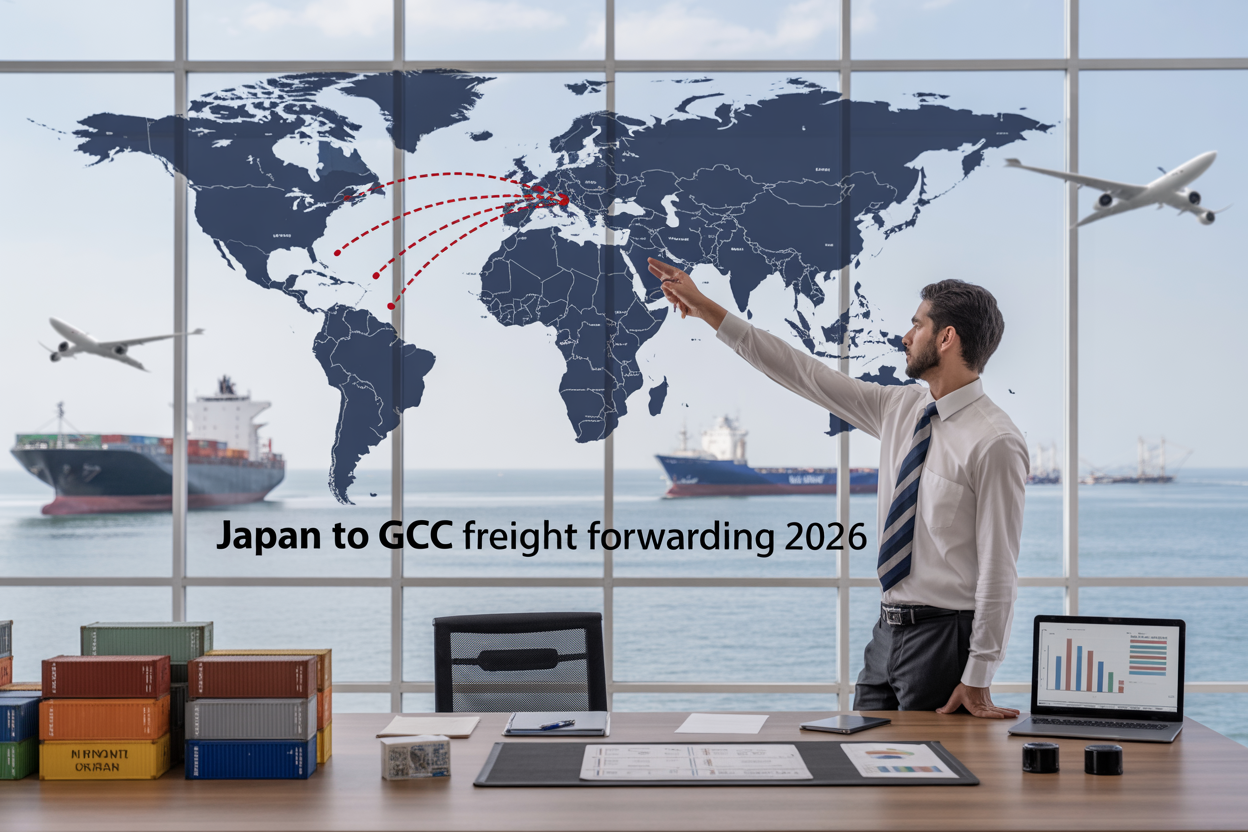
I’ll create a comprehensive, SEO-optimized blog post based on the uploaded PDF. Writing this directly in chat:
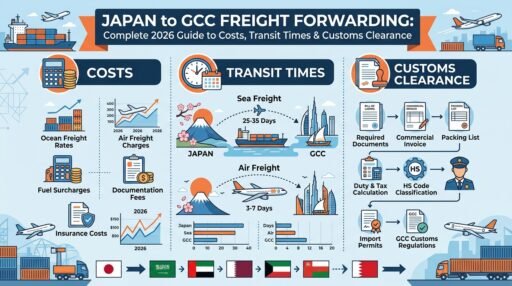
Japan to GCC Freight Forwarding: Complete 2026 Guide to Costs, Transit Times & Customs Clearance
Quick Summary for Busy Importers
Shipping from Japan to GCC costs $800–$1,500 per TEU (ocean), $4–$6/kg (air), with 14–21 day transit times for sea freight and 2–5 days for air. The GCC Freight & Logistics Market is projected to reach $120.21 billion by 2031 (6.12% CAGR). UAE customs clearance uses the FEDEX platform, Saudi Arabia requires FASAH pre-clearance 24 hours before arrival, and Kuwait uses traditional paper-based processes. FCL shipping becomes cost-effective at 60–70% container capacity; LCL consolidation saves 30–50% on small shipments. Temperature-controlled reefer containers cost 30–40% more but protect pharmaceuticals and perishables. Avoid prohibited items: alcohol (zero tolerance), pork, encryption devices, unregistered pharmaceuticals. Free zones like JAFZA (10,700+ businesses), DMCC (23,000+ businesses), and Khalifa Port Free Trade Zone offer zero-duty importation and streamlined customs. Choose a freight forwarder with IATA certification (air), FIATA membership, valid customs brokerage licenses in UAE/Saudi/Kuwait, and real-time tracking technology. Al Furqan Shipping specializes in Japan-to-GCC trade routes with 23+ years regional expertise, multimodal services (sea-air-rail), transparent pricing, and certified customs clearance specialists across all six GCC nations.
Understanding Japan to GCC Trade Routes: Why This Market Matters for Your Supply Chain
The Japan-to-GCC trade corridor represents one of Asia’s most dynamic international shipping lanes, with bilateral commerce strengthening annually. You’re looking at a region where Japanese exports dominate everything from automotive components to precision instruments, and where GCC importers actively seek reliable partners who understand both markets. This isn’t just another trade route—it’s a strategic logistics hub connecting Japan’s manufacturing excellence with the Gulf’s infrastructure ambitions.
The GCC region includes six nations: United Arab Emirates, Saudi Arabia, Kuwait, Bahrain, Qatar, and Oman. Each has distinct import demands, customs regulations, and port infrastructure. Understanding these differences is critical for avoiding delays and minimizing shipping costs. The UAE functions as a regional distribution center for re-export throughout the Gulf, while Saudi Arabia drives demand through massive Vision 2030 infrastructure projects. Kuwait focuses on automotive imports, and Qatar invests heavily in technology and construction materials following its global sporting events.
Key GCC Markets and Japanese Export Sectors
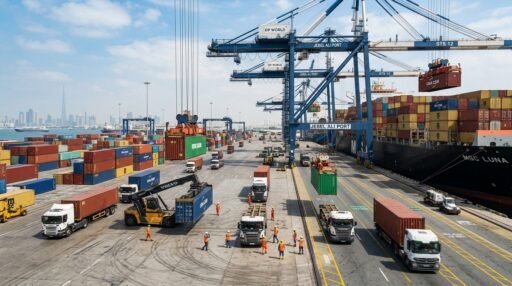
The United Arab Emirates leads in import volume, particularly through Dubai’s Jebel Ali Port (one of the world’s largest container ports) and Abu Dhabi’s Khalifa Port. Japan to UAE freight forwarding handles everything from Toyota vehicles destined for regional re-export to semiconductor equipment for oil and gas operations. The UAE accounts for approximately 45% of all Japan-GCC trade by volume, making it your primary destination choice.
Saudi Arabia stands as the largest single-country market, driven by infrastructure development, automotive demand, and industrial equipment needs. Japan to Saudi Arabia shipping volumes have grown significantly, especially for:
- Heavy machinery for construction
- Automotive components (Toyota, Nissan, Honda parts)
- Steel and metal products
- Oil and gas processing equipment
- Manufacturing technology supporting Vision 2030
Kuwait focuses on Japanese automotive imports and petrochemical equipment, while Qatar maintains steady demand for technology products and construction materials. Japan to Kuwait freight rates remain competitive due to consistent shipping volumes and well-established trade relationships. Bahrain and Oman, though smaller markets, show strong growth in consumer electronics, medical devices, and automotive parts.
Shipping Methods Explained: Choosing Between Ocean, Air, and Multimodal Freight

Selecting the right shipping method is the single biggest decision you’ll make for your Japan-to-GCC supply chain. The choice between ocean freight (cheap, slow), air freight (fast, expensive), and multimodal solutions (balanced) determines your entire cost structure and delivery timeline.
Ocean freight remains the backbone of Japan-GCC trade, handling 85%+ of container traffic. Sea shipping offers unbeatable economics for bulk cargo, but demands patience. Air freight gives you speed when you need it most, but costs 5–10x more per unit weight. Multimodal combinations split the difference, delivering moderate savings with acceptable transit times.
Ocean Freight: The Cost-Effective Workhorse
Ocean freight is your bread and butter for bulk shipments from Japan. Standard container services typically take 14–21 days for direct sailings from major Japanese ports (Yokohama, Kobe, Osaka, Nagoya) to primary GCC destinations (Jebel Ali, King Abdulaziz Port, Shuwaikh). Consolidated services using transhipment points in Singapore or Colombo may extend to 25–35 days, but offer better consolidation rates for smaller shipments.
Weekly departures are common on high-volume routes to UAE and Saudi Arabia, while services to smaller markets like Bahrain and Qatar operate on bi-weekly schedules. Peak season surcharges during Ramadan and summer months can add 15–30% to base freight rates. Here’s what you’ll actually pay:
- Japan to UAE: $900–$1,200 per 20FT container
- Japan to Saudi Arabia: $1,100–$1,400 per TEU
- Japan to Kuwait: $1,200–$1,500 per container
Major shipping lines serving Japan-GCC routes include MSC, Maersk, ONE (Ocean Network Express), and Hapag-Lloyd. These carriers offer express ocean services that reduce transit to 12–16 days for urgent shipments, though at premium rates.
Breaking down a typical 40FT container shipment from Yokohama to Dubai:
- Base ocean freight: $1,200
- Fuel surcharge (BAF, 20%): $240
- Port charges (loading/unloading): $400
- Documentation fees: $100–150
- Customs clearance (UAE): $200–300
- Total: ~$2,140–$2,290 before cargo insurance
Air Freight: Speed When Time Is Money
Air freight provides the fastest Japan-to-GCC shipping option, with transit times of 2–5 days door-to-door. Major air cargo hubs in Tokyo (NRT), Osaka (KIX), and Nagoya (NGO) connect directly to Dubai (DXB), Doha (DOH), and Kuwait (KWI) through scheduled cargo flights and combination aircraft (passenger planes carrying cargo).
Air freight rates typically range from $4.00–$6.00 per kilogram for standard cargo to $8–12/kg for express services guaranteeing 48–72 hour delivery. Premium carriers like DHL Express, FedEx, and UPS command higher rates but offer door-to-door pickup from Japanese factories.
Consolidation services (combining multiple shipments) offer middle-ground pricing of roughly $4.50–$5.50/kg while maintaining 4–7 day transit times. Temperature-controlled air freight for pharmaceuticals and perishables costs 10–20% more but ensures product integrity.
Sample air freight cost (50kg Tokyo to Dubai):
- Base air freight (50kg × $5.00): $250
- Fuel surcharge (25%): $62.50
- Handling fees (Japan airport): $75
- Handling fees (Dubai airport): $75
- Customs clearance: $150–250
- Total: ~$612–$712
Multimodal Solutions: The Balanced Approach
Multimodal transportation combines ocean and air segments to balance cost and speed. Sea-air services route cargo via Singapore or Dubai, cutting overall transit to 8–12 days while delivering 40–60% cost savings versus pure air freight. This approach works perfectly for:
- Electronics with moderate urgency
- Automotive components
- Industrial machinery (non-oversized)
- Consumer goods
- Technology products
Rail-sea combinations through transcontinental routes exist but remain less common for GCC destinations due to transit time trade-offs. Road freight through Turkey offers an alternative at roughly $2,000–$3,500 per truck, though transit times extend significantly (25–35 days total with customs delays).
Digital tracking platforms now provide real-time visibility across all transport modes, ensuring seamless handoffs between ocean carriers, air freight operators, and final-mile road transporters.
GCC Customs Clearance Decoded: Country-by-Country Requirements and Procedures

This is where most Japan-to-GCC shipments hit their first real obstacle: customs clearance. Get this wrong, and you’re facing storage fees ($5–$10 per CBM daily), cargo detention holds, and potential re-shipment. Get it right, and you clear in 24–48 hours.
Each GCC country operates under the GCC Customs Union (established 2003, fully digitized 2021), which standardizes many procedures. However, country-specific requirements still create complexity. Saudi Arabia moved to digital-first clearance in 2024, while Kuwait maintains traditional paper processes. UAE customs operates two separate systems depending on your destination port.
UAE: FEDEX Platform and Port-Specific Requirements
United Arab Emirates customs clearance requires submission through the FEDEX (Federal EDX) platform for Dubai-destined cargo. This system pre-clears documentation electronically, though physical inspections still occur for high-risk categories.
Required documents for UAE customs:
- Commercial invoice (detailed, matching PL exactly)
- Packing list (quantities matching invoice line-by-line)
- Bill of lading (accurate consignee info = license number match mandatory)
- Certificate of origin (from Japanese chamber of commerce)
- Product-specific certificates (halal for food, conformity for electronics, FDA pre-approval for medical)
Processing timeline: 24–48 hours for compliant shipments at Jebel Ali. High-risk categories (electronics, pharmaceuticals) may trigger physical inspections adding 1–2 days.
Jebel Ali Port (Dubai’s main container terminal) charges:
- Port handling: $15–25 per CBM
- Storage (free first 5 days, then $8/CBM daily)
- Documentation: $100–150
Abu Dhabi’s Khalifa Port operates on slightly different timelines (36–72 hours) but charges similar rates. Free zone benefits at JAFZA mean zero-duty importation for goods destined for re-export, creating significant cash-flow advantages.
Saudi Arabia: FASAH Pre-Clearance and Strict Compliance
Saudi Arabia customs implemented the FASAH system (Facilitate Shipment Handling) in 2022, requiring 24-hour pre-clearance notification before vessel arrival. This means you must submit all documents to Saudi customs before your ship leaves Japan, not after it arrives.
Saudi Arabia specifics:
- Pre-clearance required: 24 hours before Jeddah/Dammam arrival
- Duty rates: 5–12% standard (luxury goods 15–20%, food 5–15%)
- Processing timeline: 24–72 hours if compliant, potentially 5–7 days if documents need correction
- Port charges (Jeddah Islamic Port): $20–30 per CBM
Additional Saudi requirements:
- Halal certificates (mandatory for ALL food/animal products)
- SABER certification for regulated products (electronics, appliances, cosmetics)
- Pre-approval from Saudi health ministry (pharmaceuticals, medical devices)
- Apostille on all certificates (embassy authentication adds $50–100 per doc + processing time)
Vision 2030 industrial equipment receives preferential treatment with reduced duty rates (often 0–3%), accelerating the import push for Japanese machinery.
Kuwait and Bahrain: Traditional Processes with Digital Evolution
Kuwait maintains more traditional paper-based customs procedures at Shuwaikh Port and Shuaiba Port, though digitization initiatives are expanding. Bahrain similarly operates manual processes but introduced VAT (10%) in 2019, adding complexity to cost calculations.
Kuwait customs timeline: 48–72 hours for standard clearance. Paper documentation requirements:
- Original commercial invoice
- Original packing list
- Certificate of origin (authenticated)
- Bill of lading or air waybill
Bahrain specifics:
- 10% VAT on landed cost (duty + freight + insurance)
- Processing typically 24–48 hours
- Port handling fees: $12–20 per CBM
- No specific pre-clearance requirement
Qatar and Oman: Growing Infrastructure, Streamlined Procedures
Qatar ports (Doha Port, Al-Ruwais) use the Mirsal platform for digital submissions, similar to Saudi Arabia’s FASAH but with shorter pre-notification windows (12 hours vs. 24 hours).
Oman operates the Bayan system, which processes most clearances within 2–4 hours for compliant shipments. Muscat Port and Salalah Port offer competitive handling rates and faster clearance, making Oman an attractive gateway for cross-border GCC distribution.
Oman advantages:
- Fastest customs clearance in GCC (2–4 hours typical)
- Competitive duty rates (5% standard, similar structure to UAE)
- Excellent for re-export to other GCC nations
Comprehensive Cost Breakdown: Real Numbers for Your Budget Planning

Shipping costs vary wildly based on destination, cargo type, season, and container size. You need exact numbers, not vague ranges. Here’s what you’ll actually pay in 2026:
Base Freight Rates by Shipping Method
Ocean freight between Japan and the GCC ranges from $800–$1,500 per TEU (20-foot container) depending on destination and carrier. Japan to UAE freight rates fall on the lower end ($900–$1,200) due to high shipping volumes and fierce competition. Japan to Kuwait freight and routes to smaller GCC ports command 10–25% premium pricing due to lower consolidation volumes.
| Shipping Method | Japan → UAE | Japan → Saudi | Japan → Kuwait |
|---|---|---|---|
| Ocean (per 20FT) | $900–$1,200 | $1,100–$1,400 | $1,200–$1,500 |
| Ocean (per 40FT) | $1,400–$1,800 | $1,700–$2,100 | $1,900–$2,200 |
| Air (per kg) | $4.00–$5.50 | $4.50–$6.00 | $5.00–$6.50 |
| LCL (per CBM) | $80–$120 | $100–$140 | $120–$160 |
LCL (Less than Container Load) consolidation costs more per cubic meter but makes sense for smaller shipments under 10 CBM. Break-even analysis shows FCL (Full Container Load) becomes cost-effective when your shipment occupies 60–70% of container capacity.
Fuel Surcharges: The Hidden Cost That Kills Your Budget
Fuel surcharges (also called BAF or bunker adjustment factor) fluctuate monthly based on global crude oil prices. Ocean carriers typically charge 15–25% of base freight rates as fuel surcharge, while air freight carriers apply 20–40% depending on jet fuel costs.
Peak season surcharges hit hardest during:
- Chinese New Year (January–February): +30–50% above normal
- Pre-Christmas rush (September–November): +30–50%
- Ramadan period (exact dates vary annually): +15–30%
- Summer months (June–August): +20–40%
Dynamic pricing models mean the quote you receive today might change within days. Shipping lines adjust rates weekly or even daily based on demand. Contract rates for annual commitments typically lock in fixed pricing, protecting you from these volatility swings.
Documentation and Administrative Fees
Standard documentation packages for Japan-GCC freight forwarding include:
- Bill of lading preparation: $50–100
- Commercial invoice authentication: $30–50
- Certificate of origin (Japanese Chamber of Commerce): $30–50
- Packing list creation: $25–40
- Consular legalization (when required): $50–100 per document
- Halal certificates (food products): $100–200
Complex shipments requiring additional product-specific certificates can double these costs. Electronic documentation is becoming standard, reducing costs by 20–30% versus traditional paper processes, though certain cargo types still require hard copy originals.
Insurance and Additional Service Costs
Marine cargo insurance typically costs 0.1–0.3% of shipment value with minimum premiums around $50–100 per policy. Middle East shipping from Japan often requires enhanced coverage due to regional security considerations, potentially increasing premiums by 0.05–0.1%.
Warehouse and storage fees vary significantly:
- Dubai/Jebel Ali: $15–25 per CBM (standard handling)
- Smaller GCC ports: $20–35 per CBM (30–50% premium)
- Extended storage (beyond free periods): $5–10 per CBM per week
- Temperature-controlled storage: $25–40 per CBM
Additional service costs add up quickly:
- Customs clearance assistance: $200–500
- Final delivery to warehouse: $100–300
- Special handling for oversized cargo: $300–1,000
- Reefer container rental (vs. standard): +$500–1,000
- Insurance (additional coverage): +$50–200
Currency fluctuations between Japanese yen and GCC currencies can impact final costs by 5–10% over shipping periods, making hedging strategies important for regular shippers.
FCL vs. LCL: The Definitive Cost-Benefit Analysis for Your Shipment Size
FCL (Full Container Load) and LCL (Less than Container Load) represent fundamentally different shipping approaches, each optimal for different business scenarios.
When Full Container Load (FCL) Makes Sense
FCL shipping works best when:
- Your shipment exceeds 15 cubic meters
- You need exclusive container use for security
- You’re shipping high-value electronics, machinery, or sensitive cargo
- You require faster transit times (no consolidation delays)
- You’re moving automotive components or bulk materials
FCL advantages:
- Better security (sealed container, minimal handling)
- Faster transit (direct port-to-port, no consolidation waits)
- Lower per-unit costs for large volumes
- Simpler customs clearance (single container vs. mixed cargo)
- Reduced damage risk
FCL disadvantages:
- Higher total cost for small shipments
- Less flexibility in timing
- Potential for underutilized capacity
When LCL Consolidation Delivers Better Economics
LCL suits:
- Shipments under 10 cubic meters
- Testing new GCC markets (smaller initial volumes)
- Seasonal products with variable demand
- Multiple suppliers consolidating into one shipment
- Businesses wanting flexible shipping frequency
LCL advantages:
- Lower entry cost for small volumes
- Flexibility to ship anytime
- Shared consolidation costs
- Perfect for seasonal businesses
LCL disadvantages:
- Higher per-CBM costs ($80–$120 vs. $30–$50 for FCL)
- Longer transit times (3–5 days added for consolidation)
- More handling = increased damage risk
- Multiple handling points at consolidation ports
The Break-Even Calculation
FCL becomes cost-effective when your shipment occupies 60–70% of container capacity. Here’s the math:
- 40FT FCL to Dubai: $1,600 total = $40/CBM (for 40 CBM cargo)
- LCL consolidation: $100/CBM × 8 CBM = $800
- FCL wins financially when you reach ~16 CBM
Special equipment requirements favor FCL regardless of volume: reefer containers (temperature-controlled), open-top containers (oversized loads), and flat racks (heavy machinery) cost significantly more on a per-container basis, making consolidation uneconomical.
Temperature-Controlled Logistics: Protecting Pharmaceuticals, Perishables, and Sensitive Goods

Temperature-controlled shipping separates professionals from amateurs. A single temperature spike in the Indian Ocean or a door opening in Dubai can destroy pharmaceutical integrity, spoil food products, or damage electronics. This isn’t optional—it’s insurance for your cargo.
Understanding Cold Chain Requirements
Pharmaceutical products typically require 2–8°C storage, demanding refrigerated containers throughout the supply chain. Frozen foods need −18°C to −25°C maintenance, while chocolates and premium goods thrive in 15–20°C controlled environments.
Pre-cooling procedures in Japanese facilities ensure cargo reaches target temperature before container loading, eliminating temperature shock from entering a cold reefer. Continuous monitoring systems track:
- Temperature fluctuations (alerts if exceeding set parameters)
- Humidity levels (critical for electronics and pharmaceuticals)
- Door openings (unauthorized access = immediate notification)
Data loggers attached to shipments provide detailed temperature/humidity reports for regulatory compliance and insurance claims. GCC port facilities offer temperature-controlled storage and handling services, though capacity may be limited during peak seasons (November–December, post-Ramadan).
Reefer Container Costs and Specifications
Reefer containers cost $500–$1,000 more than standard containers but protect cargo worth thousands or millions. Container sizes:
- 20FT reefer: 25–28 CBM capacity, $1,500–$2,000 additional cost
- 40FT reefer: 55–60 CBM capacity, $2,000–$2,500 additional cost
Reefer economics: If your refrigerated shipment value exceeds $10,000–$15,000, the container rental cost ($2,000–$2,500) represents 15–25% insurance protecting your cargo.
Last-Mile Cold Chain Management
The journey doesn’t end at port. Final-mile delivery requires refrigerated trucks and trained personnel familiar with cold chain protocols. Breakage procedures for equipment failures must be pre-planned:
- Backup power systems at destinations
- Contingency routes if primary truck fails
- Real-time temperature monitoring during delivery
- Emergency response contacts
Partner selection becomes critical—not all freight forwarders maintain cold chain expertise. Certification requirements like GDP (Good Distribution Practice) ensure compliance with pharmaceutical regulations across all GCC markets. Certification costs ($5,000–$20,000 annually) protect your shipments and liability.
GCC Customs Compliance: What You Can and Cannot Ship

Prohibited items cause more problems than anything else. A single prohibited item hidden in your cargo means full seizure, potential legal consequences, and destroyed business relationships. You need the complete list.
Universal Prohibitions Across All GCC Countries
Alcohol tops every prohibited list with zero tolerance policies. Pork products face universal bans, while other meat products require halal certification from recognized Japanese authorities. Religious materials deemed offensive to Islamic beliefs face prohibition, including certain books, artwork, symbols, and non-Islamic religious items.
Telecommunications equipment faces heavy restrictions due to security concerns:
- Radio transmitters (prohibited without special permit)
- GPS devices (restricted to licensed users)
- Encryption-capable devices (banned entirely)
- Walkie-talkies and drone components (problematic without pre-approval)
- Mobile phones with advanced features (sometimes problematic)
Product Category Restrictions by Country
Pharmaceuticals and medical devices require extensive pre-registration:
- UAE Ministry of Health requires local agent registration before importation
- Saudi Arabia SFDA maintains strict requirements with quality certificates from Japanese manufacturers
- Kuwait requires health ministry pre-approval
- Qatar follows UAE standards
- Oman maintains similar but slightly less stringent requirements
Processing timeline: 4–12 weeks for pre-approval, so plan accordingly.
Cosmetics containing certain chemicals face restrictions:
- Alcohol-based formulations (problematic in some countries)
- Specific preservatives (restricted lists vary by country)
- Whitening agents (banned in some GCC markets)
Electronics and appliances face SABER certification requirements in Saudi Arabia and increasing scrutiny across GCC for:
- Energy efficiency standards
- Safety certifications
- Frequency compliance (wireless devices)
Currency and Precious Metals
Gold, silver, and precious metals have strict declaration requirements. Amounts exceeding specific thresholds (typically $10,000 USD equivalent) require:
- Central bank notifications
- Detailed documentation
- Specialized customs brokers familiar with precious metal regulations
- Jewelry shipments need detailed descriptions and often require independent appraisers
Restricted Items Requiring Special Permits
Items requiring pre-approval:
- Firearms and ammunition (de facto prohibited)
- Chemical supplies (restricted lists)
- Certain software (encryption-capable)
- GPS tracking devices
- Archaeological artifacts
- Endangered species products
Processing timelines for permits can extend 4–8 weeks, making advance planning essential.
Free Zones: Duty-Free Importation and Tax-Deferred Distribution
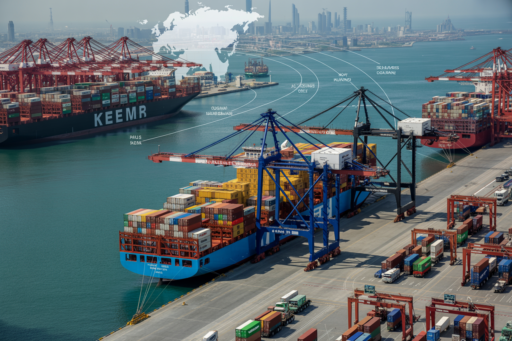
Free zones across the GCC offer game-changing advantages for Japan-to-GCC freight forwarding, allowing duty-free importation and streamlined customs procedures. You store goods indefinitely without paying duties until final distribution to local markets.
JAFZA (Jebel Ali Free Zone)
JAFZA remains the GCC’s largest free zone with over 10,700 registered businesses. Features:
- 100% foreign ownership allowed
- Zero corporate income tax for qualifying activities
- Duty-free importation of raw materials and finished goods
- Direct port access to Jebel Ali (one of world’s largest ports)
- Advanced logistics infrastructure specifically designed for Asian trade
Cost advantage: Import goods duty-free, store indefinitely, pay duties only when moving to local UAE markets. Perfect for regional distribution hubs.
DMCC (Dubai Multi Commodities Centre)
DMCC supports over 23,000 businesses with specialized focus on:
- Commodities trading
- Precious metals and gems
- Agriculture products
- Gaming and entertainment
Free zone benefits: 0% corporate tax, simplified licensing, direct seaport/airport access.
Abu Dhabi Free Zones: KIZAD and Khalifa Port
KIZAD (Khalifa Industrial Zone Abu Dhabi) and Khalifa Port Free Trade Zone offer:
- Direct port access
- Advanced logistics facilities
- Streamlined customs procedures
- Competitive handling rates ($12–18 per CBM)
- Excellent for Asian trade routes
Saudi Arabia Economic Cities
King Abdullah Economic City and Jazan Economic City represent Saudi Arabia’s push toward economic diversification. Features:
- Competitive advantages for Japanese manufacturers
- Simplified licensing procedures
- Reduced bureaucracy vs. standard Saudi market entry
- Preferential duty rates on industrial equipment
- Streamlined customs clearance
Kuwait and Bahrain Free Zones
Kuwait’s free zones focus on logistics and light manufacturing, offering attractive terms for Japanese companies seeking regional access. Bahrain’s specialized zones emphasize financial services and manufacturing, with compact size making it ideal for regional distribution planning.
Qatar: Technology and Innovation Focus
Qatar’s free zones emphasize technology and innovation sectors, offering particular advantages for Japanese electronics and automotive component imports. Modern facilities with direct airport and seaport access reduce overall logistics costs and transit times when using Qatar as a regional hub.
Choosing Your Freight Forwarder: The Complete Evaluation Checklist

Choosing the wrong freight forwarder can cost you thousands in delays, damaged cargo, and customs fines. You need to verify credentials thoroughly before signing anything.
Licensing and Accreditation Verification
First step: Check credentials. Look for:
- IATA certification (International Air Transport Association)—mandatory for air freight
- FIATA membership (International Federation of Freight Forwarders Associations)—signals professional standards
- Valid maritime licenses from relevant authorities in Japan and GCC
- Customs brokerage licenses in UAE, Saudi Arabia, Kuwait (confirms legal authority to handle GCC customs clearance)
- MLIT registration (Japan’s Ministry of Land, Infrastructure, Transport and Tourism)—verifies Japanese customs authority
- Professional liability insurance and cargo insurance coverage
Request proof of financial stability through credit reports or bank references. This verification protects your shipments and ensures you’re working with legitimate operators who can handle complications without leaving you stranded.
Service Portfolio and Specialization
Different freight forwarders excel in different areas. Matching their strengths to your needs makes all the difference:
- Automotive specialists: Understand RoRo vessel logistics, dealership networks, parts consolidation
- Electronics experts: Familiar with climate-controlled containers, static-sensitive handling, high-value security
- Machinery specialists: Experienced with project cargo, oversized shipments, equipment assembly in destination
- Cold chain experts: Hold GDP certifications, maintain refrigerated infrastructure, pharmaceutical expertise
- LCL consolidators: Combine multiple small shipments cost-effectively
- Multimodal specialists: Seamlessly combine sea-air-rail options
Evaluate their network coverage across GCC nations. A forwarder strong in Dubai might have limited presence in Kuwait or Oman. Strong local connections mean faster customs clearance and better understanding of regional regulations.
Technology Platforms and Real-Time Tracking
Modern freight forwarding relies entirely on digital visibility. Look for:
- Comprehensive online portals with real-time container tracking (Tokyo to Riyadh)
- Automated milestone notifications (Japanese port departure, GCC customs clearance, final delivery)
- Electronic documentation capabilities (digital bills of lading, commercial invoices)
- API integrations connecting to your ERP/WMS systems
- Mobile apps for on-the-go access
- Predictive analytics suggesting optimal routing and timing
- Rate comparison tools across carriers and service levels
The best systems integrate directly with GCC customs systems, speeding clearance times from 72 hours to 24 hours.
Myths vs. Facts: Separating Fasting Science from Internet Nonsense
| MYTH | FACT |
|---|---|
| “Ocean freight takes too long—everyone uses air freight” | Ocean freight handles 85%+ of Japan-GCC trade. Air freight costs 5–10x more per unit. Most businesses use ocean when delivery windows permit (2–3 weeks). |
| “All GCC countries have the same customs requirements” | Wrong. UAE uses FEDEX platform (24–48 hours), Saudi Arabia requires FASAH pre-clearance 24 hours before arrival, Kuwait uses traditional paper processes. Oman clears in 2–4 hours. |
| “Cheaper freight forwarders always cost less overall” | False. Low-cost forwarders often cause delays (additional storage fees), damage (poor handling), and customs issues (incomplete documentation) that cost thousands. |
| “Temperature-controlled shipping is only for pharmaceuticals” | Incorrect. Chocolates, electronics, cosmetics, premium foods, and luxury goods all benefit from climate control in Middle East heat. 30–35% of halal logistics operations use temperature control. |
| “Free zones mean you never pay duties” | Misleading. Zero duties UNTIL goods leave the zone for local markets. Mixed shipments need separate documentation. Goods destined for re-export enjoy permanent duty-free status. |
| “You need a local agent in every GCC country” | Not true. Established freight forwarders with local partnerships handle customs in all six nations. Personal agents are often redundant and expensive. |
| “Consolidation always saves money” | Only below 60–70% container capacity. FCL becomes cheaper at higher volumes. Consolidation adds 3–5 days to transit time. |
| “Halal certificates aren’t important for non-food products” | Correct—they’re required ONLY for food and animal products. Electronics and machinery don’t need them. |
| “HS codes are the same everywhere” | No. GCC countries extended to 12-digit HS codes in 2025 (vs. 10-digit historically). Incorrect codes cause delays and re-classification fees. |
| “You can ship anything as long as it’s legal in Japan” | False. GCC prohibitions are strict: alcohol (zero tolerance), pork, unregistered pharmaceuticals, encryption devices, non-Islamic religious items. |
FAQ: Your Top Questions About Japan-GCC Freight Forwarding Answered
Q: How long does Japan to GCC shipping actually take? Ocean freight typically takes 14–21 days from Japanese ports (Yokohama, Kobe) to major GCC destinations (Jebel Ali, Jeddah, Kuwait City). Air freight takes 2–5 days door-to-door. Multimodal combinations average 8–12 days. Add 2–5 days for customs clearance depending on the country and documentation quality.
Q: What’s the real cost for shipping a 40FT container to Dubai? Base ocean freight: $1,400–$1,800. Fuel surcharge (20%): $280–$360. Port handling: $400–500. Documentation: $100–150. Customs clearance: $250–400. Insurance (0.2% of $50,000 cargo): $100. Total: $2,530–$3,210. This assumes compliant documentation and no inspections.
Q: Can I ship electronics from Japan to Saudi Arabia without pre-approval? No. Saudi Arabia requires SABER certification for regulated electronics. Processing takes 4–8 weeks. Ship without it, and your cargo sits in Jeddah until you obtain it (storage fees accumulate daily). Budget accordingly.
Q: Which GCC country has the fastest customs clearance? Oman clears most compliant shipments in 2–4 hours using the Bayan system. UAE typically processes in 24–48 hours through FEDEX. Kuwait and Bahrain range 48–72 hours using paper-based procedures. Saudi Arabia and Qatar are typically 36–72 hours after pre-clearance submission.
Q: Is consolidation worth the wait time? Yes, if you’re shipping under 15 CBM. You’ll save 30–50% versus FCL, but expect 3–5 extra days for consolidation. For urgent shipments, FCL makes sense despite higher costs. For non-urgent shipments, consolidation dominates.
Q: What’s the biggest mistake Japan exporters make with GCC shipping? Inaccurate documentation. A single typo on the bill of lading (consignee name not matching import license), wrong HS code, or missing certificate of origin causes 2–5 day delays and additional fees. Hire your freight forwarder to review documents before shipment.
Q: Do I need cargo insurance? Absolutely. Standard insurance costs 0.1–0.3% of cargo value but saves you if cargo is damaged, lost, or stolen. For high-value shipments (>$50,000), enhanced coverage is essential. Your freight forwarder’s basic liability typically covers only $500 per package—way too low.
Q: Can I ship food products from Japan to Saudi Arabia without halal certification? No. Saudi Arabia absolutely requires halal certificates for all food and animal products. Processing takes 2–4 weeks through Japanese authorities. Start the certification process before manufacturing, not after.
Q: What happens if my shipment gets inspected by customs? Physical inspections typically add 1–3 days to clearance timeline. If documentation is accurate, inspections are routine and cause minimal additional cost. If documentation is incomplete or suspicious, inspections can reveal issues requiring expensive corrections or re-shipment.
Q: Is it cheaper to ship through Turkey to Saudi Arabia overland? Road freight through Turkey costs roughly $2,000–$3,500 per truck with 25–35 day transit times. Compare this to ocean freight ($1,400–$1,800 with 14–21 days). Ocean wins on both cost and speed. Road freight only makes sense for emergency situations where air freight is prohibitively expensive.
Q: Can I use a cheaper forwarder to save money? Only if you value complications. Cheap forwarders typically cause: delayed customs clearance (storage fee penalties), poor handling (cargo damage), incomplete documentation (re-shipment costs), limited tracking (no visibility). The 10–15% savings evaporate with first incident. Quality forwarders charge more upfront but deliver reliable service.
Q: What’s the advantage of free zones like JAFZA? Duty-free importation until goods leave the zone for local markets. Store indefinitely without taxes. Perfect for companies establishing regional distribution hubs in UAE. Goods destined for re-export enjoy permanent duty-free status. Licensing is faster and easier than local market operations.
Optimizing Your Japan-to-GCC Shipping Strategy: Cost-Saving Techniques That Actually Work

You can’t negotiate shipping costs down to zero, but you can implement strategic approaches that cut expenses by 25–50% without sacrificing reliability.
Consolidation Mastery
Consolidating shipments cuts expenses by 30–50% when done strategically. Instead of sending multiple small shipments throughout the month, combine them into one larger container. This works particularly well for businesses with regular GCC shipments to UAE, Saudi Arabia, or Kuwait.
Cross-docking at major Japanese ports (Yokohama, Tokyo, Kobe) saves significant money. Your freight forwarder receives goods from different Japanese suppliers, consolidates them at the port facility, and loads everything into one container. This eliminates multiple pickup fees and reduces handling costs dramatically.
Regional consolidation works for multi-country GCC distribution. Ship one large container to Dubai or Jeddah, then use local trucking to reach final destinations in Bahrain, Kuwait, or Oman. This often costs less than direct shipping to each country separately.
Warehouse storage in Japan for temporary consolidation: Many Japan-to-Gulf shipping specialists offer 30–60 days free storage with consolidation services. Store goods until you accumulate enough volume for consolidated shipping.
Seasonal Planning and Peak Period Management
Peak seasons hit hardest during August–October (pre-holiday stocking) and January–March (post-Chinese New Year). Rates can increase 40–60% above normal during these periods.
Off-peak windows (April–July and November–December) offer significant savings. Book space 4–6 weeks in advance during busy seasons to secure better rates and guaranteed vessel allocation.
Ramadan and Eid affect GCC customs clearance procedures and port operations. Customs offices operate shorter hours; processing times extend 2–3 days. Ship 1–2 weeks earlier than normal during religious observances.
Contract annual shipping agreements with your forwarder lock in volume discounts and rate protection. Many Japan-to-Saudi Arabia shipping specialists offer rates discounts when you commit to minimum annual tonnage.
Risk Management That Actually Reduces Costs
Temperature-controlled shipping protects sensitive products. Reefer containers cost 30–40% more than standard but save you from catastrophic cargo loss for pharmaceuticals, food, and sensitive electronics.
Proper export packaging prevents damage during multiple handling points. Japanese suppliers often use minimal packaging suitable for domestic transport, but GCC-bound cargo needs reinforcement for ocean transit and rough port handling.
Marine insurance costs 0.1–0.3% of cargo value. For $50,000 cargo, that’s $50–150 per shipment—trivial compared to potential loss.
Cargo tracking technology (GPS-enabled container seals, IoT sensors) provides real-time visibility and alerts to unauthorized access or temperature deviations. Costs $50–200 per container but prevent theft and product degradation.
Why Al Furqan Shipping Is Your Japan-to-GCC Partner
You’ve made it through the technical weeds. Now comes the practical decision: who actually handles your shipments?
Al Furqan Shipping stands out as a premier choice for Japan-to-GCC freight forwarding with comprehensive service networks spanning all six GCC nations. Their specialized teams understand the unique requirements of Japanese exporters and GCC import regulations, creating smooth shipping experiences from start to finish.
What Sets Al Furqan Apart
23+ years GCC logistics experience means they’ve seen every customs quirk, port delay, and regulatory change. They understand that Japan to Kuwait freight has different dynamics than Japan to UAE shipping. Their team operates in Japanese business culture but speaks fluent Arabic and understands GCC customs nuances.
Multimodal expertise covers everything from automotive parts to consumer electronics, handling both FCL and LCL requirements efficiently. Established offices in key Japanese ports (Yokohama, Kobe, Nagoya) and strong partnerships across UAE, Saudi Arabia, Kuwait, Bahrain, Qatar, and Oman provide consistent service quality regardless of destination.
Transparent pricing on Japan to Kuwait freight rates and Japan to Saudi Arabia shipping means no surprise fees. Advanced tracking systems keep you informed throughout the shipping process, while their customs clearance specialists navigate GCC regulations smoothly.
Technology infrastructure includes:
- Real-time shipment tracking (Japan to destination)
- Automated documentation generation
- Direct integration with GCC customs systems
- Mobile app access
- Predictive analytics for route optimization
Whether you’re shipping small packages or full containers, their team delivers personalized service backed by decades of Middle East shipping from Japan expertise.
Getting Started With Al Furqan
Contact Al Furqan’s Japan desk for a free shipping strategy consultation. Request a customized quote including:
- Your product category and specifications
- Required transit timeline
- Destination GCC country
- Regular shipping volume expectations
- Special handling needs (temperature control, hazmat, oversized, etc.)
They’ll provide transparent cost breakdowns showing:
- Base ocean/air freight rates
- Fuel surcharges and seasonal adjustments
- Documentation fees and customs clearance costs
- Insurance and handling options
- Free zone advantages if applicable
- Delivery timeline expectations

Final Takeaway: Japan-to-GCC Shipping Doesn’t Have to Be Complicated
Shipping from Japan to the GCC doesn’t require a PhD in logistics. You just need the right approach and the right partner.
Understanding the mechanics of ocean freight (cheap, slow), air freight (fast, expensive), and multimodal solutions (balanced) lets you match your shipping method to your timeline and budget.
Navigating customs regulations across six different countries demands attention to detail. But following the country-specific checklist (FEDEX for UAE, FASAH for Saudi Arabia, traditional procedures for Kuwait and Bahrain) ensures smooth clearance in 24–72 hours instead of costly delays.
Choosing the right freight forwarder might be your most important decision. Verify credentials (IATA, FIATA, customs licenses), evaluate their specialization (automotive, electronics, machinery), and test their technology platform before committing to long-term volume.
Optimizing your costs through consolidation, seasonal planning, and proper risk management can cut your expenses by 25–50% without sacrificing reliability.
The GCC market represents tremendous opportunity for Japanese exporters. By implementing these strategies and partnering with experienced Japan-to-GCC specialists like Al Furqan Shipping, you transform complexity into predictability and cost into competitive advantage.
Your future GCC supply chain starts with a conversation. Reach out to Al Furqan’s Japan desk today. (info@alfurqanshipping.com)
www.alfurqanshipping.com