
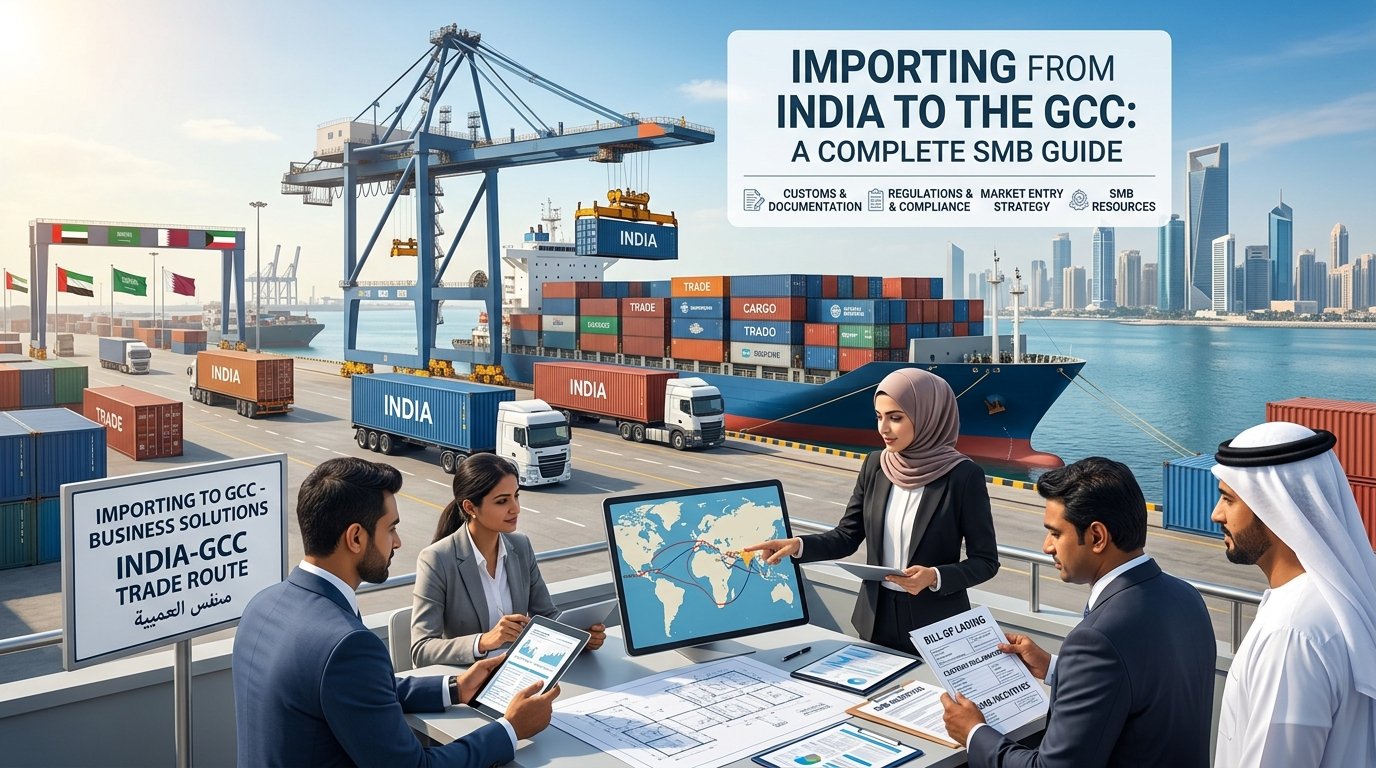
Importing from India to the GCC: A Complete SMB Guide
(All information is current as of 2025. Always double‑check the latest regulations before shipping.)
Why Import from India?
- Cost‑effective manufacturing – India’s production costs for textiles, electronics, pharma, and food are among the lowest in Asia.
- Cultural affinity – GCC consumers already recognize many Indian brands (spices, apparel, Ayurvedic products).
- Robust trade ties – A Preferential Trade Agreement (PTA) between the GCC and India gives duty reductions for a wide range of items.
- Growing middle class – Higher disposable incomes mean steady demand for Indian‑made consumer goods.
Market Hotspots – Indian Products That Sell Well in the Gulf
- Consumer electronics – smartphones, tablets, wearables, audio gear
- Home appliances – air‑conditioners, washers, LED TVs, refrigerators
- Pharmaceuticals & nutraceuticals – generic medicines, vitamins, herbal supplements
- Textiles & apparel – cotton fabrics, silk garments, sportswear, traditional wear (kurta, abaya)
- Automotive components – spare parts, tires, batteries
- Food & beverage – spices, tea, coffee, processed snacks, dairy products
- Construction materials – cement, steel, tiles, sanitary ware
Regulatory Landscape
-
Standard customs duty in the GCC: 5 % of CIF value for most goods.
-
VAT / GST (applied after duty):
- Saudi Arabia – 15 %
- UAE, Qatar, Oman, Bahrain – 5 %
- Kuwait – 15 % (on top of customs duty)
-
India‑GCC Preferential Trade Agreement (2008‑2009)
- Cuts or eliminates duty on many Indian export categories.
- Requires a Certificate of Origin (CO) issued by an Indian authorized chamber.
-
Product‑specific licences
- Food: Halal certification, health certificates, and, for processed foods, a GCC Standardisation Organisation (GSO) label.
- Pharma: WHO‑GMP compliance, GCC drug registration (if applicable).
- Cosmetics: GSO conformity certificate (safety & labeling).
- Electronics: Test reports proving compliance with GCC safety standards (e.g., CE‑equivalent).
-
Restricted / Prohibited items (same across GCC)
- Alcohol, pork, and other non‑Halal food products.
- Counterfeit goods.
- Dual‑use items (goods that could be used for military purposes).
- Certain chemicals and hazardous materials (require special permits).
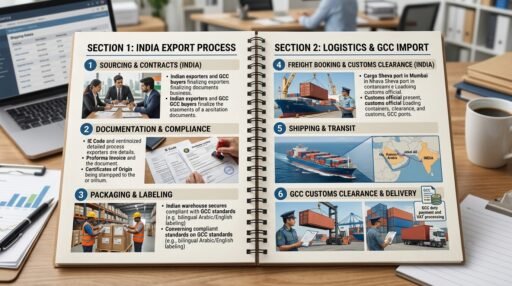
Essential Documents – The Import Checklist
-
Commercial Invoice (English; Arabic version often requested)
- Seller & buyer details
- HS code, description, quantity, value
- Incoterm used
-
Packing List – dimensions, weight, and item count per box/pallet
-
Bill of Lading (B/L) for sea freight or Air Waybill (AWB) for air freight
-
Certificate of Origin (CO) – from Indian Chamber of Commerce to claim PTA benefits
-
Import Licence (if the GCC country requires it for the product category)
-
Product‑Specific Certificates
- Halal certificate (food, cosmetics)
- Test/conformity report (electronics, toys)
- Phytosanitary certificate (plant/animal products)
-
Cargo Insurance Certificate – all‑risk policy recommended
-
Customs Declaration Forms – usually filed electronically through each GCC country’s customs portal
Choosing the Right Incoterm (Who Pays What?)
- EXW (Ex Works) – buyer handles everything after goods leave Indian premises.
- FCA (Free Carrier) – seller delivers to a nominated carrier; buyer pays export and import formalities.
- CIF (Cost, Insurance & Freight) – seller pays freight and insurance to GCC port; buyer pays duty, VAT, and local handling.
- DAP (Delivered at Place) – seller covers freight to the buyer’s warehouse; buyer clears customs and pays duty/VAT.
- DDP (Delivered Duty Paid) – seller assumes all costs up to the buyer’s door. Excellent for price‑transparent contracts, but risky if duty rates change.
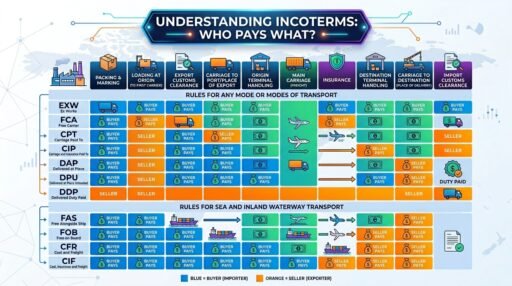
Pick the incoterm that balances your risk tolerance and the buyer’s expectations.
Shipping Modes – Which One Fits Your Business?
-
Air Freight
- Transit time: 1‑4 days.
- Best for: High‑value, low‑weight, time‑critical items (electronics, pharmaceuticals).
-
Sea Freight – Full Container Load (FCL)
- Transit time: 20‑30 days (Mumbai → Jebel Ali).
- Best for: Large volumes, heavy or bulky goods (home appliances, textiles).
-
Sea Freight – Less‑than‑Container Load (LCL)
- Transit time: 22‑35 days (depends on consolidation schedule).
- Best for: Smaller batches that can be grouped with other shippers.
-
Multimodal (Rail‑Sea)
- From northern Indian hubs via Iran’s rail network to Gulf ports.
- Useful when: Origin is far from sea‑port or you need to avoid congested maritime lanes.
-
Express Couriers
- Transit time: 1‑3 days to major Gulf airports.
- Best for: Samples, spare parts, or urgent returns.
Leveraging GCC Free Zones

-
Jebel Ali Free Zone (JAFZA) – UAE
- Duty‑free storage for up to 5 years.
- Re‑export without paying UAE import duty (temporary import for re‑export status).
-
Dubai Airport Free Zone (DAFZA) – UAE
- Air‑cargo‑centric, rapid customs clearance, ideal for electronics and fast‑moving consumer goods.
-
Riyadh (KSA) & Qatar Free Zones
- Offer warehousing, kitting, and direct re‑export to other Gulf or African markets.
How to use a free zone:
- Ship Indian cargo to the free‑zone warehouse.
- File a temporary import declaration (no duty).
- When goods move to the final GCC market, submit a re‑export declaration that references the original CO.
- Pay duty/VAT only at the final destination, not in the UAE.
Note: Free‑zone usage adds handling fees; weigh the benefit of duty deferral against the extra cost.
Cost‑Control Tips
- Base freight – request a detailed quote (fuel surcharge, terminal handling, documentation).
- Fuel surcharge (FSC) – ask for a capped rate or a “fixed‑price” contract for price stability.
- Cargo insurance – all‑risk coverage at 0.5‑0.8 % of cargo value (covers damage, theft, loss).
- Customs duty – verify PTA eligibility; many Indian electronics qualify for 0 % duty.
- VAT – calculated on CIF value + customs duty; can be prepaid under DDP.
- Port & terminal fees – vary by destination; use a forwarder that consolidates these into a single line item.
- Local inland transport – negotiate rates with a reputable 3PL in each GCC country.
Ways to save:
- Consolidate multiple Indian shipments into a single FCL container.
- Use the PTA‑eligible HS codes to eliminate duty.
- Work with a forwarder that offers “volume discounts” for regular shipments.
- Plan shipments during off‑peak periods for lower port handling fees.
Step‑by‑Step Import Playbook
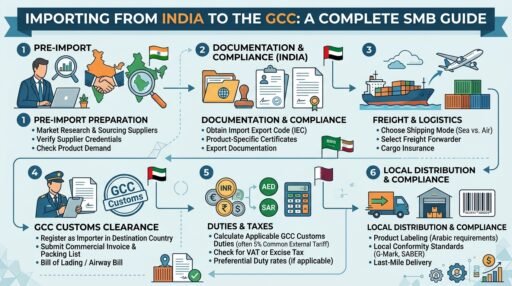
1️⃣ Market & Product Validation
- Identify target GCC country and buyer.
- Check demand, competitor pricing, and local regulations.
2️⃣ HS Code & Duty Check
- Find the 6‑digit HS code for your product.
- Look up the duty rate in the target GCC country and confirm PTA eligibility.
3️⃣ Incoterm Decision
- Align the level of responsibility you’re comfortable with (EXW vs. DDP).
4️⃣ Choose a Freight Forwarder
- Must have an India‑to‑GCC network and free‑zone expertise (if you’ll use one).
- Ask for a full‑service quote covering freight, insurance, customs clearance, and local delivery.

5️⃣ Prepare Export Docs in India
- Commercial invoice (English + Arabic if needed).
- Packing list.
- Certificate of Origin (from Indian Chamber).
- Export licence (if required).
- Insurance policy.
6️⃣ Book & Load the Cargo
- Decide on air/sea based on product profile.
- Load at the Indian port/airport with clear labeling (Country of Origin = INDIA).
7️⃣ (Optional) Free‑Zone Transfer
- Transfer to a bonded warehouse in the UAE.
- File a temporary import declaration to keep goods duty‑free.
8️⃣ Customs Clearance in GCC
- Submit commercial invoice, packing list, CO, and any product certificates.
- Pay customs duty (5 % or reduced under PTA) and VAT.
- Obtain release order and arrange inland transport.
9️⃣ Local Distribution
- Deliver to distributor, retailer, or end‑customer using a local 3PL.
🔟 Payment & Reconciliation
- Match freight invoices, customs duties, VAT, and any free‑zone fees.
- Confirm final landed cost per SKU; adjust future pricing accordingly.
1️⃣1️⃣ Review & Optimize
- Record actual lead times and total landed cost.
- Identify bottlenecks (e.g., delayed certificates, weight miscalculations).
- Refine packing strategies and incoterm selections for the next shipment.
Technology & Automation Tools
-
Flexport – end‑to‑end TMS with auto‑generated customs docs and real‑time tracking.
-
Freightos – quick online freight rate comparison for India‑GCC routes.
-
Customs Portals
- Saudi Arabia – “Nebras” e‑Customs.
- UAE – “UAE Customs e‑Gate”.
- Qatar – “Qatar Customs Single Window”.
-
Blockchain Document Exchange – TradeLens or CargoX for tamper‑proof CO and invoice sharing.
-
ERP Integration – SAP, Oracle NetSuite, or Zoho Books can pull freight data via API to keep accounting in sync.
-
WMS for Free Zones – Manhattan, FlexWMS to split LCL shipments into country‑specific loads without losing traceability.
Common Pitfalls & How to Avoid Them

-
Incorrect HS Code → higher duties & clearance delays.
- Fix: Validate the code with both Indian and GCC customs (official HS databases).
-
Missing Certificate of Origin → PTA benefits lost.
- Fix: Request CO from the Indian Chamber before the goods leave the factory.
-
Mismatched Incoterm → unexpected cost spikes at destination.
- Fix: Clearly state the incoterm on the pro‑forma invoice and confirm with the buyer.
-
Inadequate product certificates (e.g., no halal label) → shipment detained.
- Fix: Obtain the required certificates early; have Arabic translations ready.
-
Under‑insuring high‑value electronics → large loss if damage occurs.
- Fix: Insure for 110 % of declared value, covering accessories and packaging.
-
Late payment of duty/VAT → cargo held at port.
- Fix: Use a DDP forwarder or pre‑arrange a bank guarantee to cover duties.
-
Using free zone without proper temporary import filing → still paying UAE duty.
- Fix: Submit the “temporary import for re‑export” declaration before cargo enters the free zone.
-
Ignoring documentation fees (e.g., translation, filing) → budget overruns.
- Fix: Include all service fees in the forwarder quote and verify before signing.
Conclusion
Importing from India to the Gulf can give SMBs a clear advantage: competitive pricing, a proven trade framework, and a market hungry for quality products. By mastering the PTA, preparing precise documentation, choosing the right incoterm, and possibly using a UAE free zone for consolidation, you can keep landed costs low and delivery times predictable.
Start with a single product line, record every cost, and iterate. The GCC’s consumer base is expanding fast, and a smooth import process will let you capture a share of that growth.
Frequently Asked Questions
Q1: Do I need a local company in each GCC country to import?
- Not for every shipment. You can use a forwarder that offers door‑to‑door DDP service. However, for regulated products (pharma, cosmetics) a local distributor or customs broker is usually required to handle product registration.
Q2: How do I claim the India‑GCC PTA benefits?
- First, verify that your product is listed in the PTA annex. Then obtain a Certificate of Origin from an Indian authorized chamber (e.g., FICCI, Confederation of Indian Industry). Submit the CO with the commercial invoice at GCC customs; the reduced duty will be applied automatically.
Q3: What is the typical duty on Indian‑origin consumer electronics to the UAE?
- Under the PTA, most Indian electronics are 0 % duty. Without PTA, the standard GCC duty is 5 % of CIF.
Q4: Is a Halal certificate required for all food shipments?
- Yes, any food or beverage intended for the GCC consumer market must be Halal certified. The certificate must be in Arabic (or accompanied by a certified translation) and stamped by an accredited Indian certifying body.
Q5: How long does sea freight from Mumbai to Saudi Arabia usually take?
- Approximately 22‑28 days, depending on vessel routing and port congestion.
Q6: Can I ship several Indian orders in one container and then split them for different GCC ports?
- Absolutely. Your forwarder can use an LCL service to consolidate multiple consignments into a single container, then re‑package at a free‑zone or at the destination port for onward delivery.
Q7: What are the most common payment terms GCC buyers expect?
- 30 days T/T, Letter of Credit (LC) at sight, or open account for established partners. Choose terms that align with your cash‑flow and the buyer’s risk tolerance.
Q8: Do I have to register my Indian company with GCC customs?
- No formal registration is required for each shipment. However, you should have a clear company name, tax ID, and valid export licence on the commercial invoice. Some countries may request a copy of your Indian business licence for customs verification.
Q9: How can I track my shipment from India to the GCC?
- Use the tracking number on the Bill of Lading (sea) or Air Waybill (air). Platforms such as Flexport, Freightos, or the carrier’s own portal show real‑time location and ETA.
Q10: Are there any restrictions on shipping Indian textiles to Oman?
- Textiles are generally duty‑free under the PTA, but they must comply with GCC Standardisation Organisation (GSO) labeling for fibre content and care instructions. No special import licence is needed unless the fabric contains animal‑derived fibres, which would then require additional halal documentation.
Ready to ship?
- Finalize your product selection and HS codes.
- Secure a reputable freight forwarder with free‑zone experience.
- Gather all documents (especially the Certificate of Origin).
- Book the appropriate mode and monitor the cargo through the forwarder’s portal.
Your next step is a pilot shipment, followed by data‑driven refinements. The GCC market is open and eager—make the most of it with a well‑structured import process.
Happy exporting! 🚢✈️✨