
How to Ship from West Africa to the GCC Without Getting Stuck in Port
West Africa has what the GCC wants: cocoa, cashew nuts, shea butter, palm oil, fish oil supplements, premium textiles. The ports are good—Lagos, Tema, Abidjan. The labor is cheap. The margin potential is real.
But most first-time shippers from Ghana, Nigeria, Senegal, and Côte d’Ivoire hit the same wall: they don’t know how the GCC customs system works, they skip a certificate, or they pick the wrong Incoterm and lose control halfway through.
The first shipment gets expensive. The second one doesn’t have to.
Here’s what actually matters.
Why West Africa Is Suddenly Viable
The GCC imports roughly $200 billion per year. Most of it comes from Asia because those supply chains are established.
West Africa is the arbitrage play. Cheaper labor than China in most sectors. Faster transit than Southeast Asia. Products the Gulf actually wants and can’t get everywhere else: premium cocoa from Ghana, organic shea butter from Nigeria, cashew nuts from Côte d’Ivoire, fish oil supplements from Senegal.
A cocoa exporter in Accra can produce premium beans for $2.50/kg and sell them to a Saudi chocolate manufacturer for $8-12/kg. That’s a 300-400% margin before you even factor in the buyer’s markup.
Trade agreements help. The AfCFTA (African Continental Free Trade Area) allows regional value-addition. The GCC Generalised System of Preferences (GSP) offers duty-free entry for raw or unprocessed West African goods if you have a Certificate of Origin (CO). That’s 5% savings right there.
But you have to execute the paperwork correctly.
The Customs Baseline: Same Rules Across All Six States
Whether you’re shipping to Saudi Arabia, the UAE, Qatar, Oman, Bahrain, or Kuwait, the framework is identical.
Standard duty is 5% of CIF value (cost, insurance, freight). But many raw West African products are duty-free under GSP if you have a valid CO.
VAT hits after duty. It’s 5% in the UAE, Qatar, Oman, and Bahrain. Saudi Arabia and Kuwait charge 15%.
Every GCC state uses an electronic single-window customs portal. You upload documents, pay fees online, and goods clear in 24-48 hours if everything’s complete.
Miss a certificate? You’re sitting in port at $200-800 per day in storage fees.
GCC customs portals:
- UAE — eGate (Mirsal)
- Saudi Arabia — GAZT Customs Portal
- Qatar — Qatar Customs Portal
- Oman — Oman Customs
- Bahrain — Bahrain Customs
- Kuwait — Kuwait Customs
The Documents You Need (And What Everyone Misses)

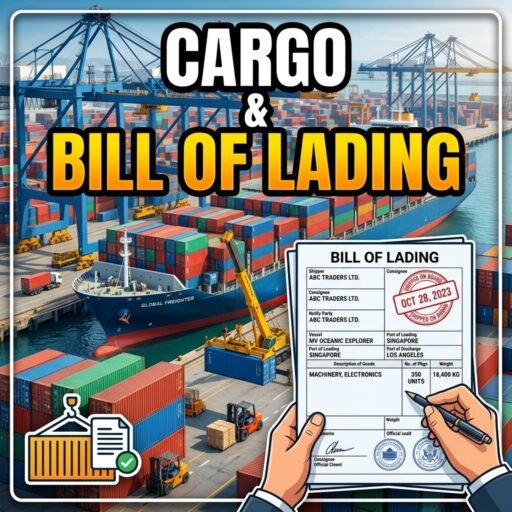
Commercial invoice, packing list, bill of lading—obvious.
Here’s what catches people:
Certificate of Origin. You get this from your country’s national chamber or Ministry of Trade. Without it, you lose GSP duty-free status. That’s 5% of shipment value you’re paying unnecessarily.
Allow 2-3 weeks. Request it early.
Halal certification. Any food, beverage, or cosmetic entering the GCC needs this. Must be Arabic-stamped and issued by a GCC-approved certifier. English-only Halal certs don’t work. Shipments get held 5 days while you scramble for a translation.
Budget $300-600 and 2 weeks. IFANCA (Islamic Food and Nutrition Council) is recognized across the region.
GCC Conformity Certificate (GSO). If it’s processed food, cosmetic, electronic, or toy, you need this. It’s a safety and quality test. Check the GCC Standardization Organization for requirements. Costs $500-2,000 depending on complexity. Labs like SGS, QIMA, and TÜV SÜD can turn it around in 1-2 weeks if you pay for expedite.
Phytosanitary certificate. Fresh produce, cocoa beans, palm oil, timber—anything plant-based. Confirms no pests or diseases. Your agriculture ministry issues these. Allow 1-2 weeks.
Import licence (if regulated). Pharmaceuticals, supplements, certain chemicals. This kills timelines. Expect 4-6 weeks and you’ll need a local agent in the destination country.
Get certificates before you book freight. Most first-timers discover these requirements after the ship has sailed.
Incoterms: Pick DAP Unless You Have a Reason Not To
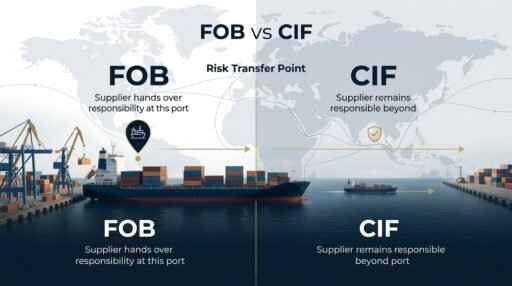
EXW (Ex Works). Buyer handles everything. You hand over goods at your factory gate. Easiest for you, worst for the buyer.
FCA (Free Carrier). You deliver to a carrier the buyer chooses. You arrange export clearance. Buyer handles freight, duty, VAT. Middle ground.
CIF (Cost, Insurance, Freight). You pay for all freight to a GCC port. Buyer clears customs and pays duty/VAT. Good for commodities.
DAP (Delivered at Place). You pay freight to a specific location in the GCC—the buyer’s warehouse. They clear customs and pay duty/VAT. This is what most SMBs should use. You control the supply chain. The buyer handles customs financials. Clean split.
DDP (Delivered Duty Paid). You cover everything: freight, duty, VAT, final delivery. Capital-intensive for you, but the buyer loves it.
For West African SMBs, DAP makes sense. You keep logistics in your hands so you can optimize costs. The buyer handles the financial part.
Read more on Incoterms at the International Chamber of Commerce.
Shipping: Air vs. Sea, Direct vs. Transhipment
Air freight is 2-5 days from Lagos or Accra to any major GCC city. Costs $3-8/kg. Use it for high-value, perishable, or time-critical stuff. Premium chocolate, shea butter cosmetics, supplements.
Carriers on this route:
Sea freight costs 1/5th as much as air. A 20-foot container from Lagos to Jebel Ali costs $850-1,200 depending on fuel surcharges. That’s $0.12-0.15/kg for a 6-7 ton load. Use sea for bulk cocoa, palm oil, timber, cashew nuts.
Major carriers:
Full container (FCL) is your friend if you have 4+ tons. Less-than-container (LCL) costs more per kilogram because you’re sharing space, but it’s useful for testing a market with smaller volume.
Ocean rates are elevated right now. Suez blockades have pushed shipping around Africa’s Cape of Good Hope. Fuel surcharges are 12-18% of base rates. Peak season (June-September) adds another 10-20%.
If you’re not urgent, book September sailings now at discounted rates.
Transit time: Lagos to Jebel Ali is 22-28 days direct. Via a hub like Singapore, add 5-7 days.
The Free-Zone Arbitrage: Your Secret Margin Play
If you’re selling to multiple GCC countries, the free zone changes everything.
Ship your entire load to Jebel Ali Free Zone (JAFZA) in Dubai. Zero UAE duty. Store it there for up to 5 years. File a “temporary import for re-export” declaration—critical. Without it, duty still applies.
Then as orders come in, split shipments. Two containers to Saudi, one to Qatar, one to Oman. You only pay duty and VAT in the destination country, not in the UAE.
You save duty and VAT on the portion being stored and re-exported. For a $100,000 shipment of cocoa, that’s $5,000-7,000 saved in UAE taxes alone.
Storage and re-loading fees? About 0.5-1.5% of cargo value. Still a clean win.
Other GCC free zones:
- Dubai Airport Free Zone (DAFZ) — for perishables
- Hamad Port (Qatar)
- Saudi Arabia Free Zones
- Oman Free Zones
This only works if you can handle the complexity of temporary-import paperwork and split shipments. But if you’re serious about multi-country distribution, it’s worth it.
Real Costs: The Math
Let’s say you’re shipping 8 tons of Ghanaian cocoa beans from Tema to Dubai.
Product cost at origin: $5,000.
Export documentation and certificates: $400 (CO, invoice prep, shipper’s LOI).
Ocean freight (FCL, 20-ft container): $950 base + $170 fuel surcharge = $1,120.
Cargo insurance (all-risk at 0.7%): $70.
UAE customs duty (cocoa, GSP duty-free under CO): $0.
UAE VAT (not charged if re-exported via free zone): $0.
Free-zone handling (temporary import filing, storage, re-loading): $250.
Final destination duty and VAT (Saudi: 5% duty + 15% VAT on CIF): $1,200.
Last-mile delivery (Saudi port to buyer’s warehouse): $350.
Total landed cost: $8,990.
Buyer’s retail price (100% markup): $17,980.
Your gross profit: $8,990.
Your margin: 50%.
Now skip the free zone. You pay UAE VAT on the full shipment even though you’re re-exporting 70% of it.
UAE VAT on $7,140 CIF: $357.
That $357 is gone. You’ve given the UAE government a free loan.
Do that 10 times a year, you’ve lost $3,570 to poor planning.
Real Stories: What Actually Happens
Golden Cocoa Ltd. (Accra) shipped 12 tons of cocoa beans to Saudi Arabia.
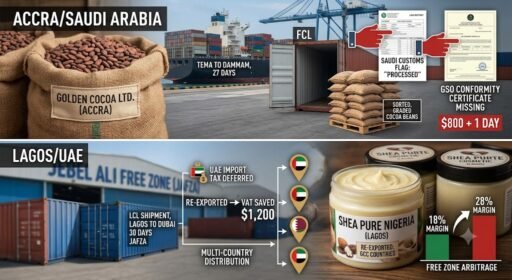
Sea FCL via Tema to Dammam, 27 days. DAP terms. Saudi customs flagged the beans as “processed” because they’d been sorted, demanding a GSO Conformity Certificate.
They didn’t have one. Golden Cocoa rushed a lab test from Dubai, cost $800, added a day.
Lesson: if your product has any processing claim—sorted, graded, cleaned—get the GSO cert before shipping.
Shea Pure Nigeria (Lagos) shipped 4 tons of shea butter cosmetics to the UAE.
Sea LCL to Dubai, stored in JAFZA for 30 days, split shipments to other GCC countries as orders came in. Saved $1,200 in UAE VAT because goods were re-exported.
Made more on the free-zone arbitrage than on actual margin. The butter was commodity-priced ($3.50/kg retail), but by deferring tax and optimizing distribution, they turned 18% margin into 28%.
Lesson: free zones aren’t just for big shippers. Multi-country distribution almost demands them.
CashewCo Ivoire (Abidjan) shipped 1 ton of roasted cashew nuts to Qatar.
Express air courier, 2 days. DDP terms—buyer wanted transparent pricing.
Qatar customs demanded Arabic labels and a GSO cert even though it was just roasted nuts.
CashewCo printed bilingual packaging before departure and got GSO testing via online portal. Clearance in 24 hours.
Lesson: bilingual packaging and pre-testing aren’t optional. They’re speed and margin protection.
OceanGold Senegal (Dakar) shipped 500 kg of fish-oil capsules to Bahrain.
Bahrain required drug registration and a Halal-certified processing statement for animal-derived supplements.
OceanGold worked with a Bahrain regulatory consultant, got Saudi Halal certification, attached batch-test reports. Cleared in 3 days.
Lesson: regulated products (pharma, supplements) need destination-country pre-approval. Start 6 weeks before shipping.
IronX Mauritania (Nouakchott) shipped 20 tons of iron-ore concentrate to Oman.
Oman required GSO conformity and proof of environmental compliance for mining.
IronX secured an IMC (International Minerals Council) sustainability report, GSO test, and relevant permits. Clearance in 48 hours.
Lesson: boring commodities still need paperwork. Plan for it.
Mistakes That Cost Money

Wrong HS code. You classify something as duty-free when it’s actually dutiable. You pay 5% on a shipment that should’ve been zero. Cross-check the GCC tariff schedule before booking. Takes 30 minutes. Saves thousands.
English-only Halal cert. Customs rejects it. Shipment sits 5 days while you overnight an Arabic translation. Order bilingual certificates from day one.
Missing CO entirely. You ship without getting a Certificate of Origin from your national chamber. Customs won’t apply GSP rates. You lose 5% on a $100,000 shipment. That’s $5,000. Request CO 3 weeks before shipping.
Oversized containers. You pack inefficiently. Dimensional weight exceeds actual weight. Freight company charges you for 10 tons when you shipped 7. Use a dimensional-weight calculator before packing. Takes 5 minutes. Saves $500+.
Underinsuring high-value goods. You ship $50,000 of shea butter. Container gets damaged. Insurance covers $30,000. You eat $20,000. Insure for 110% of declared value. Costs an extra 0.1% ($50). Protects you against catastrophic loss.
Paying VAT on re-exported goods. You import to the UAE, pay VAT, then re-export 80% to other countries. VAT is non-recoverable. You’ve given the UAE government free money. File temporary-import paperwork from the start.
Forgetting peak season surcharges. You book freight in July. Costs 20% more than May. You should’ve locked May rates 6 weeks ahead. Next time, book September sailings in June.
The 12-Step Playbook
1. Pick a product. Something with proven GCC demand. Ghanaian cocoa, Nigerian shea butter, Ivorian cashews, Senegalese supplements. Not something experimental.
2. Validate the HS code. Look it up on the GCC tariff schedule. Confirm if it’s GSP duty-free or dutiable.
3. Get quotes. Contact two forwarders with West Africa–GCC experience. Ask for FCL, LCL, and air pricing.
4. Secure certificates. CO from your national chamber. Halal cert if needed (Arabic-stamped). GSO test if processed. Phytosanitary if plant-based. Import licence if pharma. Do this in parallel.
5. Lock the Incoterm. Agree with your buyer (usually DAP). Get it in writing.
6. Book freight. Lock fuel-surcharge caps (12% max). Purchase all-risk insurance.
7. Prepare documentation. Commercial invoice, packing list, CO, certificates. Ensure Arabic translations where required.
8. If using a free zone: File temporary-import declaration with JAFZA before cargo arrives.
9. Submit customs filings. Upload everything to the destination country’s electronic portal. Pay duty and VAT.
10. Arrange last-mile delivery. A local 3PL gets it from port to the buyer’s warehouse.
11. Track landed cost. Sum freight, duty, VAT, insurance, handling. Calculate actual margin. If lower than expected, figure out why before shipment #2.
12. Document the SOP. What worked? What delayed you? Use this for the next shipment.
FAQ
Do I need a company registered in each GCC country?
No. A forwarder acts as your importer of record under DAP or DDP. You don’t need a local entity.
How does the GSP actually work?
Present a valid Certificate of Origin proving the goods are West African. Duty waives or drops to zero. But the CO has to be legitimate and attached.
Is a GSO cert required for all foods?
Not for raw cocoa beans or palm oil. Only if you’ve processed it—roasted, ground, refined. Plain raw commodity? No cert needed.
What’s the standard duty on fresh Ghanaian cocoa beans?
Zero. Classified as HS 1801 (raw cocoa), GSP duty-free. You need the CO and phytosanitary cert.
Best shipping mode for premium shea butter cosmetics?
Air if under 500 kg—3-5 days, moderate cost per kilogram, minimal degradation risk. Sea FCL + short-term free-zone storage if over 500 kg.
Can I store perishables in a free zone?
Yes. Use a facility with temperature-controlled warehousing (Dubai Airport Free Zone has this). File temporary-import paperwork. Defer duty and VAT until goods leave the zone.
Do I need separate import licences for each GCC country?
Typically no. A single GCC-wide licence or one from the destination country is presented to each customs authority. Confirm with your forwarder.
Transit time from Lagos to Jebel Ali?
22-28 days direct. Via a hub like Singapore, add 5-7 days.
How do I track an LCL shipment?
Use the Bill of Lading number on the carrier’s website (Maersk, MSC, etc.). Or integrate with a TMS like Flexport.
Any restrictions on Nigerian supplements to Saudi Arabia?
Saudi customs requires drug registration and a Halal-certified processing statement for animal-derived supplements. Both must be Arabic-stamped.
How do I handle returns?
Set up an RMA process with a local 3PL. Returns ship back under reverse-DDP arrangement so the forwarder handles insurance, re-entry customs, and final disposition.
Starting Now
Pick one product. Validate the HS code. Request the CO 3 weeks before shipping. If it’s food, order the Halal cert. If it’s processed, order the GSO test. If it’s fresh, order the phytosanitary cert.
Book freight 4-6 weeks ahead to avoid peak-season surcharges. Use DAP so you control the supply chain but the buyer handles customs. Use a free zone if you’re serving multiple GCC countries.
The first shipment is expensive because you’re learning. The second one costs half as much because you have a playbook.
The margin math is real: get this right and you’re printing 25-40% gross profit on West African goods in GCC markets. Get it wrong once, and you’re wondering why you bothered.
The difference is usually just paperwork and planning. Not skill. Not luck.
Related Resources
These principles scale across regions. Whether you’re importing from East Africa to the GCC, managing costs during ocean freight spikes, shipping from Egypt to the GCC, or optimizing free-zone logistics, the fundamentals are the same: plan early, validate documentation, lock costs, measure results.
Al Furqan Shipping & Logistics handles West Africa–GCC shipments regularly. If you want a detailed landed-cost analysis or a free consultation on your first shipment, reach out here.