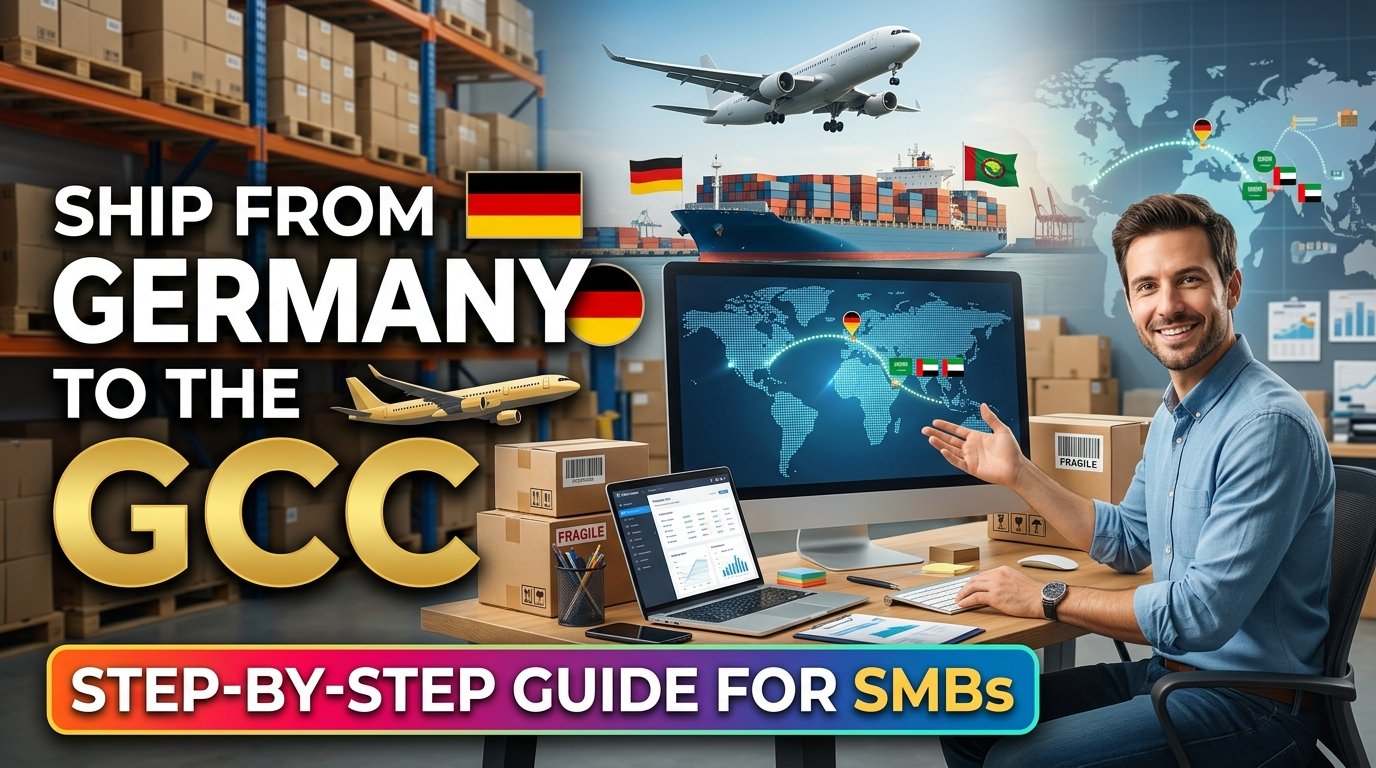
You want to scale your German manufacturing business into the Gulf markets.
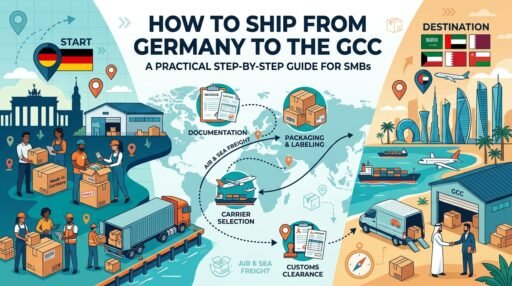
Smart move. The GCC—Saudi Arabia, UAE, Qatar, Oman, Bahrain, Kuwait—represents $3+ trillion in combined GDP and an insatiable appetite for premium German goods: machinery, pharmaceuticals, chemicals, automotive parts, electronics, and luxury products.
But here’s what trips up most first-time exporters: they think shipping to the GCC is the same as shipping to France or Belgium. It’s not. The customs framework, documentation requirements, Halal certification, and free-zone strategy are completely different. Get it wrong, and you’re sitting in port for two weeks while customs holds your cargo. Get it right, and you’re printing 50-65% margins on German goods in Gulf markets.
This playbook walks you through the actual system. Everything from Incoterm selection through free-zone leverage to duty optimization. No fluff. Just step-by-step practical guidance that works.
Why the GCC Is a Hotspot for German Exporters (And Why You Haven’t Noticed)
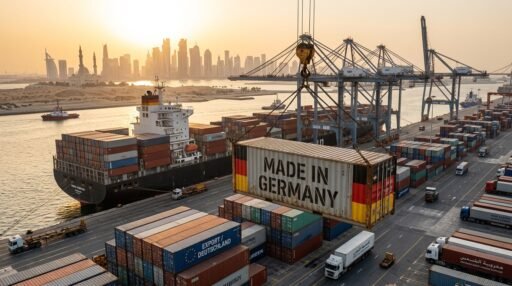
Here’s the gap most German SMBs miss: the GCC isn’t just another export market. It’s a high-purchasing-power destination that actively seeks premium German goods. We’re talking about six nations with some of the world’s highest per-capita incomes. Billions in sovereign wealth funds. Construction booms. Healthcare infrastructure expansion. Industrial automation requirements. These economies don’t haggle on price—they buy on quality and reliability.
German manufacturing reputation? That’s your competitive advantage. Products stamped “Made in Germany” command 30-50% price premiums in GCC markets because customers associate German engineering with precision, durability, and regulatory compliance. Your Siemens control systems, your Bosch automotive components, your Merck pharmaceuticals—these aren’t commodities. They’re quality signals.
But demand alone doesn’t get you there. You need to understand the logistics infrastructure, the customs duties, the certification requirements, and the distribution channels. That’s what separates successful German exporters from the ones sitting in port.
Let me break it down:
Market fundamentals that matter:
- Saudi Arabia alone is spending $500+ billion on Vision 2030 infrastructure projects.
- The UAE imported $22+ billion in machinery and electrical equipment in 2023 alone.
- Qatar’s healthcare expenditure is projected to reach $6+ billion annually.
- Kuwait’s industrial diversification strategy demands high-tech manufacturing equipment.
- Jebel Ali Port (Dubai) and King Abdulaziz Port (Saudi Arabia) are among the world’s busiest, with fast turnaround times for European shipments.
- German brands (Siemens, Bosch, BASF, Merck, BMW, Volkswagen, SAP, DHL) are household names in Gulf business circles.
- Preferential trade treatment under the EU-GCC Trade and Investment Framework means German goods often enter duty-free or at reduced rates.
The economics are undeniable: you’ve got premium products, willing buyers, established brand recognition, and preferential trade access. All you need is a system to get the goods there profitably.
The Regulatory Baseline: What Applies Everywhere in the GCC
Whether you’re shipping to Riyadh, Dubai, Doha, Muscat, Manama, or Kuwait City, the customs framework is uniform across all six GCC member states. This is both good news and a gotcha. Good news: you don’t need six separate compliance strategies. Gotcha: miss one requirement and you’re blocked in all six markets.
Here’s what every GCC country requires:
Customs duty: 5% of CIF value (cost, insurance, freight) for most finished goods. But here’s the trick—many German industrial and manufacturing goods qualify for duty-free entry under the EU-GCC Trade and Investment Framework if you have a valid Certificate of Origin (CO) from the German Chamber of Commerce (IHK). That’s a 5% instant margin gain most exporters don’t leverage.
VAT on top of duty: 5% VAT in UAE, Qatar, Oman, Bahrain. 15% VAT in Saudi Arabia and Kuwait. So your total landed cost includes both the duty AND the VAT. On a €100,000 shipment with 5% duty + 5% VAT, that’s €10,000 in taxes before the goods even hit the shelf.
Halal certification (for food, beverage, cosmetics, personal care): Mandatory. Non-negotiable. And here’s the catch—it must be Arabic-stamped and issued by an approved Gulf regulatory body. An English-only Halal certificate won’t cut it. The Saudi Food & Drug Authority (SFDA), UAE Ministry of Climate Change, and equivalent bodies in each GCC country recognize only specific certifying bodies.
GCC Conformity Certificate (GSO): For processed foods, cosmetics, medical devices, electronics, toys, and other regulated categories, you need proof of compliance with GCC Standardization Organization standards. Most German industrial goods don’t require this—but if you’re exporting consumer products, it’s mandatory.
Import licences (for specific categories): Pharmaceuticals, certain chemicals, dual-use items, and controlled goods require pre-approval from the destination country’s ministry. For Saudi Arabia, pharmaceuticals need SFDA approval before the goods even board the aircraft. This can take 4-8 weeks, so plan early.
Electronic customs declaration: Every GCC state uses a single-window e-customs portal. The UAE has eGate (Mirsal). Saudi Arabia has GAZT Customs Portal. Qatar has the Qatar Customs Portal. You can’t walk into a port office with printed documents anymore. Everything’s digital. Everything’s submission through these portals. If your documents are incomplete, the system rejects them. No exceptions.
The universal lesson: get the documentation right before the cargo leaves Hamburg or Bremen. Once it’s on a container ship, you can’t go back and “fix” a missing certificate. You’ll sit in port at $200-800 per day in demurrage fees.
Essential Documents: The Checklist You Can’t Afford to Miss
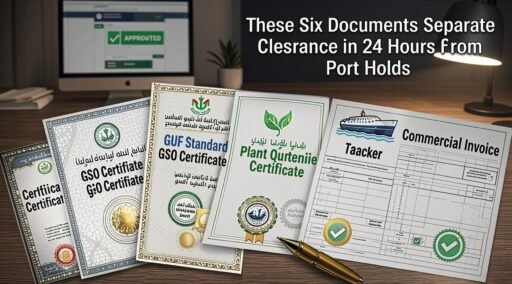
Before your cargo leaves Germany, you need these documents. Not on the ship. Not in your email. Actually in hand, checked, triple-verified.
Commercial invoice – This is your baseline proof of sale. It must include the HS code for every item, the unit price, total value, and the agreed Incoterm. GCC customs scrutinizes this because they’re looking for under-invoicing (claiming lower value to reduce duty). Be transparent. Be accurate. The invoice is the single most important document.
Packing list – Weight (total and per pallet), dimensions, SKU count, contents of every box. This tells customs exactly what they’re looking at and helps your buyer verify the shipment. Pro tip: create a detailed packing list with photos. If customs suspects something, visual confirmation speeds up clearance by hours.
Bill of Lading (sea freight) or Air Waybill (air freight) – Your carrier (Maersk, MSC, Lufthansa) issues this. It’s proof of shipment and your receipt. Keep multiple copies. GCC customs needs this to match against the manifest.
Certificate of Origin (CO) – Issued by the German Chamber of Commerce (IHK) or an authorized authority like the German Export Association (DGeV). This proves your goods are German-made and qualifies them for preferential duty treatment under the EU-GCC framework. Without it, you pay the full 5% duty instead of 0-2%. Request this at least 2 weeks before loading. Most IHK chambers can issue electronically now, but turnaround is still 7-10 business days.
Halal certificate (for applicable products) – If you’re shipping food, beverage, cosmetics, or personal-care items, this is mandatory. But—and this is critical—it must be Arabic-stamped and issued by an approved body. JAKIM (Malaysia), GAZT (Saudi Arabia), Sharjah Islamic Affairs (UAE), and a handful of others are recognized. English-language Halal certificates often get rejected at GCC customs. Budget $300-800 and 2-3 weeks for this. Start the process early.
GCC Conformity Certificate (GSO) – If your product falls under a regulated category (medical devices, electronics, cosmetics), obtain this from an accredited testing lab in the UAE, Germany, or via your logistics partner. Labs like SGS, QIMA, and TÜV SÜD can verify compliance and issue certificates. Cost: $400-1,500. Turnaround: 1-2 weeks. Not required for raw materials or industrial machinery, but essential for anything that touches consumers directly.
Import licence (for regulated goods) – Pharmaceuticals, certain chemicals, and dual-use items require pre-approval from the destination country’s ministry. For Saudi Arabia: contact SFDA. For UAE: contact Dubai Health Authority. These can take 4-8 weeks, so start the application process immediately upon finalizing the sale.
Cargo insurance (all-risk policy) – Covers the full CIF value plus 10% buffer. Cost: 0.5-0.8% of declared value. Protects you against loss, damage, or theft in transit. Essential for high-value machinery or pharmaceuticals.
German export declaration (Ausfuhranmeldung) – Required for shipments over €500 EUR. File electronically via the German Customs portal. Your logistics partner usually handles this, but you need to provide the data.
Checklist exercise: Print this out. Before you book freight, check off every single item. If something’s missing, don’t load the container. I’ve seen €50,000 shipments stuck in port for two weeks because the commercial invoice didn’t include HS codes. Don’t let that be you.
Choosing the Right Incoterm: DAP vs. DDP vs. CIF
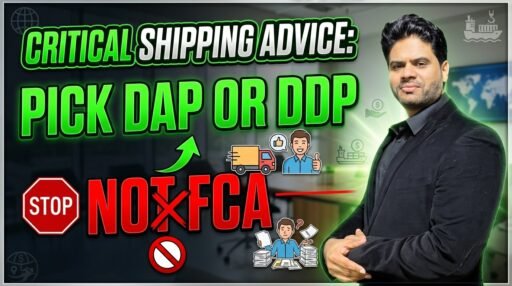
An Incoterm is a three-letter code that defines who pays for what and who assumes risk at each stage of the journey. Pick the wrong one, and you’re either absorbing costs you shouldn’t bear, or you’re creating friction with your buyer.
Here’s the breakdown for German-to-GCC shipments:
EXW (Ex Works) – You hand over goods at your factory gate in Munich or Hamburg. The buyer arranges everything: export clearance, freight, insurance, import duty, VAT, local transport. You have zero risk. You also have zero control. The buyer saves money because they handle logistics themselves. Use this only if the buyer insists and has GCC customs experience.
FCA (Free Carrier) – You deliver goods to a named carrier at a German port (e.g., “FCA Hamburg Port”). The buyer takes over from there. Similar to EXW in terms of risk transfer, but slightly more structured. Good for buyers who are experienced with customs but want flexibility on freight routing.
CIF (Cost, Insurance, Freight) – You pay freight + insurance to a named Gulf port (e.g., “CIF Jebel Ali, Dubai”). But the buyer clears customs, pays duty, VAT, and handles final delivery. You control the ocean leg (speed, carrier, routing). The buyer handles the customs leg (risk, cost). Middle-ground approach. Common for B2B industrial sales.
DAP (Delivered at Place) – You pay freight to a named location in the GCC (e.g., “DAP Dubai warehouse”). The buyer takes physical receipt and handles import duty/VAT. This is the sweet spot for most German SMBs. Why? You retain control over the entire shipping chain (Hamburg port → sea → GCC port → final warehouse). You know exactly where your goods are at every stage. The buyer pays duty and VAT separately, which often feels more transparent than bundling everything into a DDP price. You assume risk only up to the named location—if something happens after the goods are delivered to the Dubai warehouse, that’s the buyer’s problem.
DDP (Delivered Duty Paid) – You pay everything: freight, duty, VAT, insurance, local delivery. You deliver to the buyer’s door. The buyer has zero stress and no surprise costs. Sounds buyer-friendly (and it is), but DDP is expensive for you because you’re fronting duty and VAT (which can be 10-20% of the shipment value). Only use DDP if you’ve vetted the buyer, you’re confident they’ll accept the goods, and you can afford the cash-flow impact.
My recommendation for German SMBs: Start with DAP. You control logistics. The buyer pays duty/VAT separately. Both parties know exactly what they’re paying for. As you build relationship history and confidence with buyers, you can offer DDP as a premium service for larger orders.
Shipping Modes: When to Use What
Your choice of shipping mode depends on value, urgency, volume, and product sensitivity.
Air freight – 2-5 days from Germany to major GCC airports (Dubai, Doha, Riyadh). Cost: roughly €2.50-4.00 per kg. Use case: High-value machinery, urgent spare parts, time-critical pharmaceuticals, precision components. Example: A €50,000 engine control module that your buyer needs in 48 hours. Air freight is expensive per kg, but the total cost (€2,500-4,000 for a 1,000 kg load) might be justified if it closes a €500,000 contract.
Carriers: Lufthansa Cargo, Qatar Airways Cargo, Emirates SkyCargo.
Sea freight – Full Container Load (FCL) – 22-30 days from Hamburg/Bremen to Jebel Ali (Dubai). Cost: €0.20-0.40 per kg (roughly €2,000-4,000 for a 20-foot container, €3,500-7,000 for a 40-foot). Use case: Large-volume industrial machinery, bulk chemicals, mass-produced components, anything weighing 10+ tons. Example: 15 tons of industrial pumps bound for a Saudi manufacturing facility. Sea FCL is the most economical mode for volume.
Carriers: Maersk, MSC, CMA CGM, HAPAG-Lloyd.
Sea freight – Less-Than-Container Load (LCL) – 25-38 days (adds time for consolidation). Cost: €0.35-0.75 per kg. Use case: Smaller shipments (1-8 tons) that don’t justify a full container. Testing market demand. Sample shipments. Example: 4 tons of specialty chemicals going to a UAE distributor for market testing. LCL is pricier per kg than FCL but far cheaper than air if you’re not in a rush.
Consolidators: Freightos, most German-based forwarders also offer groupage services.
Express courier (DHL, FedEx, UPS) – 1-3 days to major GCC cities. Cost: €3.00-5.00 per kg. Use case: Urgent spare parts (≤ 30 kg), critical documents, high-value samples. Example: A €10,000 replacement part that your buyer needs overnight. The €500-1,500 courier fee is worth it if it keeps their production line running.
Free-zone hub strategy (game-changer for cross-GCC distribution) – Ship your goods to a GCC free zone (usually UAE), store them duty-free, then re-package, re-label, or split loads for distribution to Saudi Arabia, Qatar, Oman, etc. This strategy defers duty payment until goods actually leave the free zone for final consumption.
Why this matters: Instead of paying 5% duty + VAT on the full shipment in Saudi Arabia, you pay duty only on the portion that actually sells in Saudi Arabia. The rest stays in inventory in the UAE free zone, duty-free. This preserves cash flow and gives you flexibility to serve multiple GCC markets from a single hub.
Free zones to consider: Jebel Ali Free Zone (JAFZA) – largest, 5-year duty-free storage, on-site customs. Dubai Airport Free Zone (DAFZA) – best for air cargo, fast clearance. Ras Laffan Industrial City (Qatar). Sohar Port & Free Zone (Oman).
Decision tree for mode selection:
- High-value + urgent? → Air freight
- Volume > 15 tons + non-urgent? → Sea FCL
- Volume 1-8 tons? → Sea LCL
- Emergency spare parts (≤ 30 kg)? → Express courier
- Testing market + want flexibility? → Free-zone hub (ship FCL to JAFZA, re-export from there)
Leveraging GCC Free Zones: The Hidden Margin Multiplier
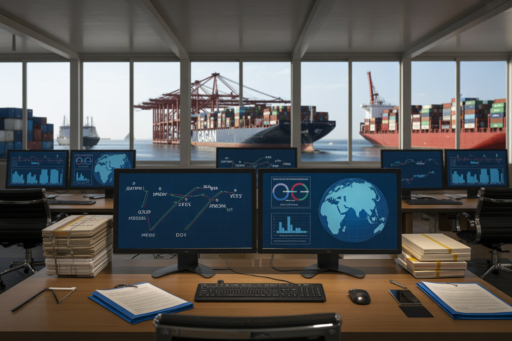
Here’s a strategy most German SMBs don’t know about: GCC free zones are not just storage facilities. They’re duty-deferral engines that can unlock significant margin and distribution flexibility.
A free zone is a geographically defined area where goods imported for re-export or trans-shipment are exempt from customs duty and VAT. The big three are in the UAE: Jebel Ali Free Zone (JAFZA), Dubai Airport Free Zone (DAFZA), and Dubai Silicon Oasis. But Qatar, Oman, Saudi Arabia, and Bahrain have their own free zones too.
Typical free-zone workflow:
- Ship from Hamburg to JAFZA in Dubai (or your chosen free zone) via sea FCL. Cost: €3,500-7,000 for a 40-foot container.
- File a “temporary import for re-export” declaration with JAFZA customs. This tells customs you’re not selling these goods in the UAE—you’re just holding them temporarily. No duty is charged while goods are in the zone.
- Store, re-label (add Arabic language), or re-kit as needed. Your goods are now in a duty-free warehouse. You’re not paying 5% duty on inventory sitting on shelves.
- Issue a new Bill of Lading/Air Waybill for each GCC destination. Say you’ve got 100 pumps in the JAFZA warehouse. You split the load: 40 pumps to Saudi Arabia, 35 to Qatar, 25 to Oman. Each shipment gets its own documentation and routing.
- Pay duty & VAT only at the final port of entry (Dammam for Saudi Arabia, Doha for Qatar, Muscat for Oman). You pay 5% duty + VAT only on the portion actually leaving the free zone for that destination.
Benefit: You pay customs duty once, at the point of final consumption. Not twice (once entering the UAE, again entering Saudi Arabia). Plus, you maintain centralized inventory in a professional GCC hub, which speeds up order fulfillment and reduces per-unit distribution costs.
Real example: You export 100 tons of industrial pumps to JAFZA. Cost: €40,000 (freight only, no duty). You store these in a bonded warehouse. A Saudi buyer orders 40 tons. You generate a new shipment document, pay duty + VAT on those 40 tons only (€3,600 + VAT). The remaining 60 tons stay duty-free in JAFZA. A month later, a Qatar buyer orders 30 tons. You pay duty on 30 tons (€2,700 + VAT). The remaining 30 tons keep appreciating in value as inventory, still duty-free.
Compare that to the traditional approach: You ship 100 tons directly to Saudi Arabia. You pay 5% duty + VAT upfront (€5,000 + VAT). Now you’re stuck with inventory in Saudi Arabia, and distributing to Qatar requires a whole new shipment with its own documentation and costs.
The free-zone approach is a game-changer for multi-country GCC distribution.
Cost-Control Tactics: Protecting Your Margins
German goods command premium prices in GCC markets. But freight, duty, insurance, and handling can eat 15-25% of your revenue if you’re not careful. Here’s how to protect margins:
Consolidate shipments – Instead of shipping one 5-ton order solo, wait for two or three orders from different buyers totaling 15-18 tons. Combine them into a single FCL. Most German forwarders (DHL Global Forwarding, Hellmann Worldwide, Geodis) offer groupage services. Cost per kg drops 20-30% when you consolidate.
Negotiate fuel-surcharge caps – Fuel surcharges fluctuate weekly based on Brent crude prices. Lock your forwarder into a fuel-surcharge cap of 12-15% of base freight for the next 3-6 months. Protects you against sudden €5,000 spikes on a €50,000 shipment.
Use a free-zone hub – As discussed above, defer duty until goods are actually consumed. Preserves cash flow. Enables cross-GCC distribution flexibility.
All-risk cargo insurance at 0.5-0.8% of declared value – Costs roughly €250-800 on a €50,000-100,000 shipment. Protects against loss, damage, or theft in transit. Essential for high-value machinery. Recovers quickly if something goes wrong.
Validate HS code & CO eligibility – Before booking, confirm your product qualifies for duty-free entry under the EU-GCC framework. Some German goods (medical equipment, certain chemicals, industrial machinery) enter at 0% duty with proper CO. Others are standard 5%. Know which category you’re in before you quote.
Pre-pay VAT for DDP shipments – If you’re offering DDP terms (you pay duty + VAT), pre-pay the VAT through a local tax agent or your forwarder’s VAT-pay service. Cost: 1-2% brokerage fee. Benefit: Eliminates customs holds and speeds up clearance by 12-24 hours. On a time-critical shipment, that’s invaluable.
Optimize dimensional weight – Oversized boxes trigger higher freight tiers. Pack efficiently. Use collapsible crates. Consolidate pallets. A 10% reduction in dimensional weight can save €500-1,000 on a large FCL shipment.
Use carrier volume discounts – Lock a 3-month forecast with Maersk or MSC. Predictable monthly volume earns carrier rebates of 5-10%. On €30,000 monthly freight, that’s €1,500-3,000 annual savings.
Reverse-logistics agreements – Empty containers and pallets can be returned to Germany via “return cargo” arrangements, reducing your pallet costs by 30-40%. Negotiate this with your forwarder upfront.
Negotiate payment terms with your forwarder – Net 30 or Net 45 instead of prepay. Improves cash flow without increasing costs.
Stack all these tactics together, and you’re potentially saving 8-12% on total landed costs. On a €100,000 shipment, that’s €8,000-12,000 in margin protection.
Step-by-Step Playbook: From Factory Gate to GCC Shelf
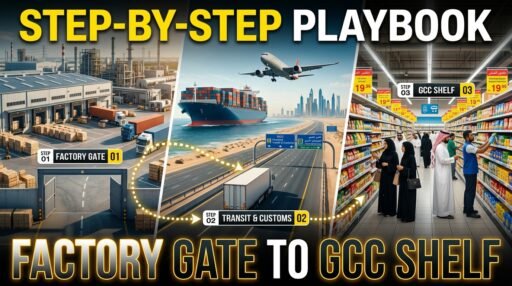
Here’s the exact process to follow. No shortcuts. No guessing.
Step 1: Confirm market demand – Validate that your product has actual buyers in your target GCC country. Talk to five potential customers. Confirm pricing, volume, and payment terms (usually Letter of Credit or open account after credit check). Don’t ship speculative inventory.
Step 2: Classify the product – Determine the exact HS code for your product. Use the WCO HS Code database and cross-reference with the World Bank’s WITS. Confirm whether it falls under any duty-free categories (medical equipment often does). Confirm whether it requires GSO certification or import licence.
Step 3: Select Incoterm – Based on your risk tolerance and buyer relationship, pick DAP (recommended for SMBs) or DDP. Document in the sales contract. Confirm the specific named place (e.g., “DAP Dubai Port” vs. “DAP Buyer’s Warehouse, Dubai”).
Step 4: Choose a German-to-GCC forwarder – Must have: (1) direct contracts with sea carriers on Hamburg/Bremen→Jebel Ali route, (2) integration with GCC e-customs portals, (3) free-zone handling capability, (4) experience with Halal/GSO certification. Request a free quote for both FCL and LCL. Compare.
Companies: DHL Global Forwarding, Hellmann Worldwide, Geodis, Schenker (DB Schenker).
Step 5: Obtain all certificates – Immediately request: CO (from German Chamber of Commerce), Halal certificate (if applicable, from approved body), GSO certificate (if applicable, from accredited lab), import licence (if applicable, from destination country ministry). Budget 2-4 weeks total. Don’t wait until cargo is ready to ship.
Step 6: Prepare export documents – Prepare: commercial invoice (with HS codes), packing list (detailed, with photos if possible), insurance policy quote, CO, Halal/GSO certs, any import licences. Have bilingual (EN/AR) versions of labels and documentation for any consumer-facing products.
Step 7: Book the shipment – Contact your forwarder. Confirm: (1) mode (air, sea FCL, sea LCL, free-zone hub), (2) Incoterm, (3) carrier, (4) booking reference, (5) fuel-surcharge cap, (6) all-risk insurance. Lock in the freight rate. Get confirmation in writing.
Step 8: File German export declaration – Submit electronically via German Customs portal (Zoll Online). Your forwarder usually handles this, but confirm. Required for shipments > €500 EUR.
Step 9: Pack and label – Use quality packaging. Include bilingual labels (English/Arabic) for any consumer products. Create detailed packing list with photos. This speeds up customs inspection if needed.
Step 10: Transport to German port & load – Your forwarder arranges pick-up from your factory, transport to Hamburg/Bremen, and loading onto the vessel. Confirm container number and seal. Keep records.
Step 11: Track the shipment – Use the Bill of Lading number on the carrier’s online portal (Maersk, MSC) or via Flexport. Most give real-time updates. Alert your buyer to expect cargo in 22-30 days (sea) or 2-5 days (air).
Step 12: (Optional) Transfer to free zone – If using JAFZA: After arrival at Jebel Ali, file a temporary-import declaration. Goods move to bonded storage. Now you can store duty-free and distribute to multiple GCC countries on demand.
Step 13: Final customs clearance – Your buyer (or their customs broker) uploads all documents to the destination country’s e-customs portal. Pays 5% duty (or reduced if CO qualifies for preferential treatment) + VAT. Goods are released. Usually 12-24 hours if documents are complete.
Step 14: Arrange last-mile delivery – Engage a local 3PL (Aramex, DPD,, Lulu Express) to arrange warehouse pickup and final delivery to buyer’s location. Confirm receipt and signature.
Step 15: Calculate landed cost & margin – Sum: freight + duty (5% of CIF) + VAT + insurance + 3PL delivery. Compare against buyer’s payment. Confirm margin. 50%+ is healthy for German goods in GCC markets.
Step 16: Document & optimize – Capture: lead time (days from factory to buyer receipt), cost variances (expected vs. actual), any documentation gaps or delays. Refine your SOP before the next shipment. You’ll shave 2-3 days and €500-1,000 per shipment with experience.
This playbook works. Follow it exactly the first time. Customize it after you’ve run three or four shipments and understand where friction happens in your specific supply chain.
Common Pitfalls & Quick Fixes: Learn From Others’ Mistakes

I’ve seen German exporters lose deals and leave margin on the table because they didn’t know these pitfalls. Here’s what to avoid:
Wrong HS code → You classify a machine as HS 8429 (machinery, not specified) when it’s actually HS 8471 (automated machinery, duty-free). Customs hits you with 5% duty instead of 0%. On a €100,000 shipment, that’s €5,000 you didn’t budget for. Fix: Spend 30 minutes verifying HS code on WCO database before you even quote. Cross-check with your forwarder.
Missing Certificate of Origin – You ship without CO because you thought it was optional. Customs won’t grant preferential duty treatment. You pay full 5% instead of 0-2%. Fix: Request CO from German Chamber of Commerce at least 2 weeks before loading. It’s not optional if you want duty-free entry.
Halal certificate in English only – You obtained a Halal certificate from a non-Gulf certifier. It’s English-only. Customs in Riyadh or Dubai rejects it. Cargo sits in port for 2-3 days. Fix: Obtain an Arabic-stamped Halal certificate from an approved Gulf body (SFDA, GAZT, or JAKIM with GCC recognition). Budget €300-800 and 2-3 weeks.
Over-packing on dimensional weight – Your goods weigh 8 tons but occupy 25 cubic meters (dense packaging). Carrier bills you for 25 m³ instead of 8 tons. You get surprise freight surcharge of €1,500-2,000. Fix: Calculate dimensional weight (length × width × height ÷ 5,000 = DW in kg) before booking. Compare DW vs. actual weight. Pack efficiently to optimize the ratio.
Under-insuring high-value machinery – You insure a €80,000 control system for only €60,000. If it’s damaged in transit, you recover only €60,000. The €20,000 difference is your loss. Fix: Insure for 110% of declared value (covers the product + packaging + accessories). Cost is only 0.5-0.8% of value, so the extra coverage costs maybe €160.
Late VAT payment under DDP terms – You offered DDP but didn’t pre-pay the VAT. Customs holds the cargo at the port until you pay. Demurrage costs accrue at €200-400/day. By day 5, you’ve spent €1,000-2,000 in unnecessary port fees. Fix: Use a forwarder’s VAT-pay service to pre-pay VAT before cargo arrives. Cost: 1-2% brokerage. Saves you from customs holds and demurrage.
Shipping to free zone without temporary-import filing – You shipped goods to JAFZA planning to store duty-free and distribute later. But you didn’t file a temporary-import declaration. Customs charged 5% duty immediately. Your duty-deferral strategy failed. Fix: Before cargo enters the free zone, file a temporary import for re-export declaration (Form 12) with JAFZA customs. This legally exempts goods from duty while in the zone.
Ignoring buyer’s preferred Incoterm – You quoted DAP, buyer wanted DDP, and you didn’t discuss this. When the bill arrived, buyer was unhappy about the duty/VAT charges they didn’t budget for. Relationship soured. Fix: Agree on Incoterm in the sales contract. Confirm in writing before you send a pro-forma invoice. Make sure buyer understands what they’re paying for and when.
Skipping Arabic label translation on consumer packaging – You shipped cosmetics or food with English-only labels. GCC customs flagged it as non-compliant. Product was held for 2-3 days pending relabeling. Fix: Provide bilingual (EN/AR) labeling for any product sold directly to consumers. This is often a GSO requirement anyway.
Using a forwarder with no GCC customs portal integration – Your forwarder is sending documents by email instead of uploading to e-customs systems. Customs can’t find your submission. Cargo is delayed. Fix: Choose a forwarder with direct integration into UAE eGate, Saudi GAZT, and Qatar Customs. Ask explicitly: “Are you integrated into the e-customs portals?” If they say no, find another forwarder.
Learn from these mistakes now. Don’t repeat them on your first shipment.
Frequently Asked Questions: Your Real Questions Answered
Q: Do I need to set up a legal entity (subsidiary) in each GCC country?
A: No. Not required. You can appoint a customs broker or freight forwarder to act as the importer of record on your behalf under DAP or DDP terms. This is standard practice. Your forwarder handles all customs submissions and holds responsibility for compliance. You remain the exporter, they’re the importer. No subsidiary needed.
Q: Can I use the EU-GCC Trade and Investment Framework to get duty-free status?
A: Yes, if your product qualifies and you have a valid German Certificate of Origin (CO). The framework covers most industrial goods, machinery, chemicals, and electrical equipment. Some consumer goods qualify too. Check with your forwarder or the destination country’s customs ministry. If you qualify, duty drops from 5% to 0-2% (often 0%).
Q: What are the typical transit times?
A: Air: 2-5 days (Hamburg to Dubai/Doha/Riyadh). Sea FCL: 22-30 days (Hamburg/Bremen to Jebel Ali). Sea LCL: 25-38 days (includes consolidation time). Express courier: 1-3 days (for small parcels ≤ 30 kg).
Q: Which free zone is best for high-value electronics?
A: Dubai Airport Free Zone (DAFZA). It has the fastest air-cargo clearance (2-4 hours), excellent kitting and labeling facilities, and direct connections to all six GCC countries. Perfect for high-value items that you want to split across multiple buyers.
Q: How can I track a sea shipment from Hamburg to Jebel Ali?
A: Use the Bill of Lading number on the carrier’s online tracking portal (Maersk, MSC, CMA CGM) or integrate with a Transport Management System like Flexport for real-time updates and automated alerts to your buyer.
Q: Are there special permits for shipping pharmaceuticals to Saudi Arabia?
A: Yes. You need a pharmaceutical import licence from the Saudi Food & Drug Authority (SFDA). You also need a GCC Conformity Certificate for the product class. The licence typically takes 4-8 weeks to obtain, so apply immediately after the buyer places an order. Without it, your cargo won’t clear customs in Saudi Arabia.
Q: What’s the best way to handle returns from GCC customers?
A: Set up a Return Merchandise Authorization (RMA) process with your local 3PL partner. Ship returns under a reverse-DDP arrangement (buyer pays return freight; you handle customs re-entry to Germany). This keeps paperwork simple and enables re-shipment or refund once goods are back in your warehouse.
Q: Can I consolidate multiple German suppliers into one container heading to GCC?
A: Absolutely. Most German forwarders offer groupage services where they collect shipments from multiple suppliers (Siemens, Bosch, Merck, etc.), consolidate at Hamburg, and send one FCL to Jebel Ali. Cost per kg drops 20-30%. Turnaround: usually 10-15 days to consolidate + 22-30 days transit.
Q: Is it worth pre-paying VAT at origin?
A: For DDP shipments, yes. Pre-paying VAT through a local tax agent or forwarder’s VAT-pay service eliminates customs holds and speeds clearance by 12-24 hours. Cost: 1-2% brokerage fee. On a €100,000 shipment, that’s €1,000-2,000 well spent if it keeps your buyer happy and accelerates cash collection.
Q: What if my product doesn’t have a CE mark? Can I still export to the GCC?
A: Depends on the product category. Industrial machinery, electronics, medical devices usually require CE marks for GCC entry. Consumer goods may require GSO certification instead. Raw materials and certain industrial chemicals don’t always need CE. Check with your forwarder or the destination country’s customs ministry. Don’t assume—verify before you commit to a shipment.
Q: How do I know if my product qualifies for duty-free entry under the EU-GCC framework?
A: Check the EU-GCC Trade and Investment Framework tariff schedule. Your forwarder can also advise. As a rule of thumb: industrial machinery, electrical equipment, chemicals, and many medical devices qualify. Most consumer goods and processed foods don’t. If you’re uncertain, provide a sample HS code + product description to your forwarder and they’ll confirm eligibility.
The Bottom Line: You’re Ready to Ship
Shipping from Germany to the GCC is straightforward once you understand three fundamentals:
1. Documentation is the gatekeeper – Certificate of Origin, Halal/GSO certificates, accurate HS codes, and commercial invoices. Get these right before cargo leaves Hamburg, and everything else flows smoothly. Get them wrong, and you’re stuck in port.
2. Incoterm strategy protects margins – DAP gives you control without the DDP cash-flow burden. You retain logistics oversight. The buyer handles customs costs. Everyone’s incentives align.
3. Free zones unlock flexibility – Use a UAE free-zone hub to defer duty, maintain centralized inventory, and distribute to multiple GCC countries on demand. This strategy compounds in value as your GCC business scales.
By following the step-by-step playbook, implementing the cost-control tactics, and avoiding the common pitfalls, German SMBs can ship efficiently to GCC markets, capture 50-65% gross margins on premium products, and build recurring revenue streams that scale.
The GCC market is waiting. German manufacturing reputation is your competitive moat. The logistics infrastructure is world-class. Al Furqan Shipping & Logistics has 23+ years of German-to-GCC experience and can handle every step: Certificate of Origin coordination, free-zone hub management, customs portal integration, and last-mile delivery across all six GCC countries.
Ready to launch your first shipment? Reach out for a free landed-cost analysis. We’ll walk you through the exact process, confirm duty eligibility, and get your goods to market profitably.
Your German products belong in the Gulf. Let’s make it happen.