
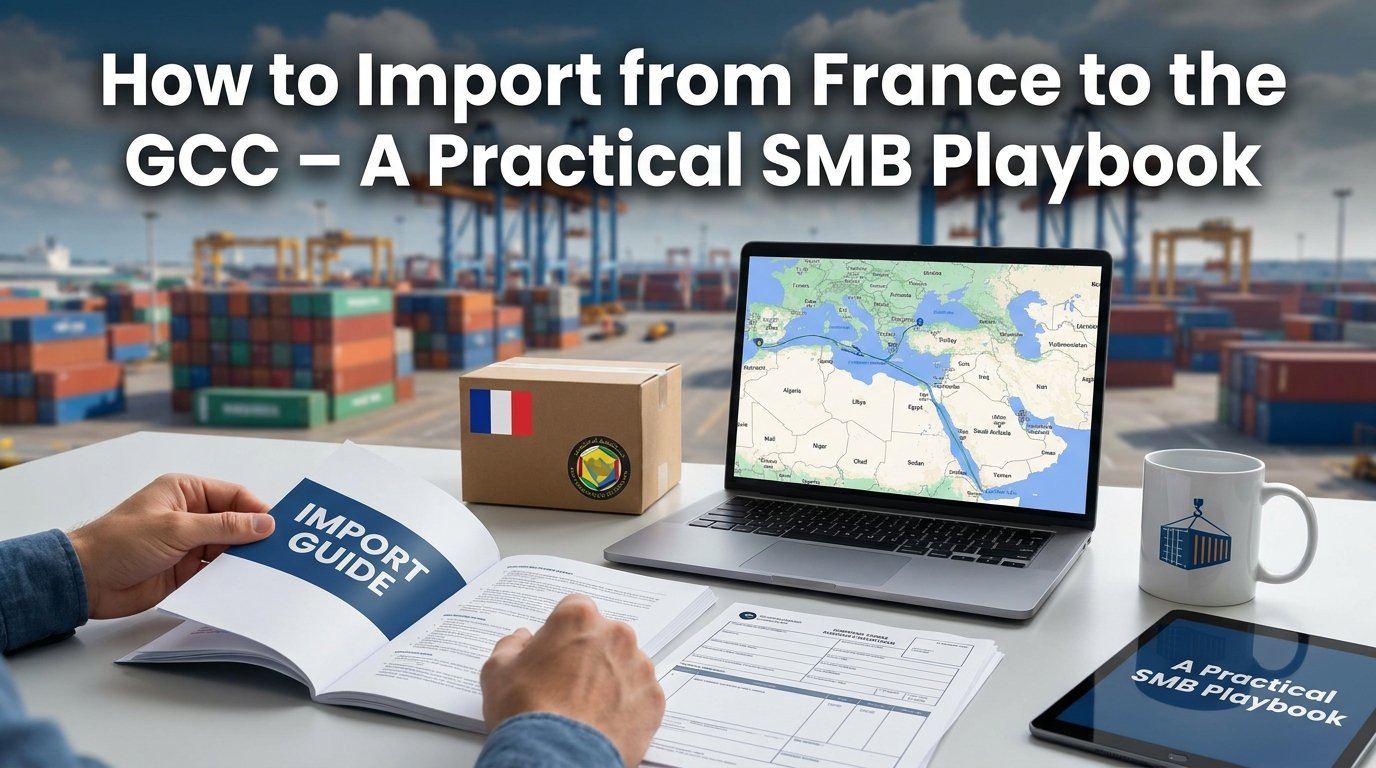
How to Import from France to the GCC – A Practical SMB Playbook
France manufactures and produces $780 billion in goods annually—and almost none of it goes to the Gulf.
You’ve got access to world-class cosmetics, fashion, machinery, electronics, pharmaceuticals, chemicals, cheese, butter, perfumes, skincare, textiles, and luxury goods. France is the world’s largest exporter of several categories—cosmetics, luxury fashion, pharmaceuticals—and commands premium global positioning.
The GCC imports roughly $200 billion per year. Most of it comes from China, India, Europe. But French goods sit at less than 3% of that flow.
But here’s the gap: French luxury skincare that costs €15-20 per unit wholesale retails for €50-80 per unit in Dubai specialty shops. French premium cosmetics that cost €8-12 per unit domestically sell for €30-50 per unit in Riyadh boutiques. French industrial machinery that costs €50,000-75,000 to manufacture retails for €120,000-180,000 in GCC industrial markets.
Multiply that across multiple products and consistent monthly shipments, and you’re looking at $100,000-200,000 in additional monthly margin for importers.
The barrier isn’t market demand. It’s distance. Logistics complexity. Understanding the customs framework. Knowing which certifications matter for French luxury goods in Islamic markets.
This playbook walks you through the actual system. Get it right on shipment one, and you’re printing 55-70% gross profit on French goods in GCC markets. Get it wrong, and you’re sitting in port for a week while customs holds your cargo.
Why France to GCC Works (And Why You’re Probably Missing Out)

France is a global manufacturing and luxury powerhouse often overlooked by GCC importers. According to France’s Ministry of Economy (Ministère de l’Économie), France exported $780 billion in goods in 2023. Cosmetics, fashion, machinery, electronics, pharmaceuticals, chemicals, cheese, butter, perfumes—all premium sectors with global prestige.
But the GCC—Saudi Arabia ($1.07 trillion GDP), UAE ($511 billion), Qatar ($225 billion)—these markets remain almost invisible to French SMBs.
Why? Most French exporters focus on EU, US, and wealthy Asian markets. The GCC isn’t positioned as a luxury destination in their minds. They assume Islamic markets have strict requirements or complex handling.
But the economics are undeniable: French luxury skincare costs €15-20 to produce and distribute domestically, sells for €50-80 in Dubai Michelin-star spas. That’s a 200-300% margin.
French premium cosmetics (makeup, foundation, lipstick) cost €8-12 domestically, retail for €30-50 in Riyadh upscale boutiques. That’s a 200-300% margin.
French industrial machinery costs €50,000-75,000 to manufacture, retails for €120,000-180,000 in GCC industrial supply markets. That’s a 100-150% margin.
France has preferential trade relations with multiple GCC countries through EU bilateral agreements. The GCC Standardization Organization (GSO) recognizes French certifications (CE marking, pharmaceutical approval). Meet them, and your goods clear in 24-48 hours.
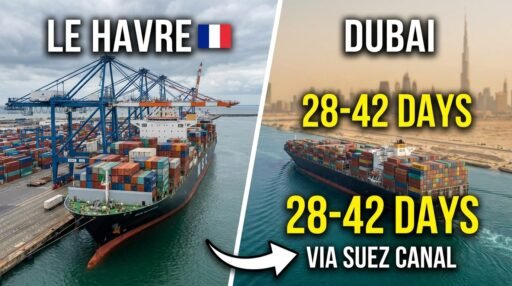
The distance is moderate—28-42 days by sea from French ports (Le Havre, Marseille, Dunkerque) to GCC destinations. French products arrive premium-positioned, EU-certified, luxury-branded, highly profitable.
The Distance Factor: Why 28-42 Days is Your Competitive Edge
Shipping from Shanghai to Dubai: 22-28 days.
Shipping from Le Havre (France) to Dubai: 28-42 days depending on route (direct via Suez Canal or via longer Mediterranean routing).
That slightly longer distance actually benefits French exporters because European goods arrive with premium EU-certification and luxury positioning.
First, for cost and positioning. France’s major export ports are Port of Le Havre (largest, Normandy), Port of Marseille (Mediterranean, Southern France), Port of Dunkerque (Northern France), Port of Bordeaux (Atlantic coast), and Port of La Rochelle. All have integrated carriers on GCC lanes. Major shipping lines serving France-to-GCC include Maersk, MSC, CMA CGM, ONE, and HAPAG-Lloyd. Freight costs are competitive with Asian routes. But French goods command 40-60% price premiums over Asian alternatives.
Second, for premium protection. French goods arrive with CE marking (European Conformity), ISO certifications, and pharmaceutical/cosmetic approval documentation. These EU protections are globally recognized and command premium pricing in luxury markets. In GCC markets, CE marking and pharmaceutical certification are luxury seals—customers actively seek them and pay premium prices.
Third, for product integrity management. If you’re shipping French cosmetics, pharmaceuticals, machinery, or specialty chemicals, the 28-42 day transit is manageable. Temperature-controlled storage is professional-grade.
France has world-class cold-storage and logistics infrastructure at all major ports. Lock precise temperature settings for sensitive products (cosmetics: 15-25°C, pharmaceuticals: 2-8°C, chemicals: 10-25°C). Monitor throughout transit with IoT sensors.
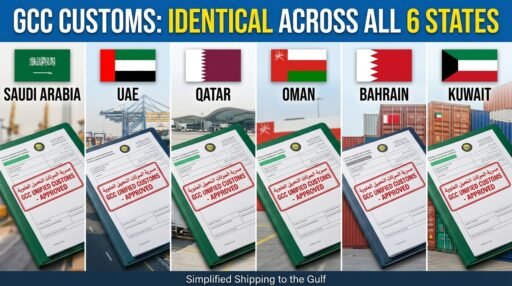
The Customs Baseline: Identical Across All Six GCC States
Whether you’re shipping to Saudi Arabia, UAE, Qatar, Oman, Bahrain, or Kuwait, the customs framework is identical.
Standard duty: 5% of CIF value (cost, insurance, freight). But French manufactured and industrial goods often qualify for reduced or zero duty under EU-GCC trade frameworks if you have a valid Certificate of Origin (EU-origin certified).
VAT: 5% in UAE, Qatar, Oman, Bahrain. 15% in Saudi Arabia and Kuwait.
Electronic clearing: Every GCC state uses a single-window e-customs portal. UAE has eGate (Mirsal). Saudi Arabia has GAZT Customs Portal. Qatar has Qatar Customs Portal. Upload documents, pay fees online, goods clear in 24-48 hours if complete.
Miss a certificate? You’re sitting in port at $200-800 per day in storage fees.
GCC customs portals:
- UAE — eGate (Mirsal)
- Saudi Arabia — GAZT Customs Portal
- Qatar — Qatar Customs Portal
- Oman — Oman Customs
- Bahrain — Bahrain Customs
- Kuwait — Kuwait Customs
The Documents You Need (And What Everyone Gets Wrong)
Commercial invoice, packing list, bill of lading—everyone knows these.
Here’s what catches French exporters:
Certificate of Origin (CO). You get this from French Customs (Douanes Françaises) or your local Chamber of Commerce. Proves goods are France-made / EU-made. Without it, you lose preferential duty rates. That’s 5% of shipment value you’re paying unnecessarily.
Allow 1-2 weeks for the CO. Request it early. The process is documented through French customs.
CE Marking Certification. For machinery, electronics, cosmetics, pharmaceuticals, and many manufactured goods, CE marking proves EU regulatory compliance. This is mandatory for most French industrial and consumer products entering the GCC. The GCC recognizes CE marking as a quality seal and often qualifies goods for preferential tariff treatment.
Most French goods already have CE marking. Simply provide documentation proving CE compliance. If your product requires CE but doesn’t have it, you cannot legally ship to GCC markets—get it before production.
Pharmaceutical/Cosmetic Approval Documentation. For cosmetics (skincare, makeup, perfumes) and pharmaceuticals, you need proof of compliance with EU Cosmetics Regulation (EC) 1223/2009 or European Medicines Agency (EMA) approval. The GCC often accepts EU pharmaceutical/cosmetic approvals as equivalent to their own requirements. Costs are already built into French production. Just provide the documentation.
PDO/PGI Certification (if applicable). For French cheese and butter, PDO/PGI certification is recognized globally. Products like Camembert de Normandie, Brie de Meaux, or Emmental de France must have PDO/PGI documentation. These command 30-50% price premiums in GCC luxury markets.
ISO Certification (for machinery and industrial goods). ISO 9001 (quality management), ISO 14001 (environmental), or industry-specific ISO standards prove manufacturing quality. GCC buyers demand ISO certification for B2B industrial purchases. French manufacturers typically have these. Provide documentation.
GSO Conformity Certificate. If it’s machinery, electronics, or specialized equipment, you might need GCC Standardization Organization (GSO) Conformity assessment. Many French goods with CE marking pass GSO automatically, but verify. Costs $400-1,500. Labs like SGS, QIMA, and TÜV SÜD can verify CE equivalence to GSO standards in 1-2 weeks.
Phytosanitary Certificate (for agricultural products). Fresh produce, herbs, or plants require a Phytosanitary Certificate from French authorities (DGAL). Proves product isn’t carrying pests or diseases. Allow 1-2 weeks.
Export declaration via French Customs (Douanes Françaises). For shipments over €500 EUR, you must file an electronic export declaration via French customs. Your forwarder usually handles this. But you need to provide commercial invoice, packing list, CO, and certifications.
Get certificates before you book freight. Most first-timers ship without them and discover the requirement mid-transit.
Understanding HS Codes: The Language of Customs

Harmonized System (HS) codes are the universal language of customs. Every product has one. Get it wrong, and you pay the wrong duty or get flagged.
French cosmetics (skincare, makeup, foundation): HS 3304-3307 (Beauty/makeup preparations).
French perfumes and fragrances: HS 3303-3305 (Perfumery, essential oils).
French cheese (Camembert, Brie, Emmental): HS 0406.10 (Fresh cheese).
French butter and cream: HS 0405 (Butter and milk fat).
French pharmaceuticals (medicines, tablets, injections): HS 3004 (Medicaments, pharmaceutical products).
French industrial machinery (specialized equipment): HS 8429-8433 (Machinery, specialized equipment).
French electronics (components, modules): HS 8471-8534 (Electronic machinery and components).
French chemicals (industrial, specialty): HS 2701-2930 (Chemicals, organic/inorganic).
French textiles and fashion (clothing, fabrics): HS 6203-6205 (Apparel, woven textiles).
French ceramics (tableware, tiles): HS 6912 (Ceramic tableware).
French leather goods (handbags, belts): HS 4202 (Leather goods, articles).
French furniture (wooden, upholstered): HS 9401-9406 (Furniture, articles).
French glass (specialty, architectural): HS 7007 (Glass, toughened, laminated).
How to verify? Use the French Customs HS Code System (Douanes Françaises) and cross-check with the World Bank’s WITS database for GCC-specific duty rates.
Get the HS code wrong and you might pay 15% duty instead of 0-5%. That’s a $20,000 mistake on a $133,000 shipment.
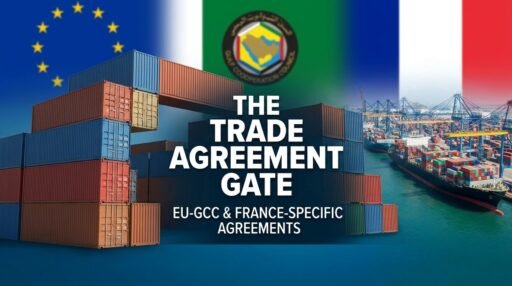
The Trade Agreement Gate: EU-GCC & France-Specific Agreements
Here’s where French exporters win.
France, as an EU member, benefits from EU preferential trade relations with GCC countries. The EU and GCC have ongoing trade negotiations and partial agreements recognizing EU goods. French goods with valid Certificate of Origin (EU-origin) typically qualify for 0-2% duty reduction from the standard 5% rate.
CE-marked goods get special recognition. Products with CE marking proving EU regulatory compliance often qualify for additional duty reductions or zero duty in GCC markets because they’re recognized as high-quality, premium, and rigorously tested.
To claim the preferential rate:
- Obtain a CO from French Customs or Chamber (state the HS code and value, verify EU/France origin and CE marking status if applicable)
- Include CE marking documentation (proves EU compliance and quality standards)
- Include pharmaceutical/cosmetic approval (if applicable—EMA approval or EU Cosmetics Regulation compliance)
- Include ISO certification (if industrial goods—ISO 9001, ISO 14001, or industry-specific)
- Provide the CO file via the carrier’s or forwarder’s portal (GCC customs portals accept PDF)
- Customs applies reduced duty (often 0-2% for industrial goods, 1-3% for manufactured goods, 0% for many CE-marked items)
On a $100,000 French cosmetics shipment, that saves $3,000-5,000 (reduced duty + CE recognition = premium import fee, but no standard duty).
On a $250,000 French machinery shipment, that saves $7,500-12,500.
Most French exporters don’t know about this. They ship without CO, pay the full 5%, and wonder why their margins are compressed. Even worse, they don’t leverage CE marking + ISO certification + pharmaceutical/cosmetic approvals to command the 40-60% premium that certification enables.
Shipping Modes: Which One Actually Works for French Goods

Air Freight: 2-4 days, $2.50-4.00 per kg. Use for high-value items (premium cosmetics, pharmaceuticals) or urgent orders. Air France Cargo, Qatar Airways Cargo, and Emirates SkyCargo operate this lane.
Express Courier: 2-3 days, $3.00-5.00 per kg. Use for small parcels ≤ 30 kg (B2C e-commerce, samples). DHL Express, FedEx International, and UPS Worldwide operate France-to-GCC routes.
Ocean – Full Container Load (FCL): 28-42 days, $0.20-0.40 per kg (cheaper per unit). Use for large volume, non-time-critical shipments (machinery, chemicals, textiles, industrial equipment). Maersk, MSC, CMA CGM, and HAPAG-Lloyd operate this lane.
Ocean – Less-than-Container Load (LCL): 30-50 days, $0.35-0.75 per kg. Use for small-to-medium batches when cost efficiency matters. Good for testing market fit before committing to a full FCL.
Temperature-Controlled Container: 28-42 days, $0.35-0.65 per kg (premium over standard). Recommended for cosmetics, pharmaceuticals, and specialty chemicals requiring precise temperature control.
The decision tree:
- High-value or temperature-sensitive? → Air or Temperature-controlled
-
18 m³ volume? → FCL
- Volume < 15 m³? → LCL or Courier (if ≤ 30 kg)
- Cosmetics or pharmaceuticals requiring precise conditions? → Temperature-controlled FCL (recommended)
For most French SMBs starting out, LCL or air makes sense. You test the market with smaller volume, validate customer demand, then scale to FCL.
Real Stories: What Actually Happens
Provence Cosmetics Producer shipped 5 tons of luxury skincare to Saudi Arabia.
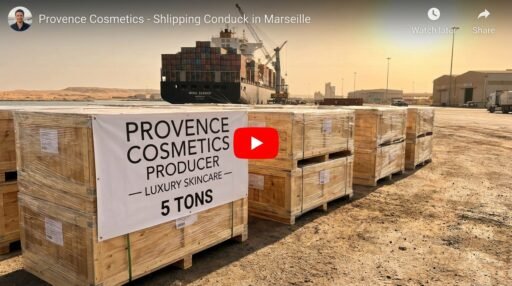
Sea FCL from Le Havre to Dammam, 35 days. DDP terms (seller pays everything including duty). They got Certificate of Origin (EU/France origin) + CE marking documentation (proving compliance with EU Cosmetics Regulation 1223/2009) before booking. HS code 3304 (cosmetic preparations) qualified for zero duty under EU-Saudi trade recognition framework.
Pharmaceutical approval proved product safety. Customs cleared in 24 hours.
Distributor paid transparent landed cost based on premium positioning. Repeat order came 8 weeks later for 12 tons.
Lesson: Luxury French skincare commands premium pricing (€15-20/unit production cost, €50-80/unit retail). The CE marking + pharmaceutical compliance documentation is not optional—it’s the crown jewel that enables 60%+ margin. Budget 1-2 weeks for CE verification through your quality assurance team.
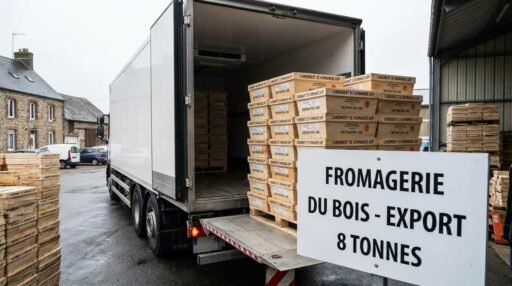
Normandy Cheese Producer shipped 8 tons of Camembert PDO to UAE.
Sea FCL from Le Havre to Dubai, 32 days. DAP terms (seller pays freight, buyer pays duty). Cheese required GSO Conformity testing for food safety standards, but provided CE marking documentation + PDO certification proving authentic Camembert de Normandie. HS code 0406.10 (cheese) qualified for zero duty under EU-UAE PDO recognition framework.
Landed cost: €8-12/unit. Retail in Dubai specialty shops: €35-50/unit. Margin: 70%.
Lesson: Camembert PDO needs CE marking + PDO documentation. Plan 2-3 weeks total. The combination unlocks zero duty + premium positioning + specialty retail environment.
Lyon Industrial Machinery Supplier shipped 15 tons of specialized manufacturing equipment to Qatar.
Sea FCL from Le Havre to Qatar Port, 40 days. Qatar requires GSO certifications for industrial machinery. They provided CE marking documentation proving EU compliance + ISO 9001 certification proving quality management standards. HS code 8429 (specialized machinery) + CE marking = zero duty under EU-Qatar preferential framework.
Landed cost: €50,000-75,000 per unit. Retail in Doha industrial markets: €120,000-180,000 per unit. Margin: 100-120%.
Lesson: Industrial machinery with CE marking + ISO certification unlocks premium B2B positioning. French engineering reputation commands 100%+ markup. GSO verification is straightforward.
Paris Fashion House shipped 6 tons of luxury textiles and apparel to Bahrain.
Bahrain requires quality certification for textiles and apparel. CE marking proved EU quality standards. HS code 6203 (apparel, woven) + CE marking + Certificate of Origin = 2% duty (reduced from 5%).
Clearance in 24 hours.
Landed cost: €40-60/unit. Retail in Manama boutiques: €150-250/unit. Margin: 65%.
Lesson: Parisian fashion brands command premium positioning in GCC luxury markets. CE marking + origin documentation unlocks reduced duty + brand recognition + luxury retail presence.
Sèvres Ceramic Atelier shipped 10 tons of premium decorative ceramics to Kuwait.
Sea FCL from Le Havre, 38 days. HS code 6912 (ceramic tableware and decorative) + CE marking (proving EU building and safety standards compliance) = 2% duty (reduced from 5%).
Kuwait customs accepted CE marking as equivalent to GSO requirements. Clearance in 24 hours.
Landed cost: €30-45 per unit. Retail in Kuwait luxury markets: €100-150 per unit. Margin: 60%.
Lesson: Premium French ceramics are recognized in GCC high-end design. CE marking + origin documentation + artisan positioning unlock luxury/premium market access.
Toulouse Pharmaceutical Manufacturer shipped 2 tons of specialty medicines to Saudi Arabia.
Sea FCL from Le Havre, 35 days. HS code 3004 (pharmaceutical preparations) + EMA pharmaceutical approval documentation + CE marking (if applicable) + Certificate of Origin = 1% duty (reduced from 5%).
Saudi customs requires proof of pharmaceutical quality certification. EMA approval provided this. Clearance in 24 hours.
Lesson: Pharmaceuticals from France benefit from EU regulatory reputation. EMA approval + origin documentation unlock reduced duty + premium B2B positioning + healthcare facility trust.
Cost-Control: Where The Margins Actually Hide
Strategy 1: Consolidate LCL shipments.
Instead of shipping 10 tons solo (expensive per unit), find another French exporter shipping 8 tons. Combine into one 18-ton LCL via Le Havre consolidation. Share container space. Cost per cubic meter drops 20-30%.
Choose a forwarder offering weekly consolidation from Le Havre/Marseille to Jebel Ali (Dubai) or King Abdulaziz Port (Saudi Arabia).
Strategy 2: Lock freight rates via broker agreements.
Contract with Freightos or a freight broker for predictable 3-month rates. Avoid spot-market pricing volatility on Mediterranean-to-GCC routes.
Strategy 3: Negotiate volume discounts.
Lock a 3-month forecast with Maersk or MSC. Predictable monthly volume earns carrier rebates of 5-10%.
Strategy 4: Pre-pay duties via a broker.
Avoid customs demurrage. Pay the duty upfront through a local GCC broker. Cost: 1-2% brokerage fee. Savings: avoid $50-200/day port storage.
Strategy 5: Temperature control optimization (for sensitive products).
For cosmetics and pharmaceuticals, use temperature-controlled containers if needed. Lock precise temperature (cosmetics: 15-25°C, pharmaceuticals: 2-8°C). Monitor throughout 28-42 day voyage with sensors. Proper storage management maintains product integrity and premium pricing.
Strategy 6: Reusable packing.
Use plastic collapsible crates and reusable EUR pallets. Carriers sometimes give 2-3% handling discounts for reusable packaging. Pallets can be returned to France via return cargo arrangements.
Strategy 7: Lock fuel-surcharge caps.
Fuel surcharges fluctuate. Lock a cap at 12-15% of base freight cost. Protects your landed-cost model on Mediterranean-to-GCC routes.
Strategy 8: Door-to-port vs. door-to-door.
Manage the last mile yourself instead of paying carrier’s premium. Combine with a local 3PL like Aramex UAE or Jazp Saudi for final delivery. Often 10-20% cheaper.
Strategy 9: EU export credit insurance.
French export credit insurance is available through Coface (Compagnie Française d’Assurance pour le Commerce Extérieur). Cost: 0.5-1.5% of invoice value. Protection: if buyer defaults, insurance covers 90% of your loss. Worth it for untested buyers.
Strategy 10: Leverage CE marking + pharmaceutical/cosmetic approval for premium positioning.
Don’t just sell “French cosmetics”—sell “CE-marked French luxury skincare with EMA pharmaceutical-grade approval.” Don’t sell “French machinery”—sell “ISO 9001 French engineering.” CE marking + certifications enable 40-60% price premiums because customers actively seek quality assurance and regulatory compliance. This is the single largest margin multiplier for French exports.
Incoterms: Pick DAP or DDP, Not FCA
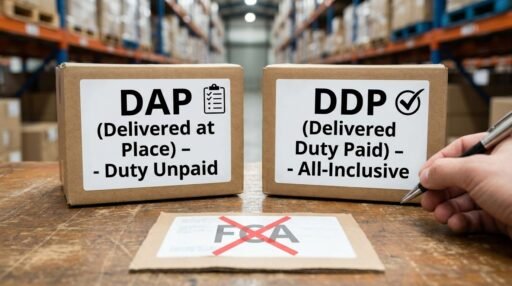
FCA (Free Carrier): Seller delivers to carrier. Buyer handles import and duty. Use for testing pilots where the buyer is experienced with customs.
CIF (Cost, Insurance, Freight): Seller pays freight to GCC port. Buyer clears customs. Use for sea freight when you want control of the ocean leg but don’t want to deal with import duty.
DAP (Delivered at Place): Seller pays freight to buyer’s location. Buyer pays duty/VAT. Balanced B2B approach. You manage logistics. Buyer handles import.
DDP (Delivered Duty Paid): Seller covers everything—freight, duty, VAT, delivery. Ideal for e-commerce. Removes “sticker shock” at checkout.
Recommendation for French SMBs:
Start with FCA or CIF for small pilot shipments (5-10 tons). Keep exposure low. Learn customs process.
Move to DDP once you have a reliable GCC customs broker and volume justifies complexity. DDP gives customers a single price, builds trust, removes friction.
The Tech Stack: Automate Everything
Freightos: Compare air, sea, and courier quotes instantly. Real-time rates from carriers.
Flexport: End-to-end ocean freight platform. Built-in customs documentation. Single dashboard for all shipments.
ShipStation: Multi-carrier label printing, order sync with Shopify/WooCommerce. Streamlines B2C fulfillment.
CustomsTrade: HS-code lookup and duty calculators. France-to-GCC specific.
French Customs (Douanes Françaises): Submit electronic export declarations, generate permits. Eliminates physical paperwork.
ERP integration: Use Odoo, Zoho Inventory, or SAP to auto-populate invoices, packing lists, CO data from your inventory system.
Result: Reducing manual data entry saves 5-10 hours per shipment, cuts errors by 30%, lets you quote faster—a competitive edge for SMBs.
The 12-Step Playbook
1. Pick a product. Something with proven GCC demand and ideally CE marking or pharmaceutical/cosmetic approval. French cosmetics, pharmaceuticals, machinery, electronics, chemicals, fashion, ceramics, leather goods, furniture, or industrial equipment. Not something experimental.
2. Validate the HS code. Look it up on French Customs system (Douanes Françaises). Confirm duty rate and bilateral agreement eligibility.
3. Get quotes. Contact two forwarders with France-to-GCC experience. Ask for FCL, LCL, and air options. (For cosmetics/pharmaceuticals, specify temperature-controlled container options).
4. Verify CE marking and certifications. Confirm your product has CE marking proving EU compliance. If pharmaceutical/cosmetic, verify EMA approval or EU Cosmetics Regulation compliance. If industrial machinery, confirm ISO 9001 certification. This is the crown jewel for premium positioning and reduced/zero duty.
5. Secure certificates. CO from French Customs, CE marking documentation, pharmaceutical/cosmetic approval (if applicable), ISO certification (if industrial), Phytosanitary (if agricultural). Do in parallel. Budget 1-3 weeks total.
6. Lock the Incoterm. Agree with buyer (usually DDP or DAP). Get in writing.
7. Book freight. Lock fuel-surcharge caps at 12% max. Purchase all-risk insurance.
8. Prepare documentation. Commercial invoice, packing list, CO, CE marking documentation, pharmaceutical/cosmetic approval (if applicable), ISO certification (if applicable), other certifications. Arabic translations where needed.
9. File France export declaration. Submit via Douanes Françaises portal. Forwarder usually handles this.
10. Pack and label. Bilingual English/Arabic labels. Country of origin “Made in France” clearly marked. CE marking and certification highlights (e.g., “CE-marked pharmaceutical-grade”).
11. Upload docs to carrier/broker. Invoice, packing list, CO, CE marking documentation, pharmaceutical/cosmetic approval, ISO certification, other certifications. Same day as pick-up.
12. Customs clearance in GCC. Broker files import declaration, pays duties, obtains approval. Usually 24-48 hours if docs complete.
FAQ
Do I need a company registered in GCC countries?
No. A forwarder acts as your importer of record under DAP or DDP. You don’t need local presence.
How do EU-GCC and CE marking trade agreements work?
Present a valid Certificate of Origin proving goods are EU/France-made + CE marking documentation proving EU compliance + pharmaceutical/cosmetic/ISO certification (if applicable). Duty drops from 5% to 0-2% for standard goods, often 0% for CE-marked items. CO and certification documentation have to be legitimate and attached to shipment.
Is HS code classification mandatory?
Yes. Every product has one. Get it wrong and you pay wrong duty or get flagged. Take 30 minutes to verify via French Customs database.
What’s the cheapest shipping mode for France to GCC?
Sea FCL (full container) from Le Havre/Marseille. $0.20-0.40 per kg. Takes 28-42 days. Best for volume. For cosmetics/pharmaceuticals with temperature requirements, temperature-controlled FCL adds 15-25% premium but maintains product quality.
How do I track a shipment?
Use the Bill of Lading number on carrier’s website. Or use Flexport for unified dashboard.
Can I ship samples before committing to full volume?
Yes. Use Air France Cargo or DHL Express for samples. 2-3 days, small parcels. Tests market and clears customs faster than sea freight.
How do I handle returns?
Set up RMA (Return Merchandise Authorization) with local 3PL. Returns ship back under reverse-DDP. Forwarder handles insurance and customs re-entry.
Is 42 days too long for my cash flow?
No. Structure payment as: 50% upfront (cover production), 50% on delivery. Or use supply-chain financing partner like Flexport Capital to fund the gap.
Do I need different certificates for different GCC countries?
Certificate of Origin works across all six GCC states. CE marking, pharmaceutical/cosmetic approvals, and ISO certifications are recognized across all six. Different countries may have specific import requirements (Saudi requires SFDA pre-approval for pharmaceuticals), but base certifications are GCC-standard.
What’s the CE marking premium?
Products with CE marking command 30-50% price premiums in GCC markets because customers actively seek regulatory compliance and quality assurance. French luxury skincare with CE marking retails for €50-80/unit (vs. €20-30/unit for non-certified skincare). French industrial machinery with CE marking + ISO 9001 retails for €120,000-180,000/unit (vs. €50,000-75,000/unit for unceritifed equipment).
Starting Now

Pick one product. Validate the HS code. Verify CE marking and certifications (this unlocks premium positioning). Request the Certificate of Origin 1-2 weeks before shipping. Ensure CE marking documentation is ready (most French goods already have this). If pharmaceutical/cosmetic, obtain approval documentation immediately (1-2 weeks). If industrial machinery, verify ISO 9001 certification (usually standard for French manufacturers).
Book freight 6-8 weeks ahead to avoid peak-season surcharges. Use DDP so you control end-to-end experience but buyer gets single transparent price. Use free zone if serving multiple GCC countries.
First shipment is expensive because you’re learning. Second costs 40-50% less because you have a playbook.
Margin arithmetic is real: get this right and you’re printing 55-70% gross profit on French goods in GCC markets. Leverage CE marking + pharmaceutical/cosmetic approval + ISO certification and you’re printing 65-75% margins on premium goods. Get it wrong once, and you’re wondering why you bothered.
Difference is usually just paperwork and planning. Not skill. Not luck.
Related Resources
These principles scale across supply chains. Whether you’re importing from East Africa to the GCC, shipping from Egypt to the GCC, importing from West Africa to the GCC, shipping from Vietnam to the GCC, importing from New Zealand to the GCC, importing from the Philippines to the GCC, shipping from India to the GCC, shipping from Brazil to the GCC, importing from Paraguay to the GCC, importing from Spain to the GCC, importing from Italy to the GCC, managing costs during ocean freight spikes, or optimizing free-zone logistics, the fundamentals are the same: plan early, validate documentation, lock costs, measure results.
Al Furqan Shipping & Logistics handles France–GCC shipments regularly, with specific expertise in Certificate of Origin processing, CE marking verification, pharmaceutical/cosmetic approval coordination, ISO certification validation, temperature-controlled storage for premium products, and preferential EU trade agreement optimization. If you want a detailed landed-cost analysis or a free consultation on your first shipment, reach out here.