How to import from Austria to GCC
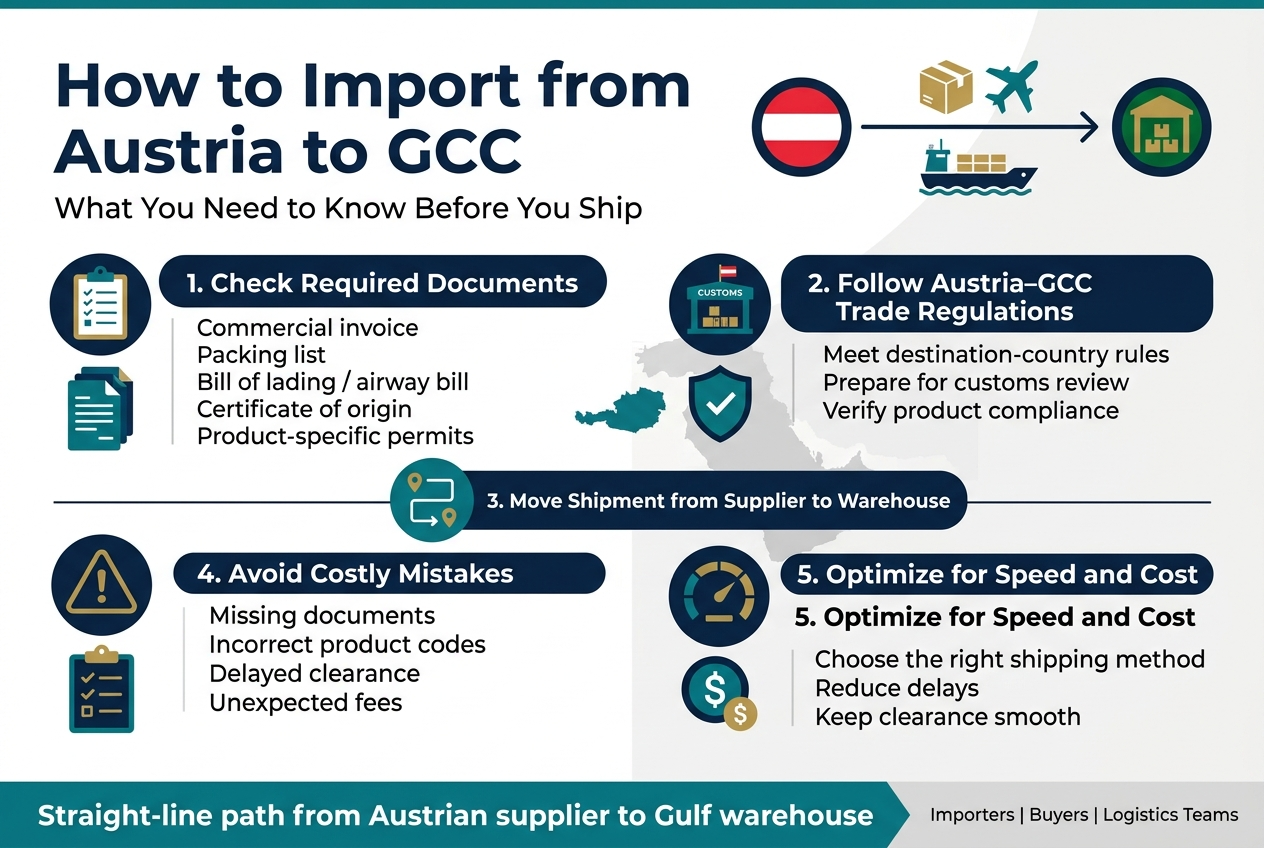
How to Import from Austria to GCC: What You Need to Know Before You Ship
If you’re a business owner, procurement manager, or trade professional looking to bring goods from Austria into the Gulf, you’ve probably already hit a wall of questions. What documents do you actually need? How do customs clearance between Austria and GCC countries work? And what’s the fastest, most cost-effective way to get your shipment moving?
This guide is built for importers, buyers, and logistics teams who are either just starting out or trying to fix gaps in their current process. We’ll walk you through the key Austria GCC trade regulations you need to follow, break down the step-by-step import process from origin to destination, and cover the critical Austria GCC import documentation that customs officers expect to see. Along the way, we’ll flag the most common (and costly) mistakes so you can skip them entirely.
No jargon, no fluff — just a straight-line path from Austrian supplier to Gulf warehouse.
Understanding the Austria-GCC Trade Relationship
Key Trade Agreements and Frameworks Between Austria and GCC Countries
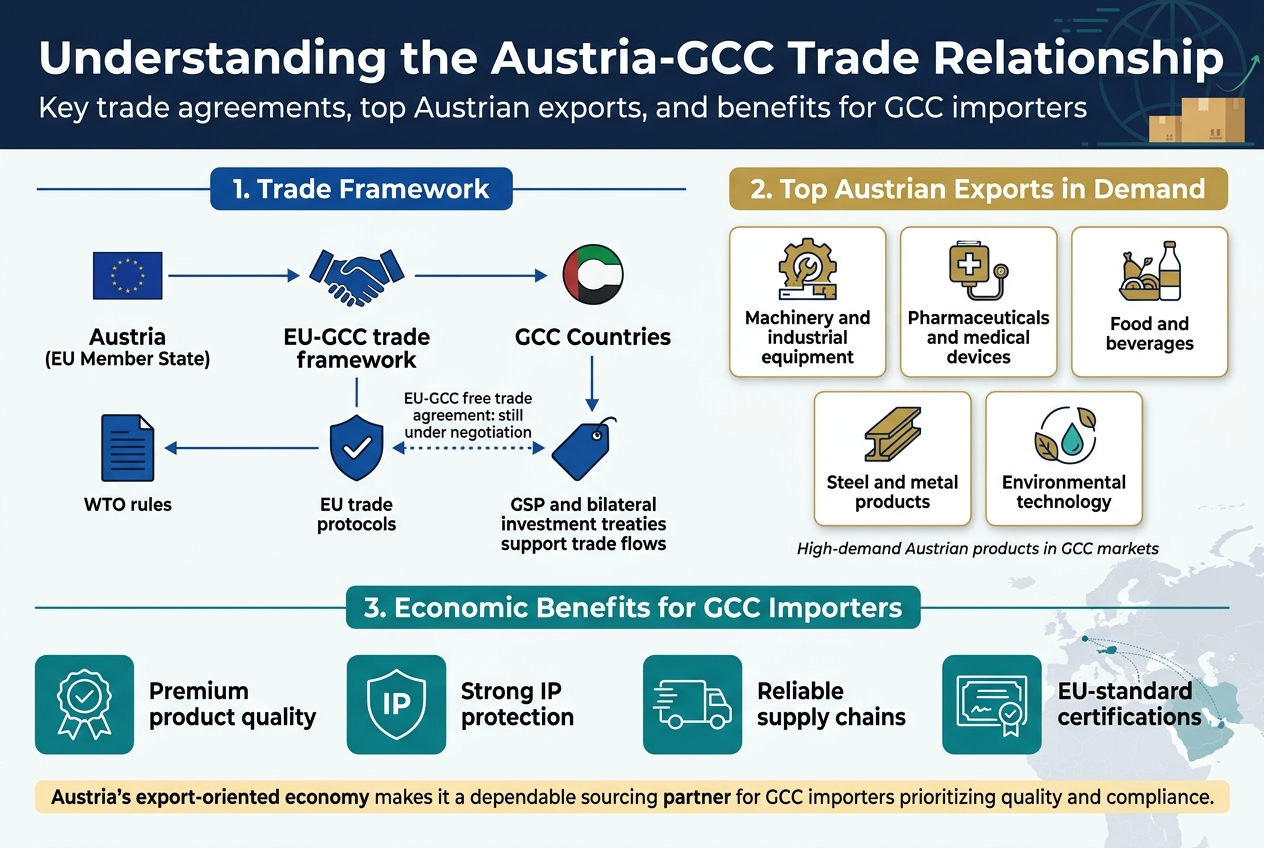
Austria, as an EU member state, engages with GCC nations primarily through the EU-GCC trade framework. While a comprehensive EU-GCC free trade agreement is still under negotiation, bilateral trade between Austria and Gulf countries operates under World Trade Organization (WTO) rules and existing EU trade protocols. The EU’s Generalized System of Preferences (GSP) and various bilateral investment treaties further support smoother trade flows when importing goods from Austria to GCC markets.
Top Austrian Products in Demand Across GCC Markets
GCC buyers consistently seek out these Austrian exports:
-
Machinery and industrial equipment – Austria’s engineering sector is globally recognized
-
Pharmaceuticals and medical devices – high compliance standards make them GCC-ready
-
Food and beverages – Austrian dairy, confectionery, and wines are popular luxury imports
-
Steel and metal products – key inputs for Gulf construction projects
-
Environmental technology – water treatment and energy solutions gaining ground in the region
Economic Benefits of Importing from Austria
| Benefit | Why It Matters |
|---|---|
| Premium product quality | Reduces post-import quality issues |
| Strong IP protection | Lowers counterfeiting risks |
| Reliable supply chains | Ensures consistent delivery timelines |
| EU-standard certifications | Simplifies GCC customs clearance |
Austria’s export-oriented economy makes it a dependable sourcing partner for GCC importers prioritizing quality and compliance.
Essential Legal and Regulatory Requirements
GCC Customs Regulations You Must Comply With
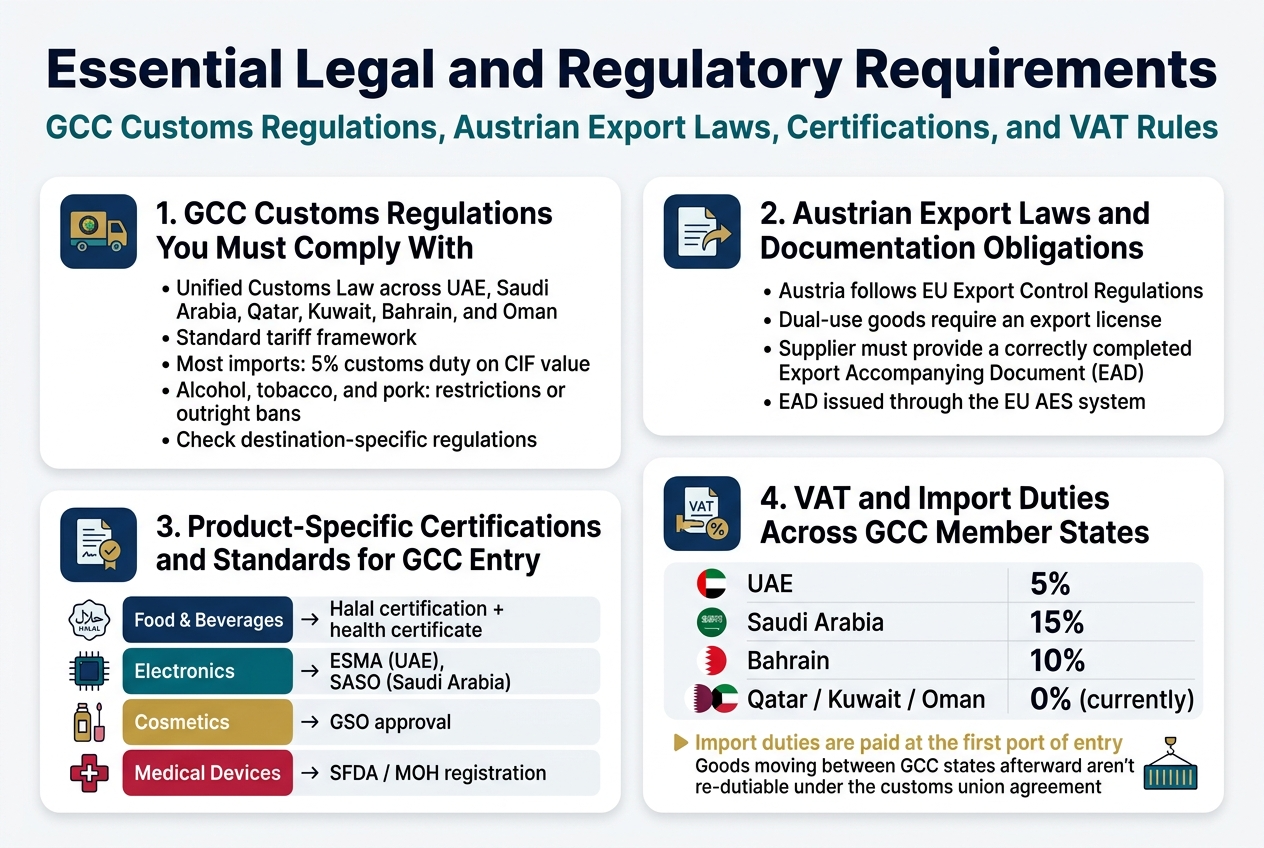
GCC countries follow the Unified Customs Law, which means goods entering UAE, Saudi Arabia, Qatar, Kuwait, Bahrain, or Oman face a standard tariff framework. Most imports carry a 5% customs duty on CIF value. Some product categories — alcohol, tobacco, pork — face restrictions or outright bans.
Each member state may add local requirements on top of the unified rules, so always check destination-specific regulations.
Austrian Export Laws and Documentation Obligations
Austria, as an EU member, requires exporters to comply with EU Export Control Regulations. Dual-use goods need an export license. Your Austrian supplier must provide a correctly completed Export Accompanying Document (EAD) through the EU’s AES system.
Product-Specific Certifications and Standards for GCC Entry
| Product Category | Required Certification |
|---|---|
| Food & Beverages | Halal certification + health certificate |
| Electronics | ESMA (UAE), SASO (Saudi Arabia) |
| Cosmetics | GCC Standardization Organization (GSO) approval |
| Medical Devices | SFDA / MOH registration |
VAT and Import Duties Across GCC Member States
| Country | VAT Rate |
|---|---|
| UAE | 5% |
| Saudi Arabia | 15% |
| Bahrain | 10% |
| Qatar/Kuwait/Oman | 0% (currently) |
Import duties are paid at the first port of entry. Goods moving between GCC states afterward aren’t re-dutiable under the customs union agreement.
Step-by-Step Import Process from Austria to GCC
Identifying and Vetting Reliable Austrian Suppliers
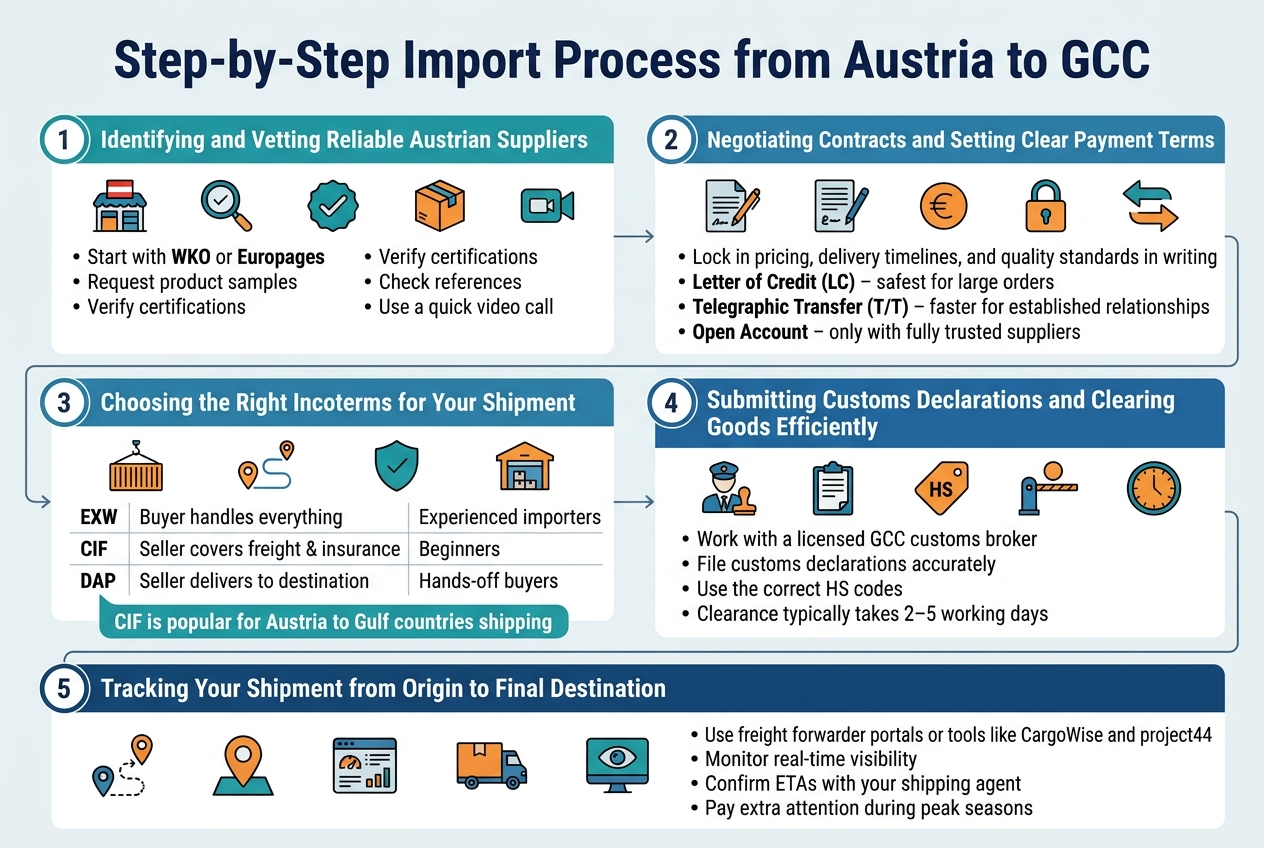
Start with directories like the Austrian Federal Economic Chamber (WKO) or platforms like Europages. Always request product samples, verify certifications, and check references before committing. A quick video call goes a long way in building trust.
Negotiating Contracts and Setting Clear Payment Terms
Lock in pricing, delivery timelines, and quality standards in writing. Common payment methods for Austria-GCC trade include:
-
Letter of Credit (LC) – safest for large orders
-
Telegraphic Transfer (T/T) – faster for established relationships
-
Open Account – only with fully trusted suppliers
Choosing the Right Incoterms for Your Shipment
| Incoterm | Responsibility Shift | Best For |
|---|---|---|
| EXW | Buyer handles everything | Experienced importers |
| CIF | Seller covers freight & insurance | Beginners |
| DAP | Seller delivers to destination | Hands-off buyers |
CIF is popular for Austria to Gulf countries shipping as it simplifies risk management.
Submitting Customs Declarations and Clearing Goods Efficiently
Work with a licensed GCC customs broker. File your customs declaration accurately using the correct HS codes—errors cause costly delays. Customs clearance for Austria-GCC shipments typically takes 2–5 working days when documentation is complete.
Tracking Your Shipment from Origin to Final Destination
Use freight forwarder portals or tools like CargoWise and project44 for real-time visibility. Always confirm ETAs with your shipping agent, especially during peak seasons.
Shipping and Logistics Options to Maximize Efficiency
Air Freight vs Sea Freight from Austria to GCC
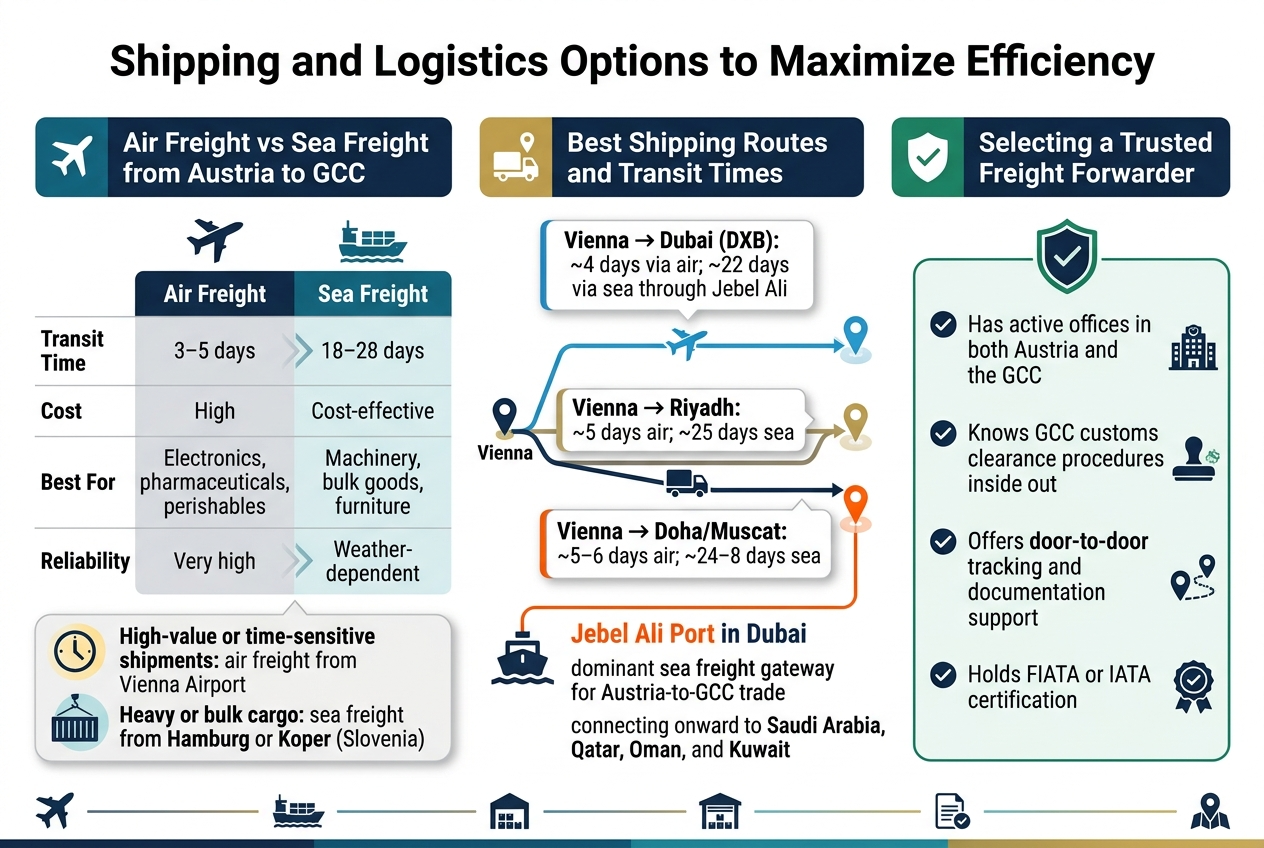
| Factor | Air Freight | Sea Freight |
|---|---|---|
| Transit Time | 3–5 days | 18–28 days |
| Cost | High | Cost-effective |
| Best For | Electronics, pharmaceuticals, perishables | Machinery, bulk goods, furniture |
| Reliability | Very high | Weather-dependent |
For high-value or time-sensitive shipments, air freight from Vienna Airport makes sense despite the premium cost. For heavy or bulk cargo, sea freight from ports like Hamburg or Koper (Slovenia) offers significant savings when importing goods from Austria.
Best Shipping Routes and Transit Times
-
Vienna → Dubai (DXB): ~4 days via air; ~22 days via sea through Jebel Ali
-
Vienna → Riyadh: ~5 days air; ~25 days sea
-
Vienna → Doha/Muscat: ~5–6 days air; ~24–28 days sea
Jebel Ali Port in Dubai is the dominant sea freight gateway for Austria-to-GCC trade, connecting onward to Saudi Arabia, Qatar, Oman, and Kuwait.
Selecting a Trusted Freight Forwarder
When handling Austria to Gulf countries shipping, pick a forwarder who:
-
Has active offices in both Austria and the GCC
-
Knows GCC customs clearance procedures inside out
-
Offers door-to-door tracking and documentation support
-
Holds FIATA or IATA certification
Critical Import Documentation You Need to Prepare
Commercial Invoice and Packing List Requirements
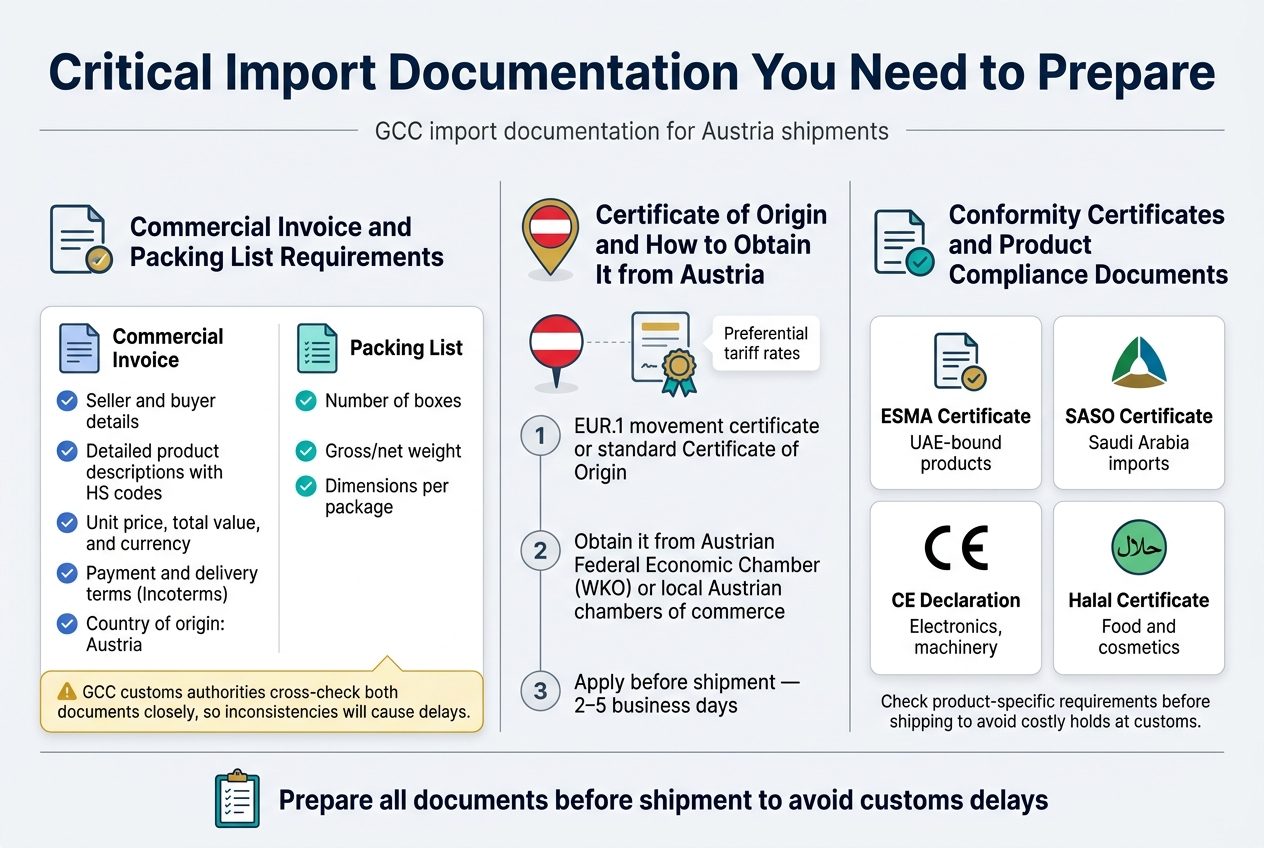
Your commercial invoice needs to include:
-
Seller and buyer details (full names, addresses, contact info)
-
Detailed product descriptions with HS codes
-
Unit price, total value, and currency
-
Payment and delivery terms (Incoterms)
-
Country of origin (Austria)
The packing list should mirror the invoice but focus on physical shipment details — number of boxes, gross/net weight, and dimensions per package. GCC customs authorities cross-check both documents closely, so inconsistencies will cause delays.
Certificate of Origin and How to Obtain It from Austria
For Austria GCC import documentation, you’ll need a EUR.1 movement certificate or a standard Certificate of Origin, depending on whether you’re claiming preferential tariff rates.
Obtain it from:
-
Austrian Federal Economic Chamber (WKO) — most common route
-
Local Austrian chambers of commerce
Apply before shipment, as the process typically takes 2–5 business days.
Conformity Certificates and Product Compliance Documents
GCC import requirements vary by product category. Common compliance documents include:
| Document | Applies To |
|---|---|
| ESMA Certificate | UAE-bound products |
| SASO Certificate | Saudi Arabia imports |
| CE Declaration | Electronics, machinery |
| Halal Certificate | Food and cosmetics |
Check product-specific requirements before shipping to avoid costly holds at customs.
Managing Costs and Avoiding Common Import Pitfalls
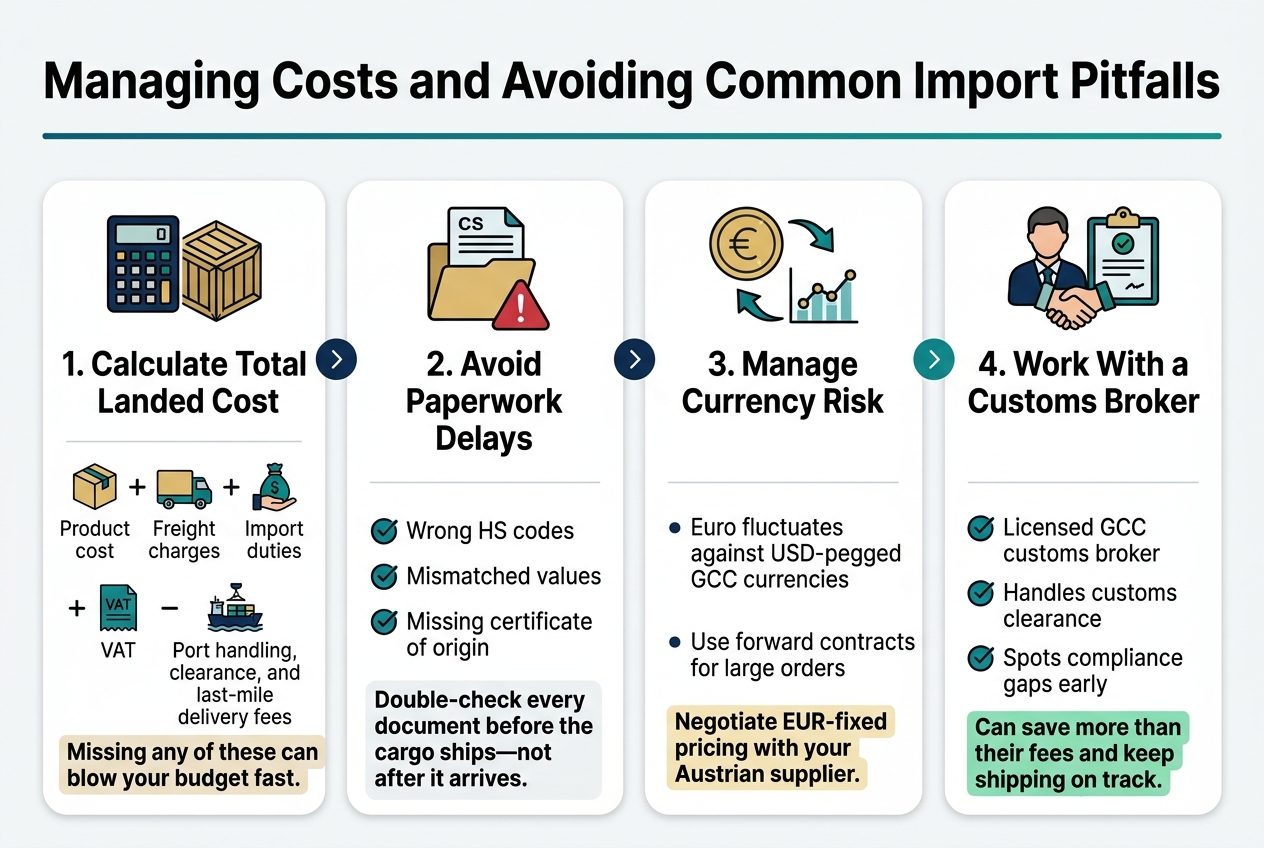
Calculating Total Landed Cost for Austrian Imports
Your total landed cost goes well beyond the product price. Factor in:
-
Product cost (EUR-denominated invoice value)
-
Freight charges (sea or air from Austria to GCC ports)
-
Import duties (typically 5% under GCC Unified Customs Tariff)
-
VAT (5% in UAE, Saudi Arabia; varies by country)
-
Port handling, clearance, and last-mile delivery fees
Missing any of these can blow your budget fast.
Avoiding Delays From Incomplete or Incorrect Paperwork
Wrong HS codes, mismatched values, or missing certificates of origin are the top reasons shipments get held at GCC customs. Double-check every document before the cargo ships—not after it arrives.
Navigating Currency Exchange Risks Between Euro and GCC Currencies
The Euro fluctuates against the USD-pegged GCC currencies. Lock in rates using forward contracts for large orders, or negotiate EUR-fixed pricing with your Austrian supplier to keep costs predictable.
Working With a Customs Broker to Reduce Costly Errors
A licensed GCC customs broker who understands Austria GCC trade regulations can save you significantly more than their fees. They handle customs clearance, spot compliance gaps early, and keep your Austria to Gulf countries shipping timeline on track.