
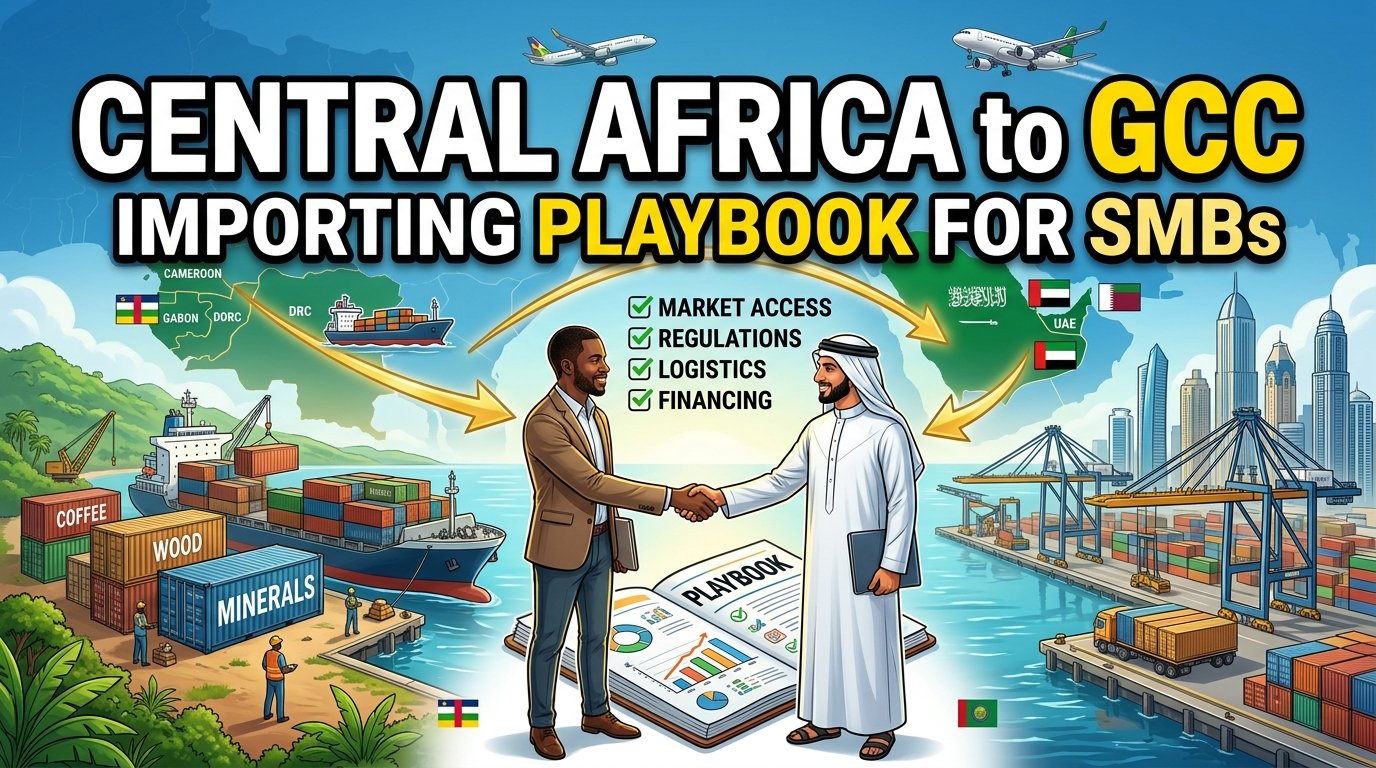
Importing from Central Africa to the GCC – A Bullet-Point Playbook for SMBs
Central Africa holds untapped opportunity for GCC importers. Rich natural resources, competitive production costs, and a wave of “Made in Central Africa” momentum make this corridor one of the fastest-growing trade lanes. But the logistics, customs rules, and documentation requirements can feel overwhelming if you’ve never imported from the region.
This guide is built on 23+ years of GCC multimodal freight experience and direct execution across this exact trade lane. It’s a concrete playbook—stripped of jargon, packed with real stories, and structured so you can move from research to first shipment in weeks, not months.
Sources & External Resources: This guide draws on data from the World Bank Trade Statistics, ITC TradeMap, African Development Bank, and official GCC Customs Authorities. All duty rates, free-zone regulations, and compliance requirements reflect current 2024–2025 GCC tariff schedules and bilateral trade agreements. Operational insights are informed by hands-on experience at Al Furqan Shipping & Logistics Services LLC, a Sharjah-based multimodal freight forwarder specializing in GCC import/export and Central Africa trade corridors.
Why Consider Central Africa?
- Resonance with Gulf buyers. Natural, organic, artisanal products from Central Africa command premium positioning in the UAE, Saudi Arabia, and smaller GCC markets.
- Production costs that work. Agriculture, mining, timber, and cosmetics production costs run 30–50% lower than equivalent Asian facilities.
- Unmatched resources. Specialty coffee from Cameroon, cocoa nibs from DR Congo, shea butter from Chad, sustainable hardwood from Gabon, cobalt and copper for renewable energy projects, halal-certified livestock products from across the region.
- Supply-chain diversification. Every major retailer and distributor in the GCC is actively looking to reduce dependence on China and India. Central Africa fills that gap.
- Policy tailwinds. Saudi Vision 2030 and the UAE’s Green Economy initiatives prioritize African partnerships, offering simplified customs pathways and preferential tariffs for qualifying goods.
Hot-Selling Product Categories—By Country
Cameroon & DR Congo
- Specialty coffee (high-altitude Arabica beans, green and roasted)
- Cocoa nibs and cocoa butter
- Shea butter and cosmetic-grade plant oils
- Artisanal spices and dried herbs
Congo & Gabon
- Sustainable hardwood (mahogany, iroko, teak)
- Palm oil for food and biofuel
- Tropical timber (finishing-grade lumber for furniture)
Chad & Central African Republic
- Leather hides and finished leather products
- Beef and goat meat (halal-certified)
- Sesame seeds and sesame oil
Rwanda & Burundi (often grouped with Central Africa in trade data)
- Tea (loose-leaf and premium blends)
- Honey (raw and processed)
- Goat cheese (fresh and aged)
- Artisanal crafts and home décor
Equatorial Guinea & São Tomé & Príncipe
- Coconut oil
- Dried fish and seafood
- Tropical fruits (pineapple, mango, cassava)
Mineral Exporters (DRC, Central African Republic)
- Cobalt and copper concentrates
- Coltan (for solar and renewable-energy projects)
- Gemstones and semi-precious stones
GCC Customs Fundamentals—The Baseline Rules

These apply uniformly across all six member states (UAE, Saudi Arabia, Kuwait, Qatar, Bahrain, Oman). Reference the official GCC Tariff Schedule (HS 2024) and each country’s customs authority for the most current rates and classifications.
- Standard customs duty = 5% of CIF value for most finished goods. Many raw agricultural products are duty-free if HS codes are classified correctly. Verify classification via ITC TradeMap or the UN Harmonized System.
- VAT/GST applied on (CIF + duty). Rates: 5% in UAE, Qatar, Oman, Bahrain; 15% in Saudi Arabia and Kuwait. See UAE Federal Tax Authority and Saudi Zakat, Tax & Customs Authority (ZATCA) for VAT specifics.
- Import licences required for pharmaceuticals, certain chemicals, dual-use items, and processed animal products (meats, cheeses, dairy). Check Saudi Ministry of Environment, Water and Agriculture (MEWA) for regulated items.
- Halal certification mandatory for all food, beverage, and most personal-care items. The stamp must be in Arabic to avoid customs holds. Refer to Halal Accreditation Body (HAB) or your country’s certified Halal issuer.
- All customs submissions are filed through each country’s single-window electronic portal (UAE e-Customs, Saudi ZATCA e-Services, Kuwait Customs e-Gate, Qatar Customs e-Portal). Paper submissions are no longer accepted.
- GCC Conformity Certificates (GSO) required for processed foods, cosmetics, electrical goods, certain minerals, and timber products. Issue authority: Gulf Standardization Organisation (GSO).
Trade Incentives & Agreements—Leverage These
GCC Generalised System of Preferences (GSP)
- Provides duty reductions of 0–2% for products from developing countries that meet origin rules. Administered by the GCC Secretariat General.
- Requires a Certificate of Origin (CO) issued by an authorized national chamber (e.g., Cameroon Chamber of Commerce, DR Congo National Traders Union). Validate CO eligibility via ITC Rules of Origin Database.
- Applies automatically if the CO is presented with the customs declaration.
Bilateral MoUs (Saudi-Africa Partnership, UAE-Gabon Investment Agreement, etc.)
- Offer simplified customs procedures and fast-track clearance for qualifying shipments.
- Status varies by country pair; check with your forwarder on the latest bilateral agreements. Reference: Saudi Vision 2030 Africa Initiative and UAE-Africa Partnership Portal.
African Continental Free Trade Area (AfCFTA) Rules of Origin
- Helpful when a product undergoes value-addition across multiple Central African nations before export to the GCC.
- Reduces the effective duty burden if the final product meets AfCFTA cumulation requirements.
- Reference: AfCFTA Secretariat.
Sustainability-Linked Incentives
- Saudi Vision 2030 and the UAE’s Green Economy initiatives may grant preferential treatment for sustainably sourced timber and biofuel feedstock.
- Must provide FSC (Forest Stewardship Council) certification or equivalent proof. Check PEFC certification for alternative compliance.
- Reference: Saudi Green Initiative and UAE Green Economy Roadmap.
Core Import Documentation Checklist

Have these ready before your shipment leaves port:
Universal Documents
- Commercial invoice – English is standard; Arabic version often required for food and cosmetics.
- Packing list – weight, dimensions, SKU per box or pallet.
- Bill of Lading (sea) or Air Waybill (air) – full container/flight details, shipper/consignee names, HS codes. Reference: IATA Air Waybill Standards and IMO Bill of Lading Guidelines.
- Certificate of Origin (CO) – issued by the national chamber of your exporting country. Validate via ITC Certificate of Origin Database.
- Cargo insurance certificate – all-risk, typically 0.5–0.8% of declared value. Standard terms: Lloyd’s of London or equivalent marine insurer.
Product-Specific Certificates (required based on product type)
- Halal certificate – Arabic-stamped, required for all consumables (even plant-based goods like coffee). Issue authority: Halal Accreditation Body or approved country certifier.
- GCC Conformity Certificate (GSO) – needed for processed foods, cosmetics, electronics, certain minerals, and timber. Issue authority: Gulf Standardisation Organisation. Testing labs: SGS (UAE, Saudi, all GCC countries), BUREAUVERITAS.
- Phytosanitary certificate – for fresh produce, coffee beans, cocoa, plant-based ingredients, seeds. Issuing authority: International Plant Protection Convention (IPPC) or your country’s agriculture ministry.
- Import licence – required for pharmaceuticals, regulated minerals, hormonal or treated animal products. Check with destination country’s ministry.
- Sustainability certification – FSC (timber), organic certification (agricultural products), or equivalent. Reference: FSC Global, PEFC.
Electronic Filing
- All documents must be uploaded to the destination GCC country’s customs portal before or upon vessel/flight arrival.
- Portal links: UAE Customs, ZATCA (Saudi), Kuwait Customs, Qatar Customs, Oman Customs, Bahrain Customs.
- Delays in document upload = cargo holds at port.
Incoterms—Quick Guide for SMBs
Choose the right one before you negotiate price. All definitions below follow ICC INCOTERMS 2020 standards:
EXW (Ex Works)
- Buyer assumes all export and import costs after goods leave your farm or warehouse.
- Highest risk for the seller; lowest risk for the buyer.
- Rarely used for international trade unless the buyer has full logistics control.
FCA (Free Carrier)
- Seller delivers to a carrier chosen by the buyer; buyer clears export and handles all freight and import costs.
- Common for SMBs shipping to a forwarder who manages the rest.
CIF (Cost, Insurance, and Freight)
- Seller pays freight and insurance to the GCC port; buyer clears customs and pays duty/VAT.
- Transparent cost-sharing; buyer bears import risk after goods arrive.
DAP (Delivered at Place)
- Seller pays freight to a named place in the GCC; buyer clears customs, pays duty and VAT, and unloads goods.
- Balances control and cost; most common for SMB imports.
DDP (Delivered, Duty Paid)
- Seller covers freight, duty, VAT, insurance, and final delivery.
- Price is transparent but capital-intensive for the seller.
- Best when the buyer insists on a fixed, all-in price.
For most SMBs: Start with DAP. It gives you visibility into costs, minimizes disputes, and keeps the buyer engaged in final-mile logistics. Full definitions and guidance: ICC INCOTERMS 2020 Official Guide.
Shipping Mode Options—Speed vs. Cost

Air Freight
- Lead time: 2–5 days door-to-door.
- Cost: $3–8 per kg from Central African capitals to major GCC hubs.
- Best for: High-value items (specialty coffee, goat cheese, gemstones), perishable goods, time-critical orders.
- Drawback: Premium pricing; only viable for small shipments or premium products.
- Regulations: IATA (International Air Transport Association) Dangerous Goods Regulations.
Sea Freight – Full Container Load (FCL)
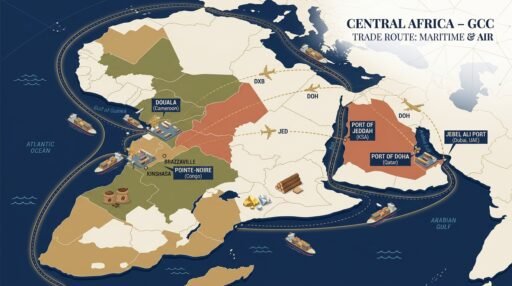
- Lead time: 22–30 days from Port of Douala (Cameroon), Port of Pointe-Noire (Congo), or Port of Matadi (DRC) to Jebel Ali (Dubai) or Port of Doha (Qatar).
- Cost: $1,200–2,000 per 40-ft container (includes fuel surcharges).
- Best for: Bulk shipments of coffee, timber, mineral concentrate, or any product where volume justifies container economics.
- Advantage: Best cost-per-unit for high-volume trade.
- Major carriers: Maersk, MSC (Mediterranean Shipping Company), CMA CGM, ONE (Ocean Network Express).
Sea Freight – Less-Than-Container Load (LCL)
- Lead time: 25–38 days (consolidation adds 2–4 days at origin).
- Cost: $80–150 per cubic meter.
- Best for: Small batches of cocoa nibs, artisanal crafts, test-market shipments, or products that don’t justify a full container.
- Drawback: Longer total transit time due to consolidation; higher per-unit cost.
- Tracking: Use Flexport or carrier-native portals for real-time visibility.
Express Courier (DHL, FedEx, UPS)
- Lead time: 1–3 days to major GCC airports.
- Cost: $8–15 per kg.
- Best for: Sample kits, spare parts, urgent returns, or replacement orders.
- Limitation: Not economical for routine bulk shipments.
- Services: DHL Express, FedEx International, UPS Worldwide.
Free-Zone Consolidation Strategy (UAE-based)
- Ship to Jebel Ali Free Zone (JAFZA) or Dubai Airport Free Zone (DAFZ).
- Store duty-free for up to 5 years; consolidate, relabel, or repackage as needed.
- Issue separate Bills of Lading for each final GCC destination.
- Pay duty and VAT only when goods leave the free zone—not on entry.
- Ideal for multi-country distribution or seasonal storage.
- Warehouse partners: DryPorts, Agility, Aramex.
Leveraging GCC Free Zones—Defer Duty, Control Costs

If you’re shipping to multiple GCC countries or need flexibility, a free-zone play can save 5–15% on total landed cost:
File a Temporary-Import Declaration
- Submit before cargo enters the free zone (zero UAE duty).
- Allows re-export or domestic clearance later without penalty.
Use Bonded Warehousing
- Cold-chain storage for fresh produce, dairy, and perishables (up to 5 years).
- Climate-controlled storage for timber seasoning or cosmetics curing.
- Pay only the monthly storage fee; no duty until goods leave.
- Service providers: Al Furqan Shipping (Jebel Ali Free Zone), Agility, DryPorts, Aramex.
Add Value in the Zone
- Apply Arabic labeling to meet final-market requirements.
- Kit products into smaller consumer packs (coffee bags, honey jars, cosmetic sets).
- Combine shipments from multiple origins into a single branded collection.
Issue New Bills of Lading for Each Destination
- Once goods are ready for final-country distribution, issue a new B/L or AWB.
- Pay duty and VAT only at the final country’s customs point.
- Significantly reduces the effective tax burden when serving 2+ GCC markets.
When it makes sense:
- Multi-country distribution (e.g., 30% to UAE, 40% to Saudi, 30% to Kuwait).
- Seasonal products needing storage between harvest and peak demand.
- Test-market shipments where you want to delay duty payment until demand is proven.
Cost-Control Tactics for Tight Margins
Freight, duty, and VAT can easily eat 25–40% of your margin. Here’s how to squeeze costs without sacrificing speed or compliance:
Consolidate Shipments
- Combine inventory from multiple farms, mines, or suppliers into a single FCL.
- Per-kg freight cost drops by 40–50% compared to LCL.
- Plan 6–8 weeks ahead to allow time for collection and quality checks.
Negotiate Fuel-Surcharge Caps
- Most forwarders add 12–15% fuel surcharges on top of base freight.
- Lock in a cap at the time of booking (e.g., “not to exceed 12%”).
- Protects you against sudden oil-price spikes mid-transit.
Utilize Free-Zone Storage
- Avoid paying UAE duty on every pallet distributed across the GCC.
- Store in JAFZA; duty is incurred only when goods leave the zone.
- Saves 5% per unit when serving 3+ GCC countries.
Insure Cargo at the Right Level
- Standard all-risk coverage: 0.5–0.8% of declared value.
- For high-value minerals or timber, insure for 110% of declared value (covers packaging loss).
- A $50K shipment damaged in transit with under-insurance = catastrophic loss.
Validate HS Code & CO Eligibility Early
- Wrong HS code = unexpected 5% duty or even customs investigations.
- Check the GCC tariff schedule 4–6 weeks before export.
- Confirm CO eligibility for GSP or bilateral MoU benefits.
Pre-Pay VAT for DDP Shipments
- Use a local forwarder’s VAT-pay service or a tax agent in the destination country.
- Keeps customs clearance smooth; avoids cargo detention for unpaid VAT.
- Typically costs 0.5–1% but saves delay penalties.
Optimize Box Dimensions
- Dimensional-weight pricing can inflate costs by 20–30% for lightweight, bulky goods (e.g., cosmetics, coffee).
- Use a dimensional-weight calculator; maximize pallet density.
- Compact packaging = lower freight, faster handling.
Step-by-Step SMB Import Playbook
Here’s how to move from idea to first successful shipment:
- Conduct market research. Confirm demand in your target GCC country, identify buyer preferences, agree on payment terms and preferred Incoterm.
- Classify your product. Determine the correct 6-digit HS code; cross-check whether GSP or bilateral MoU duty reductions apply.
- Choose an Incoterm. Most SMBs start with DAP for balanced control and cost-sharing.
- Select a freight forwarder. Must have Central African ports experience, free-zone capability, and integration with GCC customs portals. Interview at least two. Look for firms with established African-GCC corridor networks and direct relationships with port authorities in Douala, Pointe-Noire, Matadi, etc. Example: Al Furqan Shipping & Logistics (Sharjah-based, NVOCC-licensed, operates direct LCL/FCL from West & Central Africa to all GCC ports, with dedicated free-zone warehousing in Jebel Ali).
- Obtain all required certificates. CO (from your national chamber), Halal (Arabic-stamped), GSO Conformity (processed foods/cosmetics), phytosanitary (fresh produce), import licence (if regulated).
- Prepare export documents. Commercial invoice, packing list, insurance certificate, CO, product certificates. Ensure Arabic translations for food and cosmetics.
- Book the shipment. Air for urgent deliveries; sea FCL/LCL for bulk. Lock in fuel-surcharge caps and all-risk insurance before booking.
- (Optional) Transfer to a GCC free zone. File a temporary-import declaration before unloading at Dubai/Jebel Ali. Move cargo to bonded storage.
- Submit customs papers. Upload all documents to the destination country’s e-Customs portal 24–48 hours before vessel/flight arrival.
- Settle duty and VAT. Pay the 5% (or reduced rate) duty plus applicable VAT. Use a local tax agent if needed for DDP terms.
- Arrange last-mile delivery. Engage a reputable 3PL for door-to-door service or direct warehouse drop-off.
- Capture landed cost. Record all freight, duty, VAT, insurance, and handling fees. Calculate true margin per SKU.
- Review performance. Track lead time, identify document gaps, note cost variances. Refine your SOP before scaling to the next shipment.
Practical Stories—Lessons from the Field
Nothing beats learning from real importers who’ve already made the trip from Central Africa to the GCC. Here are five case studies that show how to navigate common challenges:
Story 1: Cameroonian Specialty Coffee to the UAE via Free Zone

Company: Bamenda Roast Co. (Cameroon)
Product: 10 tonnes of high-altitude Arabica beans (premium roast)
Route: Sea LCL from Douala → Dubai Port → JAFZA (28 days total)
Incoterm: FCA—buyer handled export; seller paid freight and insurance to the free zone; buyer cleared final GCC customs.
Challenge: UAE customs required a GCC Conformity Certificate for processed coffee (roasted beans) and an Arabic-stamped Halal certificate despite the product being plant-based.
Solution: Partnered with a Dubai-based lab for rapid GSO testing. Obtained a Saudi-issued Halal certificate for specialty coffee. Uploaded all documents to the UAE e-gate 48 hours before vessel arrival.
Result: Shipment cleared in 48 hours with zero delays. No duty was applied (classified under a duty-free processed coffee annex). The UAE distributor secured supply contracts with three luxury hotels for a Ramadan launch, leading to a repeat order for the next year.
Key takeaway: Even plant-based goods need Halal certification in Arabic. Plan for certificate procurement 4–6 weeks before shipment.
Story 2: DRC Copper Concentrate to Saudi Arabia for Renewable Energy

Company: Kivu Minerals Ltd. (Eastern DRC)
Product: 15 tonnes of copper concentrate (for solar-panel wiring and renewable projects)
Route: Sea FCL from Matadi → Dubai → Port of Jeddah (30 days)
Incoterm: DDP—the Saudi EPC contractor required a fixed door-to-door price with no surprise costs.
Challenge: Saudi Arabia classifies copper concentrate as a dual-use mineral and demanded an import licence plus a GCC Conformity Certificate. Without these, the shipment would have been seized.
Solution: Secured a Saudi Ministry of Industry and Mineral Resources licence well in advance. Engaged SGS Saudi Arabia for a GSO safety test. Attached the CO and licence to the customs filing.
Result: Cleared customs in 2 days with 0% duty under GSP rules (given the renewable energy application). The project stayed on schedule, and the contractor placed a repeat order for the following year worth $200K+.
Key takeaway: Dual-use minerals require early ministry engagement. Don’t wait for cargo to arrive before securing licences.
Story 3: Gabonese Sustainable Mahogany to Qatar’s Luxury Furniture Market
Company: Libreville Woodworks (Gabon)
Product: 3 × 40-ft containers of FSC-certified mahogany lumber
Route: Sea FCL from Port-Gentil → Jebel Ali → Port of Doha (27 days)
Incoterm: DAP—the Qatari buyer handled final customs and logistics.
Challenge: Qatar’s customs required proof of legal and sustainable sourcing (FSC certificate) plus a Gulf Standardisation Organisation (GSO) Conformity Certificate for timber products. Failure to provide these results in container seizure.
Solution: Provided the FSC certificate from the exporting chamber. Obtained a Gulf Trade Compliance (GTC) timber declaration from Gabon’s trade authority. Secured the GSO certificate through a UAE-based testing lab (expedited in 2 weeks).
Result: No customs holds. Duty applied at the standard 5% (mahogany not eligible for GSP). Landed cost remained within budget. The Qatari showroom reported a 30% sales increase during the Gulf Art Fair, and the importer placed a follow-on order for the next year.
Key takeaway: Sustainability certification (FSC, organic, etc.) is now standard for timber and agricultural goods. Budget 4–6 weeks for sourcing and testing.
Story 4: Tanzanian Halal Goat Cheese to Kuwait
Company: LakeVictoria Dairy (Tanzania)—often grouped with Central Africa in trade statistics
Product: 1 tonne of fresh goat cheese (already Halal-certified)
Route: Air freight (direct) – 3 days from Kotoka International Airport (Accra) to Kuwait International
Incoterm: FCA—buyer cleared export; seller paid freight and insurance; buyer paid duty and VAT.
Challenge: Kuwait required a Halal processing statement for animal-derived products, in addition to the existing Halal certificate. This is a separate compliance document from the Halal stamp.
Solution: Obtained a Kuwait Ministry of Health Halal processing declaration from a local certifier in Kuwait. Attached it to the commercial invoice and customs filing.
Result: Cheese cleared within 24 hours. Duty at 5%, VAT at 15%. The boutique restaurant chain in Kuwait launched a new spring menu featuring the cheese and placed a repeat order for the next season, growing into a 5-tonne annual contract.
Key takeaway: Different GCC countries sometimes have different Halal requirements beyond the certificate. Check with the destination country’s ministry before shipping animal products.
Story 5: Burundi Honey to Bahrain’s Premium Desserts

Company: Kigali Sweet Harvest (Burundi)
Product: 500 kg of raw organic honey (unfiltered)
Route: Sea LCL from Dar es Salaam → Dubai → Bahrain (33 days total, including trans-shipment)
Incoterm: DAP—the Bahraini buyer cleared customs.
Challenge: Bahrain’s customs flagged the honey as a processed food (due to the “organic” claim on the label) and requested both a GSO Conformity Certificate and a Halal certification.
Solution: Secured an expedited GSO certificate through a Bahrain-based testing lab (8 business days). Paired it with a Saudi-issued Halal certificate. Added an Arabic ingredient list on the product label to meet labeling requirements.
Result: No delays. Duty applied at 0% (raw honey is duty-free under the GCC tariff schedule). VAT at 5%. The Bahraini patisserie reported a 25% sales boost during Ramadan using honey-infused desserts. This grew into a standing order of 50 kg/month.
Key takeaway: “Raw” and “organic” claims trigger food-safety certification requirements. Budget for GSO testing even for simple products like honey.
Common Pitfalls & Quick Fixes
Avoid these costly mistakes:
Wrong HS Code
- Problem: Higher duty assessment and possible customs inspection.
- Fix: Cross-check the HS code on the GCC tariff schedule at least 4–6 weeks before export. Engage your forwarder to confirm the classification.
Missing Certificate of Origin
- Problem: Loss of GSP or bilateral MoU duty benefits (5% vs. 0%).
- Fix: Request the CO from your national chamber at least 2 weeks before shipment. Keep copies for your records.
Halal Certificate in English Only
- Problem: Customs hold in UAE, Saudi Arabia, Bahrain. Cargo sits for days waiting for clarification.
- Fix: Obtain an Arabic-stamped Halal certificate and attach it to the invoice. English version is secondary.
Over-Packing (Dimensional Weight)
- Problem: Lightweight, bulky goods (cosmetics, coffee, textiles) trigger dimensional weight pricing, adding 20–30% to freight costs.
- Fix: Use a dimensional-weight calculator before booking. Maximize pallet density and minimize air gaps in packaging.
Under-Insuring High-Value Raw Materials
- Problem: Copper concentrate, mahogany, or minerals damaged in transit = catastrophic loss if insurance is insufficient.
- Fix: Insure for 110% of declared value (covers packaging and handling loss). High-value goods justify the extra 0.3–0.5% premium.
Late VAT Payment Under DDP
- Problem: Cargo detention at the destination port; demurrage fees accumulate rapidly.
- Fix: Use a forwarder’s VAT-pay service or pre-pay through a local tax agent in the destination country. This ensures smooth clearance.
Free-Zone Import Without Temporary-Import Filing
- Problem: Duty is still charged even though goods are in a “free zone.”
- Fix: File a temporary import for re-export declaration before unloading cargo. This exempts the goods from UAE duty.
Ignoring Buyer’s Preferred Incoterm
- Problem: Disputes over cost responsibility; buyer and seller interpret the contract differently.
- Fix: Agree on the Incoterm in the sales contract. Confirm acceptance in writing before quoting. Use INCOTERMS 2020 definitions.
Skipping Arabic Labeling for Consumer Goods
- Problem: Clearance delays; retailer rejection if labels don’t meet local requirements.
- Fix: Prepare bilingual (English/Arabic) labeling for every product destined for end-consumer sale. Nutrition facts, ingredients, and warnings must be in Arabic.
Failing to Account for Seasonal Customs Surcharges
- Problem: Unexpected handling and documentation fees during Ramadan and Hajj peaks.
- Fix: Plan shipments 6–8 weeks ahead of major Gulf holidays. Avoid booking during the last week of Ramadan or the Hajj season (typically July–August and mid-June to mid-August).
Frequently Asked Questions
Q: Do I need a locally incorporated company in every GCC country to import Central African goods?
A: No. A forwarder can act as the importer of record under DDP or DAP terms, handling customs clearance on your behalf. This is the standard setup for first-time importers. Once you establish recurring shipments, you may want to set up a local entity for tax efficiency and direct buyer relationships.
Q: How do I claim the GCC GSP duty reduction for Central African products?
A: Provide a Certificate of Origin from an authorized national chamber that proves the product meets GSP origin rules (typically 35–40% regional value-addition or natural resource extraction). Submit it together with the commercial invoice and any required product certificates. GCC customs will apply the preferential rate automatically if the CO is valid.
Q: Is a GCC Conformity Certificate required for all food items?
A: No. Raw agricultural products (green coffee beans, fresh cocoa, raw honey, unroasted nuts) can enter duty-free without a GSO certificate. However, any processed food—roasted coffee, cocoa powder, jams, cheese, spice blends—must have a GSO Conformity Certificate. When in doubt, treat the product as processed and budget for the certificate.
Q: What is the typical customs duty on Cameroonian cocoa entering the UAE?
A: 0% if the cocoa is classified as raw cocoa beans (HS 1801) and a valid CO is presented under the GSP. If processed (cocoa powder, cocoa nibs with added ingredients), a 5% duty applies unless a specific GSO waiver is granted. Always confirm the HS code classification with your forwarder.
Q: Which shipping mode gives the best cost-to-speed ratio for high-value shea-butter cosmetics?
A: Air freight for shipments ≤ 500 kg – 3–5 days with relatively low per-kg cost ($4–6/kg) and minimal risk of product degradation. For larger quantities (500 kg – 5 tonnes), sea LCL + short-term free-zone storage provides the best balance of cost and speed. For 5+ tonnes, commit to sea FCL (locked rates, lower per-unit cost).
Q: Can I store perishable produce (e.g., fresh mangoes) in a UAE free zone before distribution across the GCC?
A: Yes. Select a free zone with cold-chain warehousing (Dubai Airport Free Zone, JAFZA Cold Storage). File a temporary-import for re-export declaration. Pay only the storage and handling fee; duty and VAT are paid when the fruit leaves the free zone for its final GCC destination. This strategy works best for seasonal products with staggered demand across multiple countries.
Q: Do I need separate import licences for each GCC country when shipping the same product?
A: Generally no. A single GCC-wide import licence (e.g., for pharmaceuticals or dual-use minerals) may be accepted across all member states. However, you must present the licence to each customs authority that processes your shipment. Always confirm acceptance with the destination country’s ministry before committing to the shipment.
Q: What is the standard transit time for sea freight from Douala (Cameroon) to Jebel Ali (UAE)?
A: 25–30 days for direct FCL sailings on the regular West Africa–Middle East service. Add 2–4 days if routed through a hub (Singapore, Rotterdam, or Suez). Seasonal delays occur during peak summer loading periods (June–August). Always book 4–6 weeks in advance for guaranteed space.
Q: How can I track a sea LCL shipment from Pointe-Noire (Congo) to Doha?
A: Use the Bill of Lading number on the carrier’s tracking portal (Maersk, MSC, CMA CGM, etc.). For more sophisticated tracking, integrate with a Transportation Management System (TMS) such as Flexport, Fourkites, or a forwarder’s proprietary platform. Most offer automatic status updates and milestone alerts (cargo consolidated, departed origin, arrived at transhipment hub, departed for GCC, arrived at destination).
Q: Are there any restrictions on importing Central African timber to Saudi Arabia?
A: Yes. Saudi Arabia requires proof of legal and sustainable sourcing (FSC certificate or equivalent) and a GSO Conformity Certificate for timber. Failure to provide these results in seizure and potential fines. The Saudi Ministry of Environment also may require a sustainable forestry declaration for high-value hardwoods. Budget 6–8 weeks for securing all documentation.
Q: What is the best way to handle returns from GCC customers?
A: Set up a Return Merchandise Authorization (RMA) process with a local 3PL in the destination country. Ship returns back under a reverse-DDP arrangement so the forwarder can manage insurance, customs re-entry, and final disposition (resale, repair, or disposal). This prevents disputes and keeps the return channel organized for future orders.
Next Steps for First-Time Central African Exporters to the GCC
Ready to make your first shipment? Here’s your action plan:
- Pick a pilot product with verified GCC demand (specialty coffee, shea butter, cocoa, premium honey).
- Validate HS code and CO eligibility to confirm any GSP or bilateral MoU duty reduction.
- Request freight quotes from at least two forwarders covering air, sea FCL/LCL, and free-zone options. Compare all-in costs, not just headline rates. (Al Furqan Shipping offers free cost estimates and route planning consultations for Central Africa–GCC shipments.)
- Assemble all required documents (commercial invoice, packing list, Certificate of Origin, Halal, GSO, phytosanitary certificates, insurance).
- Book the shipment. Lock in fuel-surcharge caps and purchase all-risk insurance before cargo is loaded.
- (Optional) Transfer to a GCC free zone. File a temporary-import declaration before unloading. Move to bonded storage if multi-country distribution is planned.
- Submit customs papers via the destination country’s portal 24–48 hours before arrival.
- Engage a reputable local 3PL for last-mile delivery to the buyer’s warehouse.
- Record landed cost and compare with projected margins. Capture any delays or document gaps for SOP refinement.
- Review and iterate. After the first shipment clears successfully, refine your process and plan the second shipment with confidence.
Ready to execute? Contact Al Furqan Shipping for a free logistics assessment, or enroll in Spot On Institute training to build your team’s import expertise.

Final Thought
The Central Africa–GCC corridor is no longer fringe trade. It’s becoming a strategic priority for importers, distributors, and retailers looking to diversify supply, access sustainable products, and tap into growing demand for artisanal and naturally sourced goods.
The logistics are straightforward once you know the playbook. The customs rules are predictable. The free zones give you flexibility. And the GSP and bilateral incentives make the economics work.
Start small, document everything, and build the relationships that turn one successful shipment into a recurring partnership. That’s how importers in this corridor succeed.
#Import #CentralAfricaToGCC #SMB #Freight #Customs #FreeZone #TradeTips #BusinessGrowth #Entrepreneur #StartUp #SupplyChain #Logistics #GCCMarket
About the Author
This guide is authored by Arshad Azhar, Director of Logistics & Freight Forwarding at Al Furqan Shipping & Logistics Services LLC (Sharjah, UAE), with 23+ years of GCC multimodal freight and supply chain management experience. Arshad holds an MSc in Supply Chain Management (University of Bolton) and a Lean Six Sigma Master Black Belt certification. He has published two books on logistics and supply chain optimization.
Al Furqan Shipping is a licensed NVOCC (Non-Vessel Operating Common Carrier) and customs brokerage firm specializing in:
- Central Africa–GCC corridor (LCL/FCL consolidation from Douala, Pointe-Noire, Matadi to all GCC ports)
- Free-zone warehousing & consolidation (Jebel Ali Free Zone, Dubai Airport Free Zone, Qatar Free Zones)
- Customs compliance & documentation (electronic filing, GSO certificates, Halal coordination)
- Last-mile logistics (3PL partnerships across UAE, Saudi Arabia, Kuwait, Qatar, Oman, Bahrain)
Services offered:
- FCL/LCL booking and consolidation
- Customs clearance and brokerage
- Bonded warehousing and free-zone management
- Certificate of Origin coordination and GSP optimization
- Import license facilitation
- Real-time cargo tracking and TMS integration
Additional Resources
For importers seeking training & mentorship:
- Spot On Training Institute offers professional development courses in import-export, supply chain management, and halal logistics compliance for GCC SMEs and entrepreneurs.
- Courses include: “Central Africa–GCC Trade Fundamentals,” “Customs Compliance Masterclass,” “Free-Zone Strategy & Cost Optimization,” and “Lean Supply Chain for SMBs.”
For SMEs seeking digital transformation & logistics automation:
- DigitalCraft provides AI-powered consulting, no-code automation systems, and digital supply-chain tooling for GCC-based businesses.
- Specialties: freight management automation, customs document generation, inventory dashboards, supplier management systems, and AI-driven cost analytics.
Get Started Today
Have a Central African product you want to import to the GCC?
- For freight forwarding & logistics: Contact Al Furqan Shipping – request a free cost estimate for your route and product category.
- For customs & compliance guidance: Book a 30-minute consultation to validate your HS code, CO eligibility, and certificate requirements.
- For training & team upskilling: Enroll in Spot On Institute courses or arrange in-house training for your team.
- For supply-chain digitalization: Explore Digital Craft automation solutions to streamline your import operations.
Questions? Reach out directly or comment below—I read every message and respond within 24 hours.