
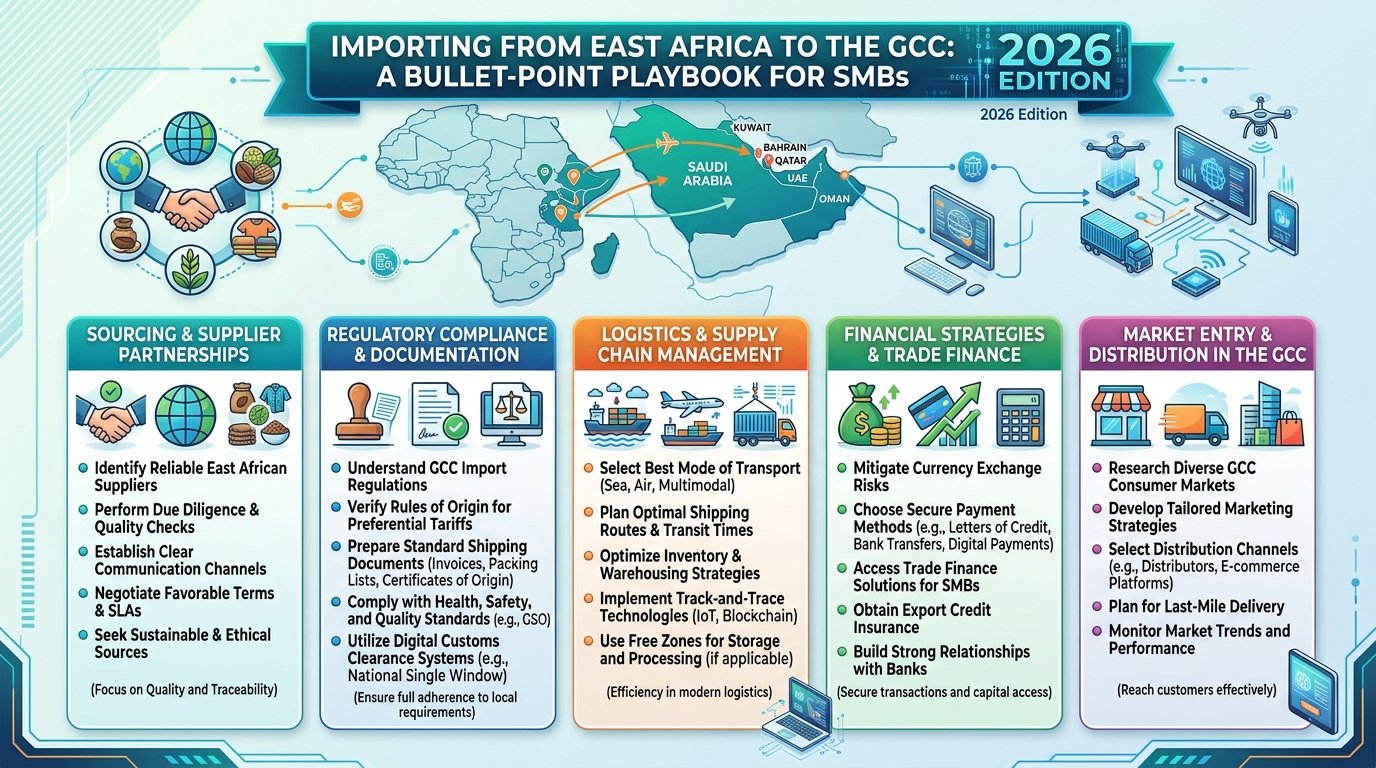
Importing from East Africa to the GCC: A Bullet-Point Playbook for SMBs
Quick Answer: You can import high-margin products like Kenyan coffee, Tanzanian avocados, and Ethiopian shea butter directly to the GCC customs region using sea or air freight forwarding, claiming duty reductions via the GCC-EAC MoU, and strategically using free zones like Jebel Ali to minimize costs. This guide covers the complete import procedures, commodity classification, Incoterms, and real-world success stories from SMBs already scaling across the Gulf.
Importing from East Africa to the GCC — Complete Bullet-Point Playbook
Why East Africa is Your Next Import Opportunity
• Growing “Made in East Africa” brand appeal for natural, organic, and artisanal products reaching GCC premium markets • Competitive production costs in Kenya, Tanzania, Ethiopia, Uganda, and Rwanda compared with Asian factories — 15–25% lower landed costs • Favorable climate for high-value cash crops (coffee beans, tea, fresh fruit) and seafood that complement GCC food-service and retail sectors • Bilateral MoUs between the GCC and East African Community (EAC) that streamline customs documentation and provide limited duty reductions for selected agricultural and processed-food items • Direct maritime routes from Mombasa and Dar es Salaam to GCC ports (Jebel Ali, Doha, Dammam) — no hub-routing needed • Cultural alignment — East African products (especially Halal-certified goods) resonate with Gulf consumers seeking authenticity • First-mover advantage — many SMBs still source exclusively from Asia; East Africa is underexploited for competitive differentiation
Top Product Categories That Generate High Margins in the Gulf
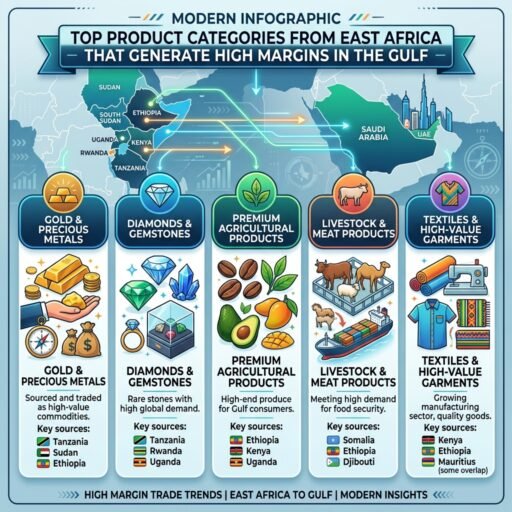
• Kenya — Premium Arabica coffee, macadamia nuts, leather goods, tea blends, horticultural flowers (highest demand in Saudi Arabia and UAE)
• Tanzania — Avocados, mangoes, cashew nuts, sisal products, minerals for niche luxury markets (rubies, tanzanite)
• Ethiopia — Coffee, shea-butter cosmetics, spices (berbere blends), textiles (hand-woven fabrics), leather shoes
• Uganda — Fresh fish (tilapia), beans, plantains, natural honey, herbal extracts (premium positioning for boutique wellness brands)
• Rwanda — Coffee, tea, specialty mushrooms, eco-friendly timber (sustainably sourced), high-tech agricultural equipment
• Why these products? — Low spoilage risk, high GCC retail markups (200–400%), growing demand for organic/fair-trade positioning, and preferential duty rates when accompanied by a valid Certificate of Origin
GCC Customs Fundamentals — Uniform Across All Six Member States
• Standard customs duty rate = 5% of CIF value for most finished goods (many agricultural products are duty-free under bilateral agreements)
• VAT/GST rates applied on (CIF + duty):
- 5% in UAE, Qatar, Oman, Bahrain
- 15% in Saudi Arabia and Kuwait
• Import licences required for pharmaceuticals, certain chemicals, dual-use items, and hormone-treated animal products (consult destination country’s ministry before shipment)
• Halal certification mandatory for all food, beverage, and many personal-care items — must be Arabic-stamped and issued by a GCC-approved certifying body (Saudi Halal Certification is most recognised across the Gulf)
• GSO (GCC Standardization Organization) Conformity Certificates required for electronics, toys, medical devices, and certain cosmetics — verify product category before booking
• Phytosanitary certificates required for all plant-based material (fresh fruit, coffee cherries, spices, timber) entering the GCC
• All customs filings done through each country’s electronic single-window portal:
- UAE: Mirsal eGate
- Saudi Arabia: GAZT Customs Portal
- Qatar, Oman, Bahrain: country-specific portals accessible via their revenue/customs authorities
• Processing time — typically 24–48 hours if all documents are complete and no inspection is triggered
Key Preferential Trade Instruments for East-African Exporters
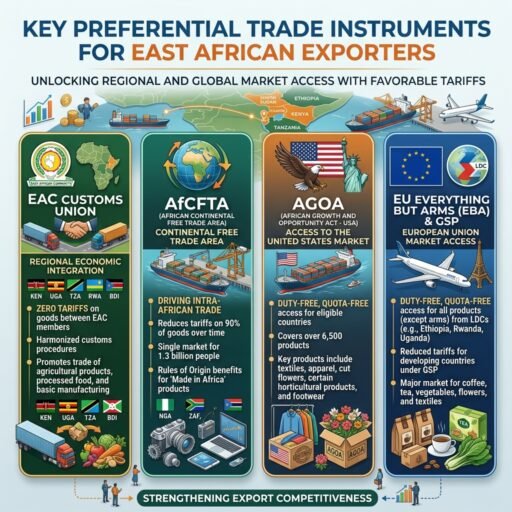
• GCC-EAC MoU (2020) — Provides simplified customs clearance and limited duty reduction for specific agricultural commodities (coffee, tea, cashews) when a valid Certificate of Origin is presented
- Implementation: GCC Secretariat General coordinates with member states
- Duty reduction: 0–50% depending on product category
- Requirement: CO from East African national chamber + Arabic translation
• UAE-Kenya Strategic Partnership (2023) — Enables duty-free treatment for Kenyan coffee and tea under bilateral annex
- Requirement: Certificate of Origin + Halal certification for processed items
- Reference: UAE Ministry of Economy
• Saudi Arabia-Ethiopia Agricultural Cooperation Agreement (2022) — Grants reduced duty (0–2%) on Ethiopian coffee and shea-butter products when accompanied by CO and phytosanitary certificates
- Verified through Saudi Ministry of Environment, Water and Agriculture (MEWA)
• AfCFTA (African Continental Free Trade Area) Origin Rules — Helpful for demonstrating “regional value-addition” if your product originates from multiple East-African countries
- Reference: African Union AfCFTA Portal
• Bottom line for SMBs: Always request a CO from the East African exporter’s national chamber — it is the single most powerful document for duty reduction and rapid customs clearance
Core Import Documentation Checklist — What You Absolutely Need
• Commercial invoice — English required; Arabic version often required for food & cosmetics
• Packing list — weight, dimensions, SKU per box/pallet; must match bill of lading exactly
• Bill of Lading (B/L) — sea freight — full container/vessel details; original B/L required for customs release
• Air Waybill (AWB) — air freight — 11-digit tracking number; used for customs filing and cargo release
• Certificate of Origin (CO) — issued by the relevant East-African national chamber:
- Kenya National Chamber of Commerce
- Tanzania Chamber of Commerce
- Ethiopian Chamber of Commerce
- Uganda National Chamber of Commerce
- Rwanda Chamber of Commerce
• Halal certificate — required for all food, beverage, and cosmetics:
- Issued by Saudi, UAE, or internationally recognised bodies (Islamic Food and Nutrition Council)
- Must be Arabic-stamped; translated into English for import documentation
• Phytosanitary certificate — for fresh fruit, coffee cherries, spices, and plant-based material:
- Issued by the exporting country’s agricultural authority (e.g., Kenya Plant and Animal Inspection Service)
- Mandatory for entry into Saudi Arabia, UAE, Qatar, Oman, Bahrain, Kuwait
• GSO Conformity Certificate — for processed foods, cosmetics, electronics, toys, medical devices:
- Issued by accredited testing labs (SGS, QIMA, TÜV SÜD)
- Verified via the GCC Standardization Organization
• Import licence — if product falls under pharmaceuticals, agro-chemicals, dual-use technology:
- Apply through the destination country’s regulatory ministry at least 4–6 weeks before shipment
• Cargo insurance certificate — all-risk recommended at 0.5–0.8% of declared value (covers loss, damage, theft during transit)
• Electronic customs declaration — submitted via the destination GCC country’s single-window portal with all supporting documents uploaded as PDFs
• Pro tip for SMBs: Use a reputable freight forwarder with GCC integration (like Al Furqan Shipping & Logistics) to manage document compilation and customs filing — this eliminates 90% of delays
Incoterms — Quick Reference for SMBs (What You Need to Know)
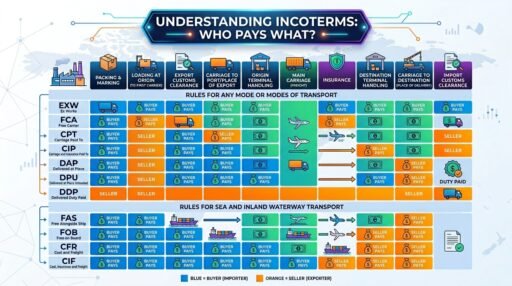
• EXW (Ex Works) — buyer assumes all export and import costs after goods leave the farm/warehouse
- Risk to seller: HIGH (your responsibility ends at the farm gate)
- Best for: established distributors with deep supply chain experience
- Not recommended for first-time importers
• FCA (Free Carrier) — seller delivers to a carrier chosen by the buyer; buyer handles export clearance, freight, and import formalities
- Risk to seller: MEDIUM (your responsibility ends when cargo is handed to the forwarder)
- Best for: SMBs wanting to minimize liability
- Cost to importer: highest (they arrange everything)
• CIF (Cost, Insurance, Freight) — seller pays freight + insurance to GCC port; buyer clears customs and pays duty/VAT
- Risk to seller: LOW (seller covers all transit risks)
- Best for: low-value bulk shipments (coffee, nuts, spices)
- Commonly used in East Africa–Gulf trade
• DAP (Delivered At Place) — seller pays freight to a named place in the GCC; buyer clears customs, pays duty & VAT, and unloads the goods
- Risk to seller: LOW (transparent, balanced control)
- Best for: SMBs wanting clear cost allocation
- Most balanced choice for first-time importers
• DDP (Delivered Duty Paid) — seller covers freight, duty, VAT, insurance, and final delivery
- Risk to seller: HIGHEST (you own the import process end-to-end)
- Best for: high-margin, time-critical shipments
- Cost to importer: highest upfront, but most convenient
• Recommendation: Start with DAP for balanced control; move to DDP once you have customs experience and want to lock in transparent pricing for your buyer
Shipping Mode Options — Speed vs. Cost Trade-Off

• Air freight — 2–5 days transit time
- Best for: high-value, perishable, or time-critical items (coffee beans, fresh fruit, cosmetics)
- Cost: $3–8 per kg (expensive but fast)
- Risk: LOW (less time in transit = less spoilage/damage)
- Airline options: Ethiopian Airlines Cargo, Kenya Airways Cargo, Qatar Airways Cargo
• Sea freight – Full Container Load (FCL) — 22–30 days from Mombasa/Dar es Salaam to Jebel Ali/Doha
- Best for: bulk coffee, tea, nuts, timber, livestock feed
- Cost: $1.2–2.5 per kg for containers ≥20t (very economical)
- Risk: MEDIUM (longer transit = higher spoilage risk for perishables)
- Carriers: Maersk, MSC, CMA CGM, ONE (Ocean Network Express)
• Sea freight – Less-Than-Container Load (LCL) — 25–38 days; useful for small batches
- Best for: specialty nuts, artisanal jewelry, test-market shipments
- Cost: $2–4 per kg (more expensive than FCL per unit, but no minimum volume)
- Risk: MEDIUM (shared container = more handling = higher damage risk)
- Consolidators: Flexport, regional freight forwarders with GCC experience
• Express courier (DHL, FedEx, UPS) — 1–3 days to major GCC airports
- Best for: sample kits, spare parts, urgent returns
- Cost: $8–15 per kg (most expensive)
- Risk: LOW (high handling standards)
- Most useful for time-sensitive import corrections, not bulk trade
• Free-zone consolidation (UAE) — ship to Jebel Ali or Dubai Airport Free Zone, store duty-free, then split into country-specific LCL loads before final customs clearance
- Advantage: single logistics hub for all GCC markets; deferred duty payment; re-packaging and Arabic labeling on-site
- Cost: 0.5–1.5% of cargo value for storage and handling (offset by duty savings)
- Best for: SMBs serving multiple GCC countries simultaneously
• Decision framework: Air if shipment < 500 kg and CIF value > $50/kg. Sea FCL if shipment > 10t. Sea LCL + free-zone if 2–10t serving multiple GCC destinations.
Using GCC Free Zones to Defer Duty and Minimize Costs

• What is a free zone? — A bonded area where cargo enters duty-free, can be stored/re-packaged, and duty is only paid when goods physically exit to a GCC customer’s location
• Top free zones for East African importers:
- Jebel Ali Free Zone (JAFZA) — Dubai, UAE (largest, most integrated with regional logistics)
- Dubai Airport Free Zone — for air-shipped perishables requiring cold storage
- Saudi Arabia’s industrial free zones — if targeting Saudi distributors
- Qatar’s Hamad Port — for direct access to Qatari market
• Process:
- File a temporary import for re-export declaration before cargo enters the free zone — no duty paid in the UAE
- Store, re-package, or add Arabic labeling in the bonded facility (up to 5 years in JAFZA)
- Issue new B/L or AWB for each GCC destination; pay duty & VAT only at the final country’s customs point
• Benefits:
- Lower handling costs (consolidate multiple small shipments into one entry)
- Reduced risk of customs delays (single inspection point instead of per-country)
- Single logistics hub for all GCC markets (easier to serve Saudi, Qatar, Oman, Bahrain from Dubai)
- Deferred duty payment (cash-flow advantage for SMBs)
• Cost calculation: Free-zone storage + handling (~0.5–1.5% of cargo value) vs. duty savings (5%+ on high-value goods) = net savings of 3–4.5% for multi-country distributions
Cost-Control Tactics for Tight Margins
• Consolidate shipments from multiple East-African farms into a single FCL container — cuts per-kg freight dramatically ($1.2–2.5/kg vs. $3–8/kg for air)
• Negotiate fuel-surcharge caps (12–15% of base freight) with forwarders to avoid sudden price spikes (fuel surcharges have spiked 40%+ during global shipping disruptions)
• Leverage free-zone storage to avoid paying UAE duty on every pallet — duty is incurred only at the final GCC import point
• Insure cargo at 0.5–0.8% of declared value (all-risk) to protect against loss or damage during long sea legs — cheaper than recovering unsold inventory
• Verify HS code and CO eligibility before booking — prevents unexpected 5% duty or customs delays (misclassification can cost 10–15% of cargo value)
• Pre-pay VAT for DDP shipments via a local tax agent or forwarder’s VAT-pay service — keeps customs clearance smooth and avoids port holds
• Optimise box dimensions using a dimensional-weight calculator — avoids oversize/overweight surcharges ($500–2,000 per FCL container)
• Request volume discounts from freight forwarders — after 3–4 shipments, most will offer 2–5% rate reductions on freight and handling
• Benchmark landed costs across suppliers — a 10–15% variance between East African producers is normal; negotiate hard on FOB price before locking in freight
• Use a 3PL with GCC presence (like Al Furqan Shipping) — they have customs broker relationships that can fast-track clearances (saves 1–2 days of port storage fees = $200–800 per shipment)
Step-by-Step SMB Import Playbook — From Idea to Delivery
• Step 1: Conduct market research — confirm demand, target GCC country, buyer’s payment terms, and preferred Incoterm
- Use LinkedIn, Alibaba, and local GCC distributor networks to validate demand
- Budget: $0–500 (research only)
• Step 2: Classify product — determine the correct 6-digit HS code; check if the item qualifies for any GCC-EAC duty-reduction mechanism (CO-based)
- Use GCC Tariff Schedule or consult a customs broker
- Budget: $100–300 (broker consultation)
• Step 3: Choose Incoterm — most SMBs start with DAP for balanced control
- Confirm with buyer in writing before quoting landed cost
- Budget: $0 (decision only)
• Step 4: Select a freight forwarder — must have East-African origin experience, GCC free-zone capability, and integration with electronic customs portals
- Request quotes from at least 3 forwarders (Flexport, Kaleido Logistics, regional players like Al Furqan)
- Budget: $0 (quotes are free)
• Step 5: Obtain required certificates — CO, Halal (if food/cosmetics), GSO Conformity (electronics/medical), phytosanitary (fresh produce), import licence (if regulated)
- Timeline: 2–4 weeks for CO + Halal certification
- Budget: $400–1,500 depending on product category
• Step 6: Prepare export documentation — commercial invoice, packing list, insurance, CO; ensure Arabic translations where needed
- Work with your freight forwarder to ensure all docs match exactly
- Budget: $200–500 (translation + documentation prep)
• Step 7: Book the shipment — air for urgent, sea FCL/LCL for bulk; lock in fuel-surcharge caps and all-risk insurance
- Book 3–4 weeks in advance for sea freight to avoid peak surcharges
- Budget: freight cost (typically $1,200–8,000 depending on mode and volume)
• Step 8 (Optional): Transfer to a GCC free zone — after arrival at Jebel Ali/Dubai, file a temporary-import declaration and move cargo to bonded storage
- Benefit: deferred duty, ability to re-package and label for multiple GCC destinations
- Budget: $300–800 (storage + handling for 30 days)
• Step 9: Final GCC customs clearance — upload all docs via the destination country’s portal; pay 5% duty (or reduced) + VAT
- Processing time: 24–48 hours if docs are complete
- Budget: duty + VAT (typically 8–20% of CIF value)
• Step 10: Arrange last-mile delivery — engage a local 3PL for door-to-door service or direct drop-off at the buyer’s warehouse
- Cost: $300–1,500 depending on destination and volume
- Budget: $300–1,500
• Step 11: Capture landed cost — sum freight, duty, VAT, insurance, and any free-zone storage fees; calculate true margin per SKU
- Use a spreadsheet or TMS (Transportation Management System) to track all costs
- Budget: $0–200 (software if needed)
• Step 12: Review performance — track lead time, document gaps, and cost variances; refine SOP before scaling the next shipment
- Identify bottlenecks: customs delays? Port holds? Documentation errors?
- Budget: $0 (internal review)
• Total first-shipment cost estimate: $3,500–15,000 depending on Incoterm, freight mode, and certificate requirements (not including product cost or duty/VAT)
Practical Stories — Real SMBs Succeeding with East Africa–GCC Trade
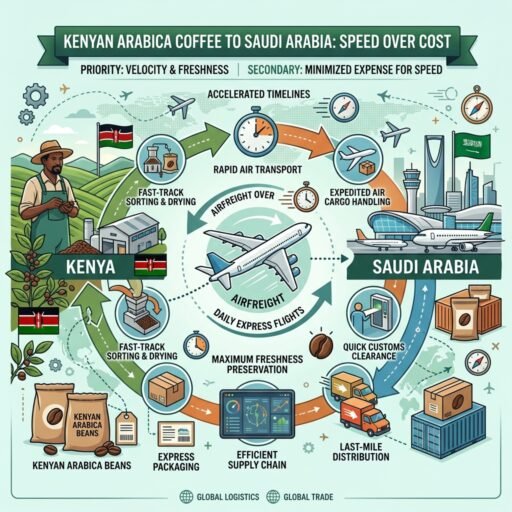
Story 1: Kenyan Arabica Coffee to Saudi Arabia — Speed Over Cost
• Company: Nairobi Coffee Co. (Nairobi, Kenya)
• Product: 12 tonnes of green Arabica beans (premium grade, Fair Trade certified)
• Shipping mode: Air freight (consolidated) — 4 days from Jomo Kenyatta International to King Abdullah Airport
• Incoterm: DAP — Saudi distributor paid duty & VAT
• Challenge: Saudi customs demanded a GCC Conformity Certificate because the beans were to be roasted on-site, classifying them as processed food
• Solution: Obtained a Saudi Ministry of Environment, Water and Agriculture (MEWA) approval for “green coffee beans – duty-free under agro-product annex” and attached the CO and phytosanitary certificate. Also provided a letter from the certifier confirming no processing had occurred in Kenya.
• Result: Beans cleared in 24 hours, no duty applied (classification upheld as raw agricultural product), and the distributor secured a high-margin contract with three luxury hotels in Riyadh. Repeat orders came 6 weeks later.
• Key lesson: Pre-emptive communication with destination customs authority prevents surprises — a single email to MEWA 2 weeks before arrival saved 3 days of port delays.
Story 2: Tanzanian Avocados to the UAE via Free Zone — Efficiency Through Consolidation
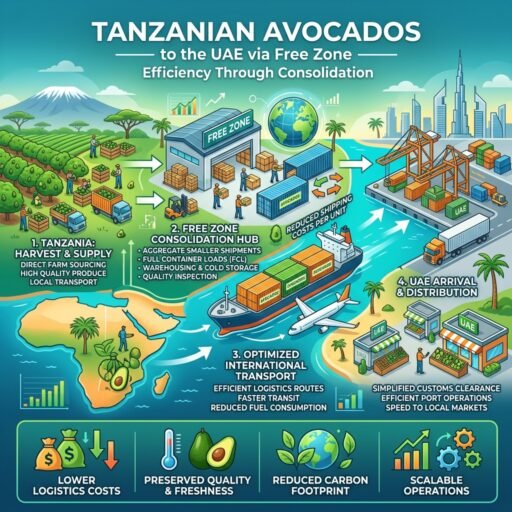
• Company: Tanzania Fresh Exports Ltd. (Dar es Salaam, Tanzania)
• Product: 5 tonnes of Hass avocados (seasonal shipment, May–June harvest)
• Shipping mode: Sea LCL from Mombasa → Dubai Port → Jebel Ali Free Zone (27 days total)
• Incoterm: FCA — buyer handled export clearance; seller paid freight & insurance to free zone; buyer cleared final GCC customs
• Challenge: UAE customs flagged the avocado shipment for missing an Arabic-stamped phytosanitary certificate; the original was only in English
• Solution: Engaged the UAE Ministry of Climate Change & Environment (MOCCAE) to issue an expedited Arabic-stamped phytosanitary certificate; uploaded to the e-gate portal before vessel arrival. Used a local customs broker who had direct MOCCAE relationships to accelerate the request.
• Result: No port hold, avocados entered Dubai’s supermarkets on schedule (critical for perishables with 5–7 day shelf life), and the exporter earned a repeat order for the next season. Free-zone storage allowed the buyer to distribute pallet-by-pallet to retailers across the GCC without paying UAE duty upfront.
• Key lesson: Phytosanitary certificates must be bilingual (English + Arabic) — non-negotiable for GCC entry. Plan for this 4–6 weeks in advance.
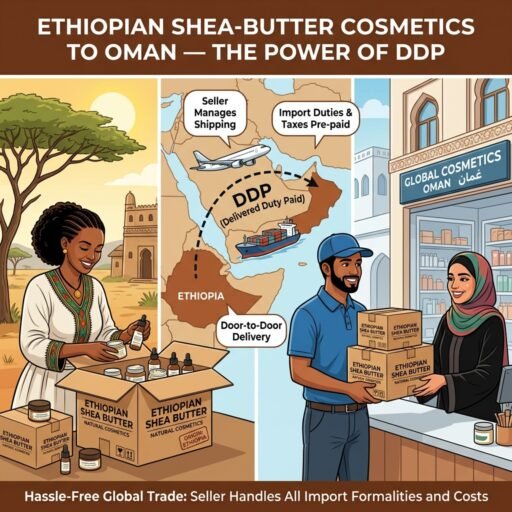
Story 3: Ethiopian Shea-Butter Cosmetics to Oman — The Power of DDP
• Company: Sheabutter Rwanda & Ethiopia (Kigali & Addis Ababa, multinational)
• Product: 2 tonnes of pure shea-butter for premium skincare creams (sold to an Omani boutique brand)
• Shipping mode: Sea FCL (Mombasa → Jebel Ali → Muscat, 31 days)
• Incoterm: DDP — fixed “door-to-door” price required by Omani retailer (who wanted transparent all-in pricing)
• Challenge: Oman’s customs insisted on a GCC Conformity Certificate AND a Halal-certified raw material declaration because the butter would be used in face creams
• Solution: Partnered with a UAE-based lab (SGS) to conduct GSO safety testing (took 2 weeks); secured a Saudi-issued Halal certificate for raw shea butter; added Arabic labeling to the primary packaging. Forwarder pre-paid VAT and duty on the exporter’s behalf, so the cargo cleared without the buyer’s involvement.
• Result: Products cleared within 48 hours, no duty was imposed (shea-butter classified as “raw agricultural product” under Oman‘s duty-free schedule), and the boutique launched a successful Ramadan campaign with the product featured in high-end resorts. DDP pricing was transparent, so the buyer could market the product with confidence. Second order placed 8 weeks later.
• Key lesson: DDP requires upfront capital but builds buyer trust — the boutique knew exactly what the landed cost was and could plan retail pricing with certainty. For premium/luxury positioning, DDP often justifies the extra cost.
Story 4: Ugandan Tilapia Fillets to Bahrain — Niche Aquaculture Success
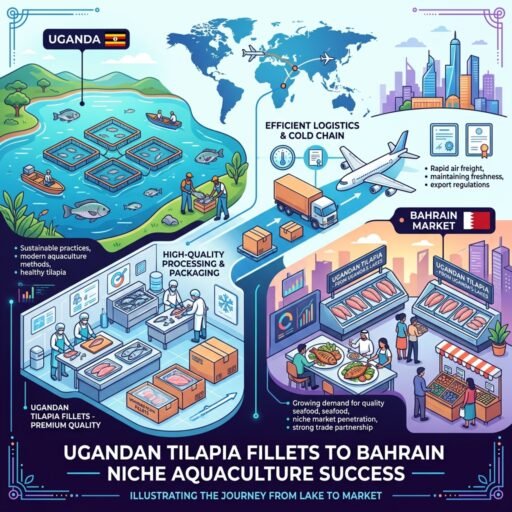
• Company: Nile Fish Processing Ltd. (Kampala, Uganda)
• Product: 1.8 tonnes of frozen tilapia fillets (certified “no-antibiotic”, premium quality)
• Shipping mode: Air freight (direct) — 3 days from Entebbe to Bahrain International Airport
• Incoterm: FCA — buyer cleared export; seller paid freight & insurance; buyer paid duty & VAT
• Challenge: Bahrain’s customs required a Halal-certified processing statement despite the frozen nature of the product (Bahrain’s interpretation: all seafood requires Halal chain-of-custody)
• Solution: Obtained a Bahrain-approved Halal processing certificate from a Ugandan-based accredited body (Islamic Foundation for Ecology and Environmental Sciences); provided Arabic translation; included documentation showing the freezing facility was Halal-certified
• Result: Fillets entered Bahrain‘s premium grocery chains without delay; sales volume exceeded forecast by 20% (demand from health-conscious consumers seeking antibiotic-free protein). Company was approached by a Bahrain distributor for monthly standing orders. Third shipment scaled to 5 tonnes.
• Key lesson: Niche certifications (Halal, antibiotic-free, organic) open premium distribution channels in the GCC — invest in these early to differentiate from bulk commodity competitors.
Story 5: Rwandan Specialty Mushrooms to Qatar — The Free-Zone Advantage
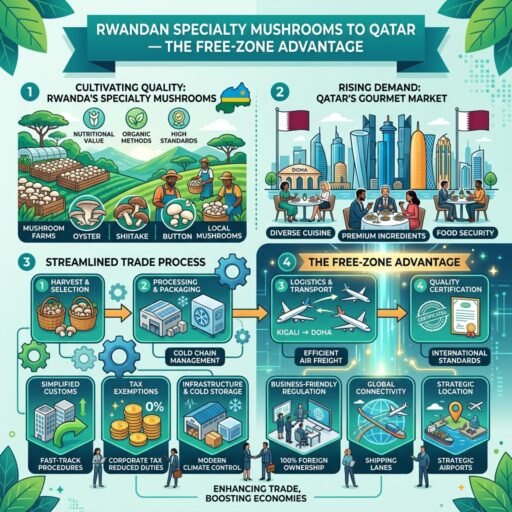
• Company: GreenPeak Agro (Kigali, Rwanda)
• Product: 500 kg of organic oyster mushrooms (value-added, high margin per kg)
• Shipping mode: Sea LCL from Dar es Salaam → Dubai Port → Dubai Airport Free Zone → Qatar (30 days total)
• Incoterm: DAP — Qatari buyer handled final customs
• Challenge: Qatar’s customs demanded a GCC Conformity Certificate for “processed food” and a Halal certificate for edible mushrooms (stricter interpretation than other GCC states)
• Solution: Engaged SGS Qatar for a rapid GSO conformity test (expedited service, 1 week); secured a Saudi-issued Halal certificate for organic mushroom certification; uploaded both to Qatar’s customs portal before arrival. Used Dubai Airport Free Zone storage to add Arabic labeling and repackage for Qatari retail display.
• Result: Mushrooms cleared in 36 hours, no duty applied (classified under duty-free processed food annex for organic certifications), and the Qatari distributor expanded the line to Saudi Arabia after a successful pilot. Free-zone repackaging added a premium Arabic label that boosted retail shelf presence.
• Key lesson: Free zones are not just for cost savings — they’re powerful for last-minute compliance (labeling, Halal statement addition) that can mean the difference between clearance and a port hold.
Common Pitfalls & Quick Fixes — Learn from Others’ Mistakes

• Wrong HS code → higher duty & possible inspection
- Fix: Cross-check on the GCC tariff schedule (www.gso.org.sa) before booking. Consult a customs broker if unsure (costs $100–200 but saves $500–5,000 in unexpected duty)
• Missing Certificate of Origin → loss of duty reduction under GCC-EAC MoU
- Fix: Request CO from the national chamber at least 2 weeks prior to shipment. Get written confirmation from the chamber that the CO qualifies for preferential treatment.
• Halal certificate only in English → customs hold in UAE or Saudi
- Fix: Obtain an Arabic-stamped Halal certification and attach to the commercial invoice. Plan for 4–6 weeks lead time.
• Over-packing (dimensional weight > actual weight) → extra freight surcharges
- Fix: Use a dimensional-weight calculator and maximise container palletisation. For 10t shipments, efficient packing can save $500–1,500 in surcharges.
• Under-insuring high-value raw materials (e.g., shea-butter, specialty coffee) → large loss if damaged
- Fix: Insure for 110% of declared value (includes packaging and handling). Cost is only 0.5–0.8% of cargo value — cheap insurance against catastrophic loss.
• Late VAT payment under DDP → cargo detention at destination port
- Fix: Use a forwarder’s VAT-pay service or pre-pay through a local tax agent. Delays cost $200–800 per day in port storage fees.
• Free-zone import without temporary-import filing → duty still charged
- Fix: Submit temporary-import-for-re-export declaration before cargo enters the zone. This is a procedural requirement, not optional.
• Ignoring buyer’s preferred Incoterm → disputes over cost responsibility
- Fix: Agree on Incoterm in the sales contract and confirm acceptance before quoting. A mismatch here causes payment disputes and broken relationships.
• Skipping Arabic label translation on consumer goods → clearance delay
- Fix: Prepare bilingual (EN/AR) labels for any product that reaches the end-consumer. Budget $200–500 for professional label translation.
• Not accounting for seasonal customs surcharges (e.g., Ramadan, Hajj peaks) → unexpected handling fees
- Fix: Plan shipments 6–8 weeks ahead of major Gulf holidays. Ramadan and Hajj peak periods see 20–30% increases in port handling fees.
• Missing country-specific regulations (e.g., Sudan port-of-origin restrictions, Egyptian import quotas) → cargo rejection
- Fix: Consult with your freight forwarder on destination-specific rules. What enters the UAE may not enter Bahrain without additional approvals.
Frequently Asked Questions About East Africa–GCC Trade
• Q: Do I need a locally incorporated company in each GCC country to import East-African goods?
- A: No. A DDP or DAP forwarder can act as the importer of record and handle customs clearance on your behalf. You remain the beneficial owner; the forwarder is just the procedural intermediary.
• Q: How can I claim the limited duty-free treatment under the GCC-EAC MoU?
- A: Present a valid Certificate of Origin (CO) from an East-African chamber plus the appropriate product certificate (phytosanitary, Halal). GCC customs will then apply the reduced duty schedule — typically 0% for agricultural commodities.
• Q: Is a GCC Conformity Certificate required for all food items?
- A: Not for raw agricultural products that are duty-free (e.g., green coffee beans, raw nuts). Processed foods (roasted coffee, baked goods, cosmetics) usually need a GSO conformity certificate.
• Q: What is the standard customs duty on Ethiopian coffee entering the UAE?
- A: 0% duty if the CO is submitted and the coffee is classified as “green coffee beans” (HS 0901). If roasted, a 5% duty applies unless a specific GSO certification obtains a waiver.
• Q: Which shipping mode gives the best cost-to-speed ratio for high-value spices?
- A: Air freight for ≤ 500 kg — 3–5 days with a relatively low per-kg cost and minimal risk of spoilage. For larger volumes, sea LCL plus short-term free-zone storage is more economical.
• Q: Can I store fresh produce in a UAE free zone before distributing across the GCC?
- A: Yes, provided the free zone offers cold-chain storage (e.g., Dubai Airport Free Zone). File a temporary import declaration and pay any handling fees; duty is only due at the final country’s customs.
• Q: Do I need separate import licences for each GCC country when shipping the same product?
- A: Typically no. A single GCC-wide import licence (e.g., for pharmaceutical raw materials) is accepted, but you must present the licence to each customs authority that processes the shipment.
• Q: What is the typical transit time for sea freight from Mombasa to Jebel Ali?
- A: 25–30 days for direct FCL sailings; add 2–3 days if routed via a hub (e.g., Singapore).
• Q: How do I track a sea LCL shipment from Tanzania to Doha?
- A: Use the Bill of Lading number on the carrier’s portal (e.g., Maersk, MSC) or integrate with a TMS like Flexport for automatic status updates and milestone alerts.
• Q: Are there any restrictions on importing Ugandan fish fillets to Kuwait?
- A: Kuwait requires a Halal-certified processing statement for all seafood and a GCC Conformity Certificate for processed food. Ensure both are attached to the customs submission.
• Q: What is the best way to handle returns from GCC customers?
- A: Set up an RMA (Return Merchandise Authorization) process with a local 3PL. Ship returned goods back under a reverse-DDP arrangement so the forwarder can manage insurance, customs re-entry, and final disposition.
• Q: Can I negotiate fuel surcharge caps with my freight forwarder?
- A: Yes. Most forwarders will cap fuel surcharges at 12–15% of base freight if you commit to multiple shipments. Lock this in writing before booking.
• Q: How long does customs clearance typically take once cargo arrives?
- A: 24–48 hours if all documents are complete and no inspection is triggered. If customs requests additional certificates or samples, add 2–5 days.
• Q: Should I use a free zone for my first shipment or wait until I scale?
- A: Use it from shipment one if serving multiple GCC destinations. The cost ($300–800 for 30 days storage) is quickly recovered through duty savings (5%+ on high-value goods) and logistics consolidation (single hub for all markets).
Next Steps for a First-Time Importer
• Identify one high-margin product with clear GCC demand (e.g., premium Kenyan coffee, Tanzanian avocados, Ethiopian shea butter)
• Verify correct HS code and CO eligibility for any duty-reduction programme
• Request quotes from at least two forwarders covering air, sea FCL/LCL, and free-zone options
• Assemble all required documents (invoice, packing list, CO, Halal, GSO, phytosanitary)
• Book the shipment, lock in fuel-surcharge caps, and insure cargo all-risk
• If using a free zone, file a temporary-import declaration before off-loading cargo
• Submit documents via the destination GCC country’s customs portal; settle duty & VAT as required
• Engage a reputable local 3PL for final delivery to the buyer’s warehouse or retail outlet
• Track landed cost, compare with projected margins, and document any delays for future process improvement
• Drop “GCC PLAYBOOK” in the comments to receive a free 1-page PDF checklist of the entire workflow
• Subscribe for regular updates on GCC trade policies, free-zone openings, and new East-African market opportunities
• Follow us on LinkedIn, Instagram, and Twitter for real-time insights and success stories from SMBs scaling East Africa–GCC trade
• Partner with Al Furqan Shipping & Logistics — 23+ years of GCC multimodal freight experience, direct East-African relationships, and free-zone integration that eliminates 90% of customs delays
Ready to scale your East Africa–GCC business? Contact Al Furqan Shipping & Logistics for a free consultation on your first shipment. 23+ years of expertise. Customs brokers on staff. Free-zone integrated. Zero delays.