

Why the GCC Matters for Japanese SMBs

The six GCC states — Saudi Arabia, UAE, Qatar, Kuwait, Oman, and Bahrain — represent a combined market of over $2 trillion. E-commerce is exploding, especially for high-quality, tech-driven, and lifestyle products that Japan is famous for.
- Strong demand: Gulf consumers increasingly seek Japanese electronics, smart home devices, fashion, and snack foods.
- Business-friendly environment: Most GCC customs regimes charge a flat 5% duty on finished goods, and many high-tech items are duty-free.
- Strategic gateway: Shipping to the Gulf opens doors to the wider Middle East, Africa, and South Asia markets.
| Key Insight
Jebel Ali Port (Dubai) is the world’s 9th largest container port and handles the majority of GCC-bound cargo from Asia. For any SMB targeting the region, the UAE is the natural first market and the logical re-export base for the wider MENA corridor. |
02 CUSTOMS & COMPLIANCE
Customs: Duties, VAT & What Is Not Allowed
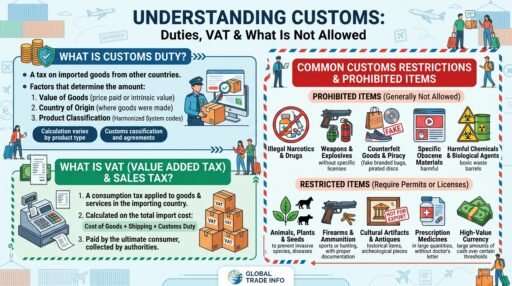
The GCC operates under a unified Common External Tariff. Understanding the duty and VAT structure — and what is outright banned — is the most important compliance step before you place your first order.
| Country | Typical Duty | VAT / GST | Notable Free-Duty Items |
| Saudi Arabia | 5%–20% | 15% | High-end electronics (with CO) |
| United Arab Emirates | 5% | 5% | Certain tech, medical devices |
| Qatar | 5% | 5% | Same as UAE |
| Kuwait | 5%–12% | 15% | Consumer electronics (usually duty-free) |
| Oman | 5% | 5% | Pharmaceuticals (with licence) |
| Bahrain | 5% | 5% | Most consumer goods |
VAT is applied on top of customs value plus duties. Saudi Arabia applies 15% while other GCC states levy 5%. Plan your landed cost model accordingly — Saudi-bound shipments carry significantly higher tax exposure.
| Restricted Categories — Verify Before You Ship
Alcohol and pork (all GCC), firearms, counterfeit goods, certain chemicals, used clothing from Japan (Saudi Arabia and Oman), and live animals/plants all face restrictions. The GCC Customs Portal (AIMU) is the definitive reference before shipping any new product category. |
03 DOCUMENTATION
The Essential Shipping Documents

Even a small shipment can be held at customs if a document is missing or contains an inaccuracy. These are the non-negotiables for every Japan–GCC consignment.
| Document | What It Covers | Issued By |
| Commercial Invoice | Seller, buyer, product details, price, Incoterm. The backbone of customs clearance — required on every shipment. | Supplier |
| Packing List | Box-by-box dimensions, weight, and SKU count for customs and carrier planning. Required on every shipment. | Supplier / Forwarder |
| Certificate of Origin | Confirms Japanese manufacture. Required when claiming FTA preferential duty. Must be issued by the JCCI. | Japan Chamber of Commerce |
| Bill of Lading / AWB | Contract of carriage with tracking number — required to release cargo at the destination port. | Carrier / Forwarder |
| Declaration of Conformity | Proof of GCC technical standards compliance. Required for electronics, toys, cosmetics. | Accredited testing body |
| Insurance Certificate | All-risk cargo insurance coverage. Recommended for any shipment over $2,000 in value — insure at 110% of invoice value. | Insurer / Forwarder |
| SMB Shortcut
Let your freight forwarder generate the Bill of Lading, packing list, and insurance certificate. Your primary responsibility is producing a clean, accurate commercial invoice and obtaining any product-specific licences or conformity certificates before the cargo leaves Japan. https://www.jcci.or.jp/en |
04 FREIGHT MODES
Choosing the Right Shipping Mode
Your mode decision is a cost-versus-speed trade-off. Each mode serves a different business scenario — understanding the fit upfront prevents expensive mid-shipment pivots.
| Mode | Typical Transit Time | Best For |
| Direct Air Freight | 2–5 days | High-value, time-sensitive items: smartphones, fashion, perishables. Premium cost, maximum speed. |
| Consolidated Air Freight | 5–10 days | Small batches where speed still matters. Share container space, share cost. |
| Sea Freight — LCL | 18–30 days | Bulk, non-urgent cargo — furniture, textiles, machinery. Pay only for the space you use. |
| Sea Freight — FCL | 20–35 days | Large orders or inventory replenishment. A sealed container for electronics and high-value goods. |
| Express Courier | 1–3 days | Samples, spare parts, documents, returns. Best under 30 kg — often cheaper than consolidated air. |
| Rule of Thumb for SMBs
Need it fast? Go air. Keeping costs low? Choose sea — especially if you can fill an FCL. Shipping under 30 kg? An express courier is often the most cost-effective and simplest solution, with zero documentation complexity. |
05 PARTNER SELECTION
Finding the Right Freight Forwarder

A good forwarder is the bridge between Japanese customs and Gulf ports. The wrong choice costs you in delays, hidden fees, and customs hold-ups. Look for these qualities and ask direct questions on each.
| Capability | What To Ask |
| GCC local presence | Do you have a licensed office or direct agent in the UAE or my destination GCC country? |
| Full-service portfolio | Can you handle air, sea, and multimodal in a single booking — and manage customs clearance in-house? |
| Transparent pricing | Give me a line-by-line quote: freight, fuel surcharge, security fee, duties, VAT, insurance, and local delivery. |
| Technology access | Do you have a real-time tracking portal I can give my customers access to? |
| HS-code expertise | Can you verify our product classification before we ship — in writing? |
| Insurance options | Do you offer all-risk cargo insurance, and what is the claims process? |
| Negotiation Tip
Bundle several shipments into a single booking period. Volume commitments — even at 4–6 FCL per quarter — typically unlock 10–15% discounts versus one-off spot rates. Always negotiate fuel surcharge caps for predictable budget planning. |
06 CARGO PREPARATION
Getting Your Products Ship-Ready
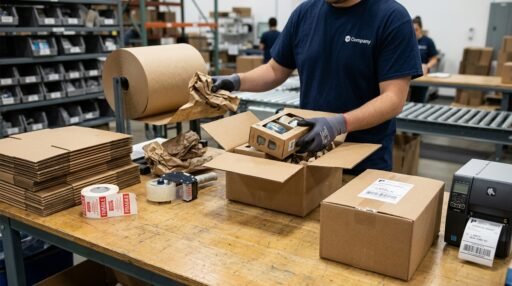
Three areas demand attention before your cargo leaves the factory: HS-code accuracy, packaging compliance, and — for regulated categories — GCC conformity certification.
HS-Code Accuracy
- Find the 6-digit heading via the World Customs Organization (WCO) database.
- Add the GCC-specific 2-digit sub-heading — which varies by country.
- Verify the code with your forwarder — wrong codes trigger extra duties, delays, and potential fines.
- The liability for misclassification rests with the importer of record, not the forwarder.
Packaging Requirements
- Use sturdy corrugated cardboard or high-density polyethylene with at least 5mm wall thickness.
- Air freight caps individual pieces at 70 kg; keep boxes under 120 cm on any side to avoid oversize surcharges.
- Apply tamper-evident security seals for high-value electronics shipments.
| Bilingual Labelling Is Mandatory
Every box must carry product descriptions in both English and Arabic, plus the Country of Origin (JAPAN) clearly printed. Missing Arabic labels are one of the most common causes of port delays across all GCC customs authorities. |
GCC Conformity Certification
If you are shipping electronics, toys, or cosmetics, a GCC Conformity Certificate is required before the goods leave Japan. Your forwarder can arrange testing and documentation — but build 2–3 weeks into your timeline for the process.
07 COST MANAGEMENT
Controlling Costs and Setting the Right Price
Use this formula to build your landed cost model for any Japan–GCC shipment before you set your customer price.
Total Cost Formula
Total Cost =
+ Freight Rate x Chargeable Weight
+ Fuel Surcharge (% of freight)
+ Security Fee (fixed)
+ Customs Duty (5% of CIF value)
+ VAT/GST (5-15% of CIF + duty)
+ Insurance (0.5-1% of declared value)
+ Local Delivery (if DAP/DDP)
Worked Example: 500 kg Electronics, Air Freight to Dubai
| Air freight ($3,500/t x 0.5t) | $1,750 |
| Fuel surcharge (15%) | $262 |
| Security fee (fixed) | $80 |
| Customs duty (0% — electronics are duty-free in UAE) | $0 |
| UAE VAT (5% of $1,750) | $87 |
| Insurance (0.8% of $40,000 cargo value) | $320 |
| Estimated total landed cost | $2,499 |
Cost-Saving Strategies
- Use the Japan–GCC FTA Certificate of Origin to claim 0% duty where eligible.
- Consolidate shipments to hit FCL threshold — cost per kilogram drops significantly.
- Negotiate fuel surcharge caps with your forwarder for predictable budgeting.
- Start with DAP Incoterms so your forwarder manages duties until your process is proven, then switch to DDP for full control.
08 EXECUTION
Step-by-Step: Your First Shipment

Follow this 11-step sequence for every first shipment to a new GCC market. Once you have completed it twice, the process becomes repeatable and can be delegated to your operations team.
| 1 | Validate market demand and set target price
Confirm there is a buyer or distributor for your product in the target GCC country before incurring freight costs. Role: Marketing / Sales | Time: 1–2 weeks |
| 2 | Check product compliance and confirm HS code
Verify the correct 8-digit HS code with your forwarder. Confirm whether a conformity certificate, import licence, or halal certification is required. Role: Product / Legal | Time: 1 week |
| 3 | Prepare document templates
Draft your commercial invoice and packing list templates. Ensure Arabic labelling is ready for production. Role: Operations | Time: 2–3 days |
| 4 | Request quotes from 2–3 forwarders
Compare air vs sea vs courier on total landed cost — not just freight rate. Include all surcharges, handling, and destination charges. Role: Procurement | Time: 1 week |
| 5 | Book space and purchase cargo insurance
Confirm booking, obtain booking reference, and arrange all-risk insurance at 110% of declared cargo value. Role: Logistics | Time: 1–2 days |
| 6 | Pack, label, seal and generate packing list
Apply bilingual labels (EN + AR), tamper-evident seals for high-value goods, and verify weights and dimensions match the packing list exactly. Role: Warehouse | Time: 2–5 days |
| 7 | Submit Japan export customs declaration
Your forwarder or customs broker handles this. Ensure the commercial invoice matches the declaration to the digit. Role: Forwarder / Customs broker | Time: 1–3 days |
| 8 | Track cargo in transit
Use your forwarder’s portal or the carrier tracking system. Set up milestone alerts for departure, transshipment, and arrival. Role: Logistics | Time: Ongoing |
| 9 | GCC import customs clearance
Your forwarder’s local partner handles duty and VAT payment under DAP. Clearance takes 12–24 hours in UAE and 2–4 days in Saudi Arabia. Role: Forwarder / Local partner | Time: 1–5 days |
| 10 | Last-mile delivery
Door-to-door delivery or to your local distributor’s warehouse. Confirm delivery window and contact details for the local receiver. Role: Forwarder / Local courier | Time: 1–3 days |
| 11 | Delivery confirmation and record-keeping
Collect POD, file all customs paperwork, and record actual landed cost versus estimate. Use the data to refine your pricing model for the next shipment. Role: Customer Service | Time: Ongoing |
| First-Shipment Tip
Start with DAP Incoterms to simplify the first few runs. You only pay freight and insurance upfront; the forwarder manages duties and VAT at destination. Once your process is proven and you understand the duty structure, switch to DDP for tighter cost control. |
GCC customs portal – https://www.aimu.gov.sa
09 TECHNOLOGY
Tech Tools That Smooth the Process
The right platform stack eliminates manual paperwork, delivers real-time visibility, and connects your logistics data directly to your order management system.
| Tool | How It Helps | Integration |
| Flexport | End-to-end visibility, auto-generated customs docs, duty calculator. | SAP, NetSuite, Shopify, WooCommerce |
| ShipBob | Fulfilment centre in the UAE with real-time inventory management. | Shopify, WooCommerce, Amazon DTC |
| Shippo | One-click label creation for DHL, UPS, FedEx with instant rate comparison. | API to most e-commerce dashboards |
| AIMU (GCC Customs Portal) | Electronic customs declaration for Saudi Arabia, UAE, Qatar, and others. | Direct upload or via customs broker |
| TradeLens | Blockchain-based container data sharing that reduces paperwork errors. | Access through partner forwarders |
| Best Practice
Hook your order management system to Flexport or a comparable platform. When a new order comes in, the system pulls product data, calculates freight, and produces a ready-to-sign commercial invoice automatically — moving the entire process from manual spreadsheet to one-click workflow. |
10 RISK MANAGEMENT
Common Pitfalls and Quick Fixes

These are the six mistakes that cost Japan–GCC shippers the most money — and the specific action that eliminates each one.
| Pitfall | Consequence | Quick Fix |
| Wrong HS code | Customs holds cargo; extra duties plus potential fines plus accumulating storage charges. | Verify every code in the WCO database and ask your forwarder to double-check in writing before booking. |
| Missing Arabic labels | Shipment held at port while customs request translation. Cargo sits, demurrage accumulates. | Print bilingual (EN/AR) label sheets and affix to every box before goods are loaded at origin. |
| Under-insuring cargo | A single damaged pallet can wipe out the profit margin of an entire shipment. | Insure for 110% of commercial invoice value to cover ancillary fees in the event of a total loss claim. |
| Late duty payment under DAP | Shipment seized at destination port; storage fees pile up while the duty dispute is resolved. | Use a dedicated customs broker or escrow service that settles duties upfront before vessel arrival. |
| No local importer of record | Customs refuses entry for regulated goods if there is no authorised GCC entity as importer of record. | Partner with a Gulf distributor or use a third-party importer of record service before the first consignment. |
| Ignoring Incoterm changes | Unexpected destination costs that were not in the budget when the Incoterm changed during execution. | Maintain a master Incoterm table in every contract and review it annually as a mandatory agenda item. |
Check your product HS code here – www.wcoomd.org
Japan Customs HS code search – https://www.customs.gov.jp/hs-code
11 FAQS
Frequently Asked Questions
Do I have to own a GCC company to import?
Not necessarily. Under DAP or DDP Incoterms, the freight forwarder or your local Gulf distributor can act as the importer of record. This is the standard approach for most first-time Japan–GCC exporters and avoids the need to incorporate a local entity before proving market demand.
How long does customs clearance actually take?
In the UAE, pre-cleared shipments with complete documentation can clear in as little as 12–24 hours. Saudi Arabia typically takes 2–4 days for standard goods. The single biggest variable is documentation accuracy — a clean invoice and matching packing list is worth more than any expediting service.
Are free-trade zones a legitimate way to manage duties?
Yes, and it is widely used by regional distributors. Zones like Jebel Ali Free Zone (JAFZA) allow you to store goods duty-free for up to five years. Duty becomes payable only when goods move from the free zone into the UAE mainland — giving you a powerful cash-flow advantage on slow-moving inventory.
How do I prove Japanese origin for the FTA preferential duty?
Submit a Certificate of Origin issued by the Japan Chamber of Commerce and Industry (JCCI). Keep one original and a scanned electronic version. The electronic copy is uploaded to the GCC customs portal (AIMU). Without a valid COO, you cannot claim the preferential duty rate — you pay the standard tariff.
What is the easiest way to handle product returns from the GCC?
Create a Return Merchandise Authorization (RMA) workflow that routes returns to a local repair or consolidation centre in the UAE. Work with the same forwarder for the reverse logistics leg — most experienced Japan–GCC operators offer DDP reverse-shipment pricing as part of their service package.
Key Takeaways: What To Do Next
| Priority | Action |
| Day 1 | Start with DAP and a GCC-licensed forwarder. Let them manage duties while you learn the customs rhythm. |
| Week 1 | Verify the HS code for every product. One wrong classification costs more than the compliance check to prevent it. |
| Week 2 | Obtain your GCC Conformity Certificate for electronics, toys, or cosmetics — allow 2–3 weeks lead time. |
| Before shipping | Ensure every carton carries bilingual (EN + AR) labels and a clear ‘Made in Japan’ origin statement. |
| Ongoing | Use the FTA Certificate of Origin (JCCI) for duty-eligible products and explore Jebel Ali Free Zone for inventory management. |
Ready to ship? Pick a product, run it through the checklist,
and let the forwarder do the heavy lifting www.alfurqanshipping.com / info@alfurqanshipping.com
AL FURQAN SHIPPING & LOGISTICS SERVICES LLC
Dubai, United Arab Emirates | 23+ Years GCC Multimodal Freight Experience
Air | Sea | Overland | Customs Clearance | Cross-Trade | Warehousing
This document is for informational purposes only. Duty rates, VAT rates, and transit times are subject to change. Always verify current requirements with a licensed customs broker before shipping.