
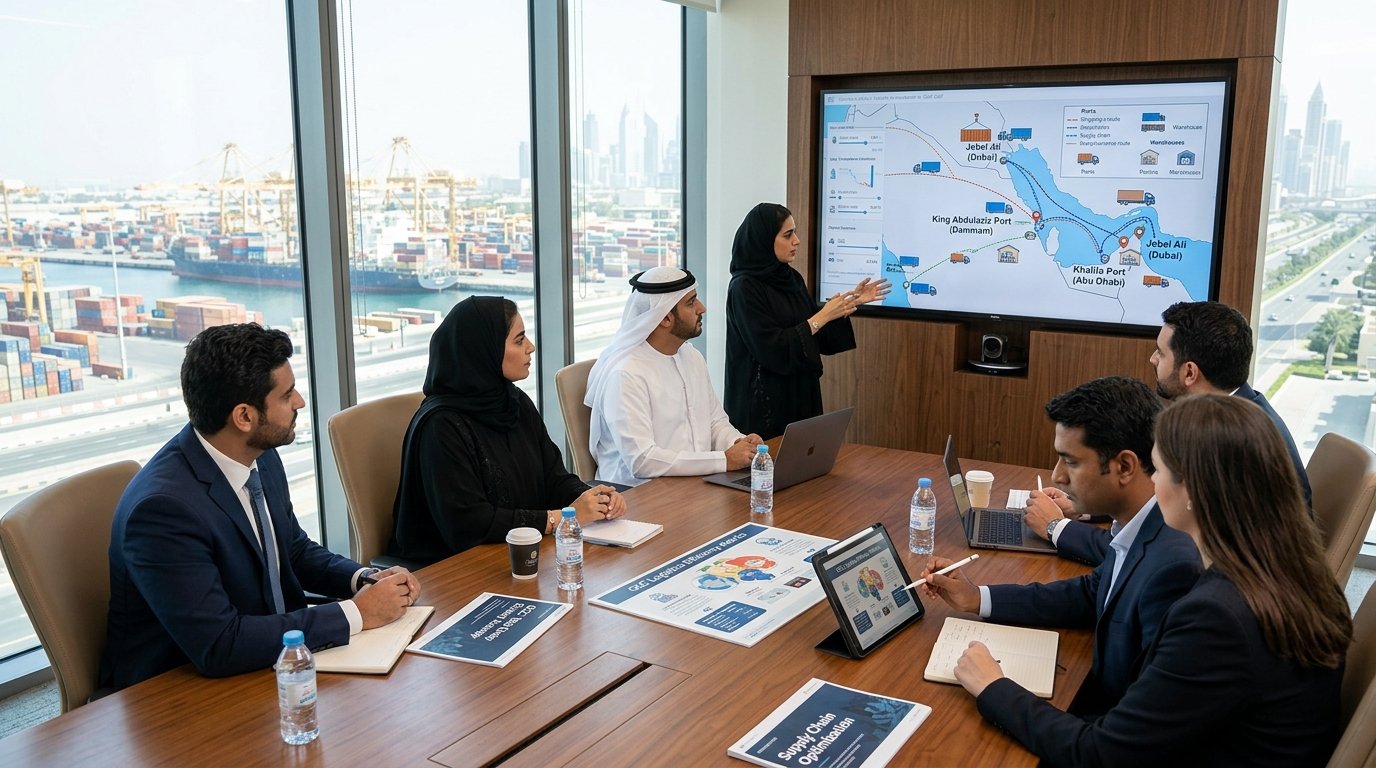
Business , Logistics & Consulting In GCC
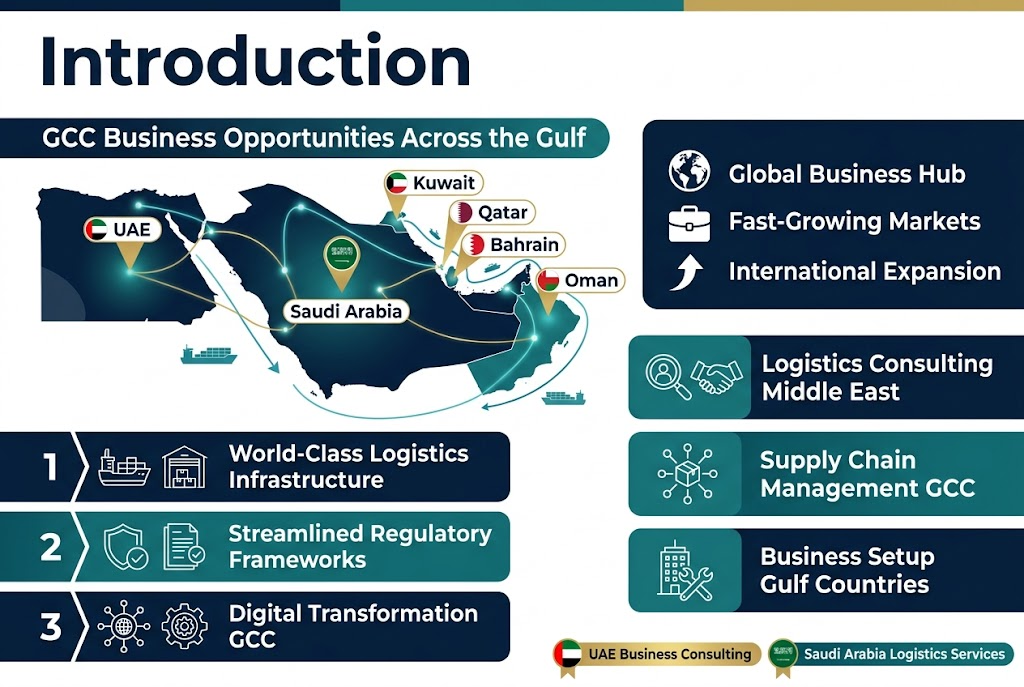
The Gulf Cooperation Council region offers some of the world’s most promising GCC business opportunities, attracting companies seeking growth in dynamic markets across the UAE, Saudi Arabia, Kuwait, Qatar, Bahrain, and Oman. This guide is designed for business owners, entrepreneurs, logistics managers, and executives who want to understand how to navigate and succeed in these rapidly evolving markets.
We’ll explore the strategic advantages that make the Gulf region a global business hub, from its world-class logistics infrastructure to streamlined regulatory frameworks that support international companies. You’ll discover how logistics consulting Middle East experts help businesses optimize their operations, and why supply chain management GCC strategies are critical for regional success.
We’ll also dive into the practical aspects of business setup Gulf countries and examine how digital transformation GCC initiatives are reshaping industries. From UAE business consulting insights to Saudi Arabia logistics services, you’ll learn what it takes to build a profitable presence in these markets and leverage the region’s unique advantages for long-term growth.
Strategic Business Opportunities in GCC Markets
High-Growth Industries and Emerging Sectors
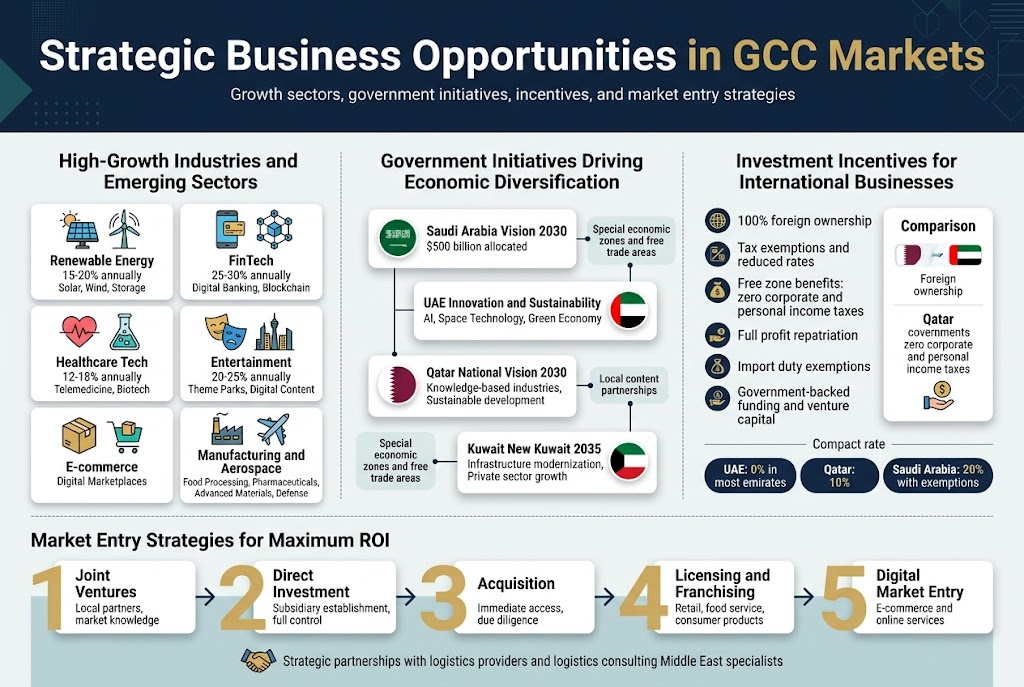
The GCC region presents exceptional GCC business opportunities across multiple high-growth industries that are reshaping the economic landscape. The renewable energy sector stands out as a primary growth driver, with massive solar and wind projects creating demand for specialized logistics and consulting services. Healthcare technology and biotechnology are experiencing rapid expansion, particularly in the UAE and Saudi Arabia, where government backing fuels innovation.
Financial technology continues to dominate growth charts, with digital banking and blockchain applications attracting significant investment. The entertainment and tourism industries are booming, especially with mega-projects like NEOM in Saudi Arabia and Expo legacy developments in Dubai. E-commerce and digital marketplace platforms are experiencing unprecedented growth rates, creating new supply chain demands.
Manufacturing sectors focusing on food processing, pharmaceuticals, and advanced materials are gaining momentum through government-supported diversification programs. The aerospace and defense industries offer substantial opportunities for international businesses with specialized capabilities.
| Industry | Growth Rate | Investment Focus |
|---|---|---|
| Renewable Energy | 15-20% annually | Solar, Wind, Storage |
| FinTech | 25-30% annually | Digital Banking, Blockchain |
| Healthcare Tech | 12-18% annually | Telemedicine, Biotech |
| Entertainment | 20-25% annually | Theme Parks, Digital Content |
Government Initiatives Driving Economic Diversification
Government-led economic diversification programs across GCC countries are creating unprecedented business opportunities for international companies. Saudi Arabia’s Vision 2030 represents one of the most ambitious transformation plans globally, with over $500 billion allocated to new city developments, renewable energy projects, and technology initiatives.
The UAE’s strategic plans focus on becoming a global hub for innovation and sustainability, with specific emphasis on artificial intelligence, space technology, and green economy initiatives. Qatar’s National Vision 2030 prioritizes knowledge-based industries and sustainable development, while Kuwait’s New Kuwait 2035 vision emphasizes infrastructure modernization and private sector growth.
These initiatives create direct opportunities for business consulting services Dubai and throughout the region. Companies specializing in project management, technology implementation, and operational excellence find themselves in high demand. The focus on local content development means international businesses can partner with domestic entities to capture market share while contributing to economic diversification goals.
Special economic zones and free trade areas are expanding rapidly, offering enhanced business setup advantages and streamlined regulatory processes. These zones typically provide tax incentives, simplified licensing procedures, and improved logistics infrastructure.
Investment Incentives for International Businesses
GCC countries offer competitive investment incentives designed to attract international businesses and accelerate economic growth. Foreign ownership rules have been significantly relaxed, with the UAE now allowing 100% foreign ownership in most sectors, while Saudi Arabia permits full foreign ownership in wholesale, retail, and manufacturing industries.
Tax incentives vary by country and sector, but generally include corporate tax exemptions for specified periods, reduced rates for qualifying activities, and accelerated depreciation allowances. Free zone establishments often benefit from zero corporate and personal income taxes, full profit repatriation rights, and exemption from import duties.
Gulf market entry strategy considerations should include these financial incentives:
-
Corporate tax rates: UAE (0% in most emirates), Qatar (10%), Saudi Arabia (20% with various exemptions)
-
Free zone benefits: Tax holidays ranging from 15-50 years
-
Investment thresholds: Minimum investment requirements often offset by generous incentive packages
-
Sector-specific incentives: Additional benefits for priority sectors like technology, healthcare, and manufacturing
Government-backed funding programs and venture capital initiatives provide additional financial support for startups and growth-stage companies. Sovereign wealth funds actively invest in promising international businesses that align with diversification objectives.
Market Entry Strategies for Maximum ROI
Successful market entry in GCC countries requires careful strategy selection based on business objectives, risk tolerance, and resource availability. Joint ventures with established local partners remain popular for companies seeking rapid market penetration and regulatory navigation support. Local partners bring market knowledge, government relationships, and distribution networks that accelerate business development.
Direct investment through subsidiary establishment offers maximum control but requires substantial commitment and regulatory compliance expertise. This approach works best for companies with significant resources and long-term market commitment. Business setup Gulf countries procedures have been streamlined, but professional guidance remains valuable for optimal structure selection.
Acquisition strategies can provide immediate market access and established customer bases, though due diligence requirements are extensive. The GCC M&A market is active, with government privatization programs creating acquisition opportunities in previously restricted sectors.
Licensing and franchising models work well for proven business concepts, particularly in retail, food service, and consumer products. These models require lower initial investment while providing rapid market coverage through established local operators.
Digital market entry through e-commerce platforms and online services offers cost-effective testing opportunities before physical presence establishment. The region’s high internet penetration and growing digital commerce adoption make this approach increasingly viable.
Strategic partnerships with regional logistics providers and logistics consulting Middle East specialists can significantly improve market entry success rates by ensuring efficient supply chain operations from day one.
Logistics Infrastructure and Supply Chain Excellence
World-Class Ports and Transportation Networks
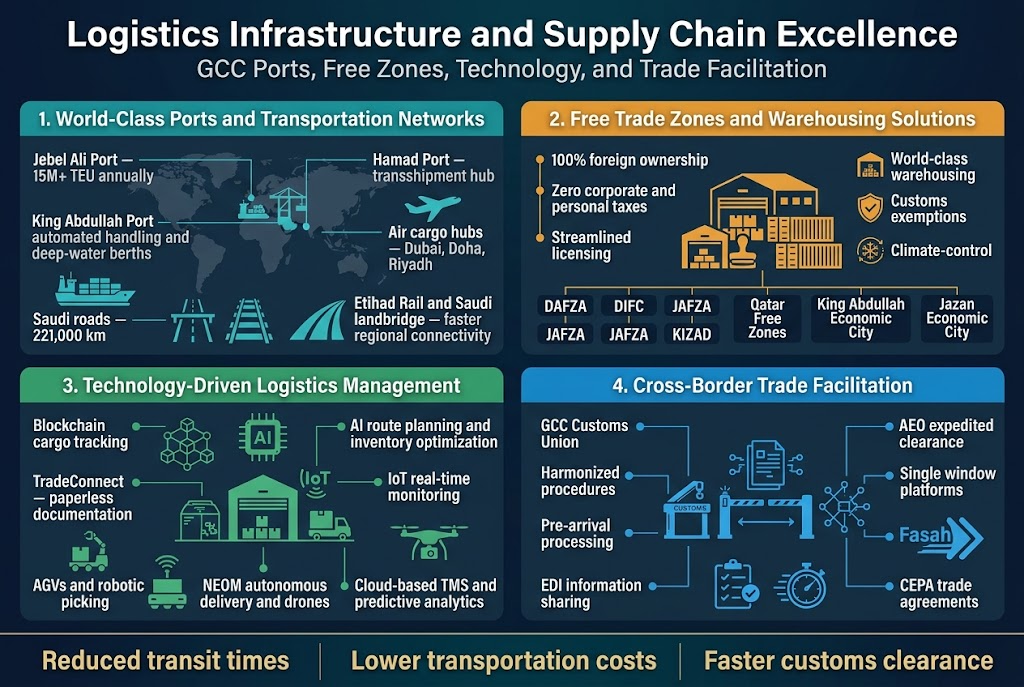
The GCC region boasts some of the world’s most advanced maritime and transportation infrastructure, making it a global logistics powerhouse. Dubai’s Jebel Ali Port ranks among the top ten container ports worldwide, handling over 15 million TEU annually. Similarly, Saudi Arabia’s King Abdullah Port in Rabigh has transformed the kingdom’s logistics landscape with automated container handling systems and deep-water berths accommodating the largest vessels.
The region’s strategic location creates natural advantages for logistics consulting Middle East operations. Qatar’s Hamad Port connects Asian markets with European destinations through efficient transshipment services. Kuwait’s Shuwaikh and Shuaiba ports serve as critical gateways for inland distribution across the Arabian Peninsula.
Road networks complement maritime infrastructure exceptionally well. The GCC highway system links all member states through modern, multi-lane expressways. Saudi Arabia’s extensive road network spans over 221,000 kilometers, connecting major industrial centers with ports and neighboring countries. Air cargo facilities at Dubai International Airport, Doha’s Hamad International, and Riyadh’s King Khalid Airport handle millions of tons of freight annually.
Rail developments are reshaping regional connectivity. The UAE’s Etihad Rail project will eventually link the country from Al Ghuweifat to Fujairah, reducing transportation costs by 30%. Saudi Arabia’s landbridge railway connecting Riyadh with Dammam port cuts transit times dramatically. These integrated transportation networks create seamless supply chain management GCC opportunities for businesses seeking regional expansion.
Free Trade Zones and Warehousing Solutions
Free trade zones across the GCC provide unmatched advantages for international businesses seeking regional distribution hubs. Dubai alone hosts over 30 specialized zones, including Dubai Airport Free Zone (DAFZA) for aviation services, Dubai International Financial Centre (DIFC) for financial services, and Jebel Ali Free Zone (JAFZA) for general trading and manufacturing.
Each zone offers distinct benefits:
-
100% foreign ownership without local partnership requirements
-
Zero corporate and personal taxes for most business activities
-
Streamlined licensing procedures reducing setup timeframes
-
World-class warehousing facilities with climate control and security systems
-
Customs exemptions on imports and re-exports
Abu Dhabi’s KIZAD (Khalifa Industrial Zone) provides direct access to Khalifa Port with automated warehousing systems and dedicated rail connections. Qatar Free Zones Authority operates multiple specialized zones focusing on logistics, technology, and manufacturing. Saudi Arabia’s expanding free zone network includes King Abdullah Economic City and Jazan Economic City, offering integrated industrial and logistics facilities.
Modern warehousing solutions incorporate advanced inventory management systems, robotics, and AI-powered optimization. Temperature-controlled facilities support pharmaceutical and food distribution across harsh Middle Eastern climates. Cross-docking capabilities enable rapid cargo consolidation and distribution to final destinations throughout the region and beyond.
Technology-Driven Logistics Management
Digital transformation revolutionizes supply chain management GCC operations through cutting-edge technologies. Blockchain implementation ensures cargo tracking transparency from origin to destination. Dubai’s TradeConnect platform eliminates paper-based documentation, reducing processing times by 80% while improving accuracy and security.
Artificial intelligence optimizes route planning and inventory management across regional networks. Smart warehouses utilize IoT sensors for real-time monitoring of environmental conditions, security, and equipment performance. Automated guided vehicles (AGVs) and robotic picking systems increase operational efficiency while reducing human error rates.
Saudi Arabia’s NEOM project showcases futuristic logistics automation with autonomous delivery systems and drone networks for last-mile distribution. The kingdom’s Vision 2030 initiative prioritizes technology adoption across all logistics sectors, creating opportunities for logistics services providers specializing in digital solutions.
Predictive analytics help businesses anticipate demand fluctuations and optimize inventory levels. Cloud-based transportation management systems (TMS) provide real-time visibility across multi-modal shipments. Integration with global shipping lines’ digital platforms streamlines booking, documentation, and payment processes for international trade.
Cross-Border Trade Facilitation
GCC Customs Union simplifies cross-border trade through harmonized procedures and reduced documentation requirements. Common external tariffs eliminate customs duties on most goods moving between member states. Advanced cargo clearance systems process shipments before physical arrival, reducing dwell times significantly.
Electronic data interchange (EDI) systems connect regional customs authorities, enabling seamless information sharing and risk assessment. Pre-arrival processing allows customs clearance while vessels are still at sea. Authorized Economic Operator (AEO) programs provide expedited processing for certified companies meeting security and compliance standards.
Trade agreement networks expand market access beyond the GCC region. Free trade agreements with major economies like India, Singapore, and EFTA countries create preferential trading conditions. The UAE’s Comprehensive Economic Partnership Agreements (CEPAs) with multiple countries offer reduced tariffs and simplified procedures for businesses operating through Emirati free zones.
Single window platforms consolidate all trade-related government services into unified digital interfaces. Saudi Arabia’s Fasah system processes customs declarations, permits, and certificates through one portal. These initiatives significantly reduce administrative burdens while improving compliance monitoring and trade facilitation across the region.
Regulatory Environment and Business Setup Advantages
Streamlined Company Registration Processes
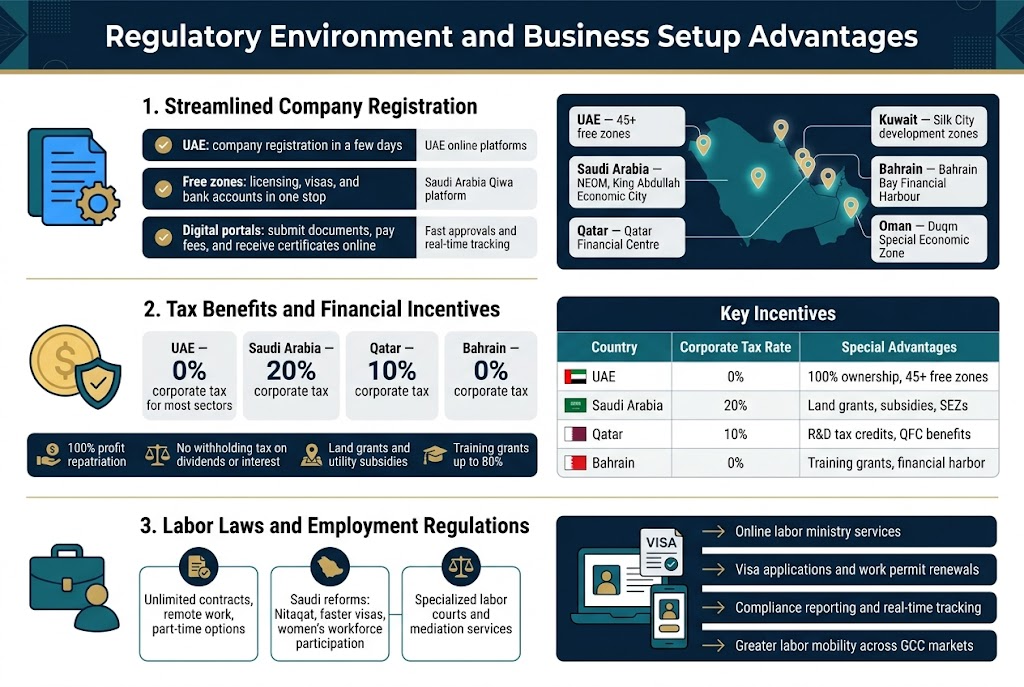
The Gulf countries have transformed their business setup procedures into some of the world’s most efficient systems. UAE leads the charge with online registration platforms that can establish a company in just a few days. Free zones across the region offer one-stop shops where entrepreneurs can complete licensing, visa processing, and bank account opening under one roof.
Saudi Arabia’s Vision 2030 initiative has revolutionized business setup Gulf countries standards. The Kingdom now allows 100% foreign ownership in most sectors and has digitized registration processes through the Qiwa platform. Investors can track application progress in real-time and receive approvals faster than ever before.
Each GCC nation offers specialized economic zones with tailored registration benefits:
-
UAE: Over 45 free zones with sector-specific advantages
-
Saudi Arabia: NEOM and King Abdullah Economic City
-
Qatar: Qatar Financial Centre with expedited setup
-
Kuwait: Silk City project development zones
-
Bahrain: Bahrain Bay Financial Harbour
-
Oman: Duqm Special Economic Zone
Online portals have eliminated bureaucratic bottlenecks. Companies can submit documents digitally, pay fees electronically, and receive certificates without physical visits. This digital approach has cut registration times from weeks to days across most GCC markets.
Tax Benefits and Financial Incentives
GCC nations maintain some of the world’s most attractive tax structures for international businesses. Most Gulf states impose zero personal income tax, creating significant advantages for expatriate professionals and business owners. Corporate tax rates remain competitive, with several countries offering complete tax exemptions for specific periods.
UAE business consulting experts often highlight the country’s tax benefits:
-
No corporate tax for most business activities
-
No withholding tax on dividends or interest
-
100% profit repatriation rights
-
No currency exchange controls
Saudi Arabia offers substantial incentives through SAGIA (now MISA) programs. Foreign investors can access land grants, utility subsidies, and training support. The Kingdom’s industrial incentive programs provide up to 50% cost reduction for manufacturing setup costs.
Bahrain’s regulatory compliance Middle East framework includes attractive financial packages for fintech and manufacturing companies. The country offers grants covering up to 80% of training costs and provides dedicated support for startups through Bahrain Development Bank programs.
| Country | Corporate Tax Rate | Key Incentives | Special Zones |
|---|---|---|---|
| UAE | 0% (most sectors) | 100% ownership | 45+ free zones |
| Saudi Arabia | 20% | Land grants, subsidies | Multiple SEZs |
| Qatar | 10% | R&D tax credits | QFC benefits |
| Bahrain | 0% | Training grants | Financial harbor |
Labor Laws and Employment Regulations
Modern labor frameworks across the GCC have evolved to balance worker protection with business flexibility. Recent reforms address work-life balance, contract transparency, and dispute resolution mechanisms. These changes support the Gulf market entry strategy for companies seeking skilled international talent.
The UAE’s new labor law introduced unlimited contracts, remote work provisions, and part-time employment options. Companies can now structure flexible working arrangements that attract global talent while maintaining operational efficiency. The law also streamlined termination procedures and reduced notice periods for business-friendly operations.
Saudi Arabia’s labor reforms under Vision 2030 include:
-
Nitaqat program: Encouraging Saudi employment with incentive tiers
-
Improved visa processes: Faster work permit approvals
-
Women’s workforce participation: Enhanced opportunities and protections
-
Flexible working hours: Supporting diverse employment models
Logistics consulting Middle East specialists note that labor mobility between GCC countries has improved significantly. The unified visa systems under development will allow skilled workers to move between member states more freely, creating larger talent pools for businesses.
Employment contract standards now include clear termination clauses, end-of-service benefit calculations, and dispute resolution pathways. Countries have established specialized labor courts and mediation services to handle workplace conflicts efficiently. These improvements reduce legal uncertainties and create more predictable business environments for companies expanding into GCC markets.
Digital transformation GCC initiatives include online labor ministry services where companies can process visa applications, renew work permits, and access compliance reporting tools. These platforms reduce administrative burdens and ensure businesses stay current with evolving regulations across different Emirates and kingdoms.
Consulting Services for Market Success
Market Research and Feasibility Studies
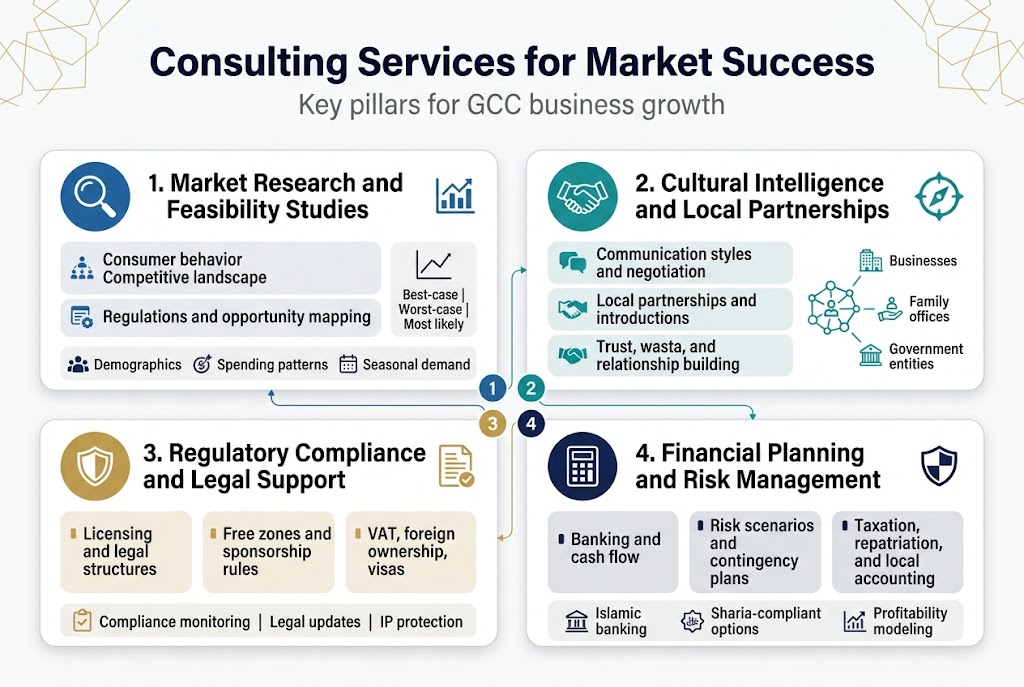
Understanding the unique characteristics of each GCC market requires comprehensive research that goes beyond surface-level analysis. Professional business consulting services Dubai and across the region provide detailed market assessments that examine consumer behavior, competitive landscapes, and sector-specific regulations. These studies identify growth opportunities while highlighting potential challenges that could impact business performance.
Feasibility studies for GCC business opportunities examine multiple scenarios, including best-case, worst-case, and most likely outcomes. This approach helps businesses make informed decisions about market entry timing, resource allocation, and expected returns on investment. Research teams analyze local procurement practices, distribution channels, and seasonal demand patterns that can significantly affect business operations.
The data collected includes demographic trends, spending patterns, and cultural preferences that shape purchasing decisions. Companies entering GCC markets benefit from understanding regional variations – what works in Dubai may require adjustments for implementation in Riyadh or Doha.
Cultural Intelligence and Local Partnership Development
Building successful operations in the Gulf requires deep cultural awareness that extends beyond basic business etiquette. Gulf market entry strategy consulting helps companies navigate complex social dynamics, religious considerations, and traditional business practices that influence relationship building.
Local partnerships often serve as the foundation for long-term success in GCC markets. Consultants facilitate introductions to established businesses, family offices, and government entities that can accelerate market penetration. These relationships provide access to local knowledge, distribution networks, and credibility that would take years to develop independently.
Cultural intelligence training covers communication styles, negotiation approaches, and decision-making processes that vary across the region. Understanding concepts like “wasta” (influence) and relationship-building protocols helps international companies avoid common pitfalls and build trust with local stakeholders.
Regulatory Compliance and Legal Support
The regulatory compliance Middle East landscape presents both opportunities and complexities that require specialized expertise. Each GCC country maintains distinct legal frameworks, licensing requirements, and operational standards that businesses must navigate carefully. Professional legal support ensures companies meet all regulatory obligations while maximizing available incentives and benefits.
Business setup Gulf countries involves understanding free zone regulations, local sponsorship requirements, and sector-specific restrictions. Legal teams provide guidance on corporate structures, intellectual property protection, and employment law compliance that varies significantly across jurisdictions.
Recent regulatory changes, including VAT implementation, foreign ownership reforms, and new visa categories, create ongoing compliance requirements. Regular legal updates and proactive compliance monitoring help businesses adapt to evolving regulations while maintaining operational efficiency.
Financial Planning and Risk Management
Strategic financial planning for GCC operations requires understanding local banking systems, currency considerations, and capital requirements that differ from other markets. Business consulting services Dubai teams work with companies to structure financing arrangements, optimize cash flow management, and establish banking relationships that support growth objectives.
Risk assessment covers political stability, economic diversification efforts, and sector-specific challenges that could impact business operations. Consultants help develop contingency plans for various scenarios, including oil price fluctuations, regulatory changes, and regional geopolitical developments.
Financial modeling incorporates local cost structures, taxation frameworks, and repatriation policies that affect overall profitability. Companies benefit from understanding Islamic banking principles, Sharia-compliant investment options, and local accounting standards that may differ from international practices.
Technology Integration and Digital Transformation
E-commerce and Digital Payment Solutions
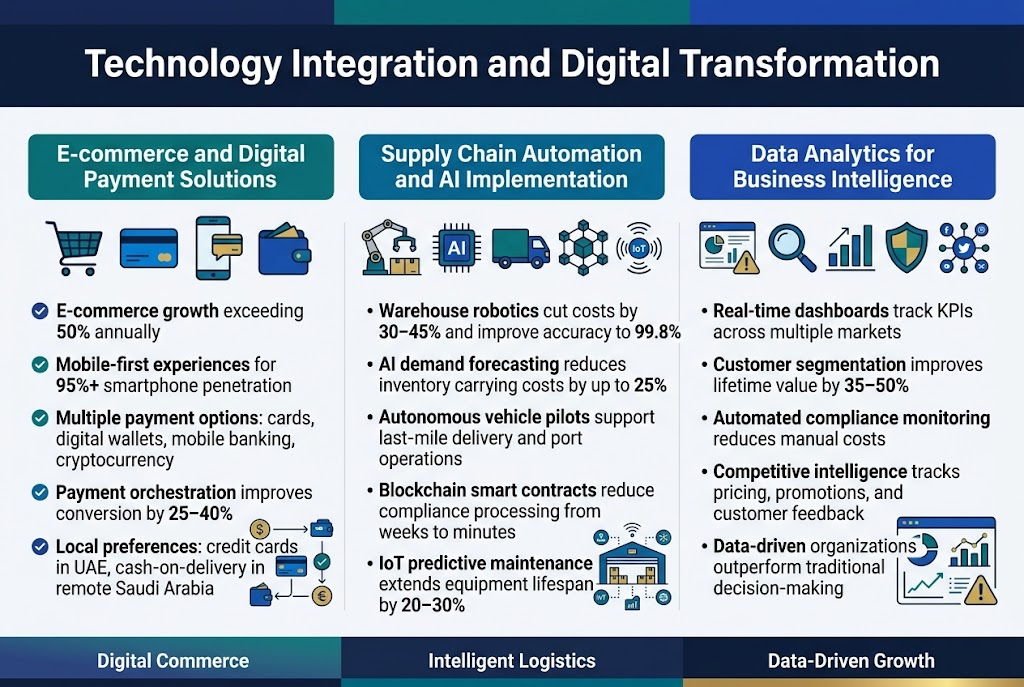
Digital transformation GCC markets are experiencing unprecedented growth in online commerce, creating massive opportunities for businesses ready to adapt. The region’s young, tech-savvy population drives demand for seamless digital experiences, with UAE business consulting firms reporting e-commerce growth rates exceeding 50% annually across key sectors.
Payment gateway integration has become crucial for market success. Local preferences vary significantly – while credit cards dominate in the UAE, cash-on-delivery remains popular in Saudi Arabia’s remote areas. Smart businesses implement multiple payment options including digital wallets, mobile banking, and cryptocurrency acceptance where legally permitted.
Cross-border e-commerce presents unique challenges in the Gulf region. Currency fluctuations, varying tax structures, and different consumer protection laws require sophisticated solutions. Companies leveraging advanced payment orchestration platforms see conversion rates improve by 25-40% compared to single-gateway implementations.
Mobile-first strategies prove essential, as smartphone penetration exceeds 95% across GCC countries. Progressive web applications and native mobile apps designed for local market preferences significantly outperform desktop-focused platforms in customer acquisition and retention metrics.
Supply Chain Automation and AI Implementation
Logistics consulting Middle East specialists emphasize automation as a competitive necessity rather than luxury. Warehouse robotics deployment across major Gulf distribution centers has reduced operational costs by 30-45% while improving accuracy rates to 99.8%.
AI-powered demand forecasting transforms inventory management strategies. Machine learning algorithms analyze local consumption patterns, religious holidays, seasonal fluctuations, and economic indicators to predict stock requirements with remarkable precision. Saudi Arabia logistics services have reported inventory carrying cost reductions of up to 25% through intelligent forecasting systems.
Autonomous vehicle pilots in controlled environments show promising results. Dubai’s logistics hubs test self-driving delivery trucks for last-mile distribution, while automated guided vehicles streamline port operations across the region. These technologies address labor shortages and improve safety standards in hazardous environments.
Supply chain management GCC companies increasingly adopt blockchain technology for transparency and traceability. Smart contracts automate compliance verification, reducing processing times from weeks to minutes while ensuring regulatory adherence across multiple jurisdictions.
Predictive maintenance powered by IoT sensors prevents costly equipment failures. Fleet management systems monitor vehicle health in real-time, scheduling maintenance based on actual usage patterns rather than arbitrary time intervals, extending equipment lifespan by 20-30%.
Data Analytics for Business Intelligence
Business intelligence platforms transform raw operational data into actionable insights for GCC market entry strategy development. Companies collecting and analyzing customer behavior, market trends, and operational metrics make informed decisions that drive sustainable growth.
Real-time dashboards provide executives with comprehensive overviews of key performance indicators across multiple markets. Gulf market dynamics change rapidly, requiring agile response capabilities that data-driven organizations consistently outperform traditional decision-making approaches.
Customer segmentation analytics reveal distinct preferences across different Emirates, Saudi provinces, and other Gulf states. Businesses using advanced analytics report customer lifetime value improvements of 35-50% through personalized marketing campaigns and targeted product offerings.
Regulatory compliance Middle East requirements generate substantial data management obligations. Automated compliance monitoring systems track regulatory changes, flag potential violations, and maintain audit trails that satisfy government oversight requirements while reducing manual compliance costs.
Competitive intelligence gathering through public data sources, social media monitoring, and market research integration provides strategic advantages. Companies systematically analyzing competitor pricing, promotional activities, and customer feedback adapt faster to market changes and identify untapped opportunities.
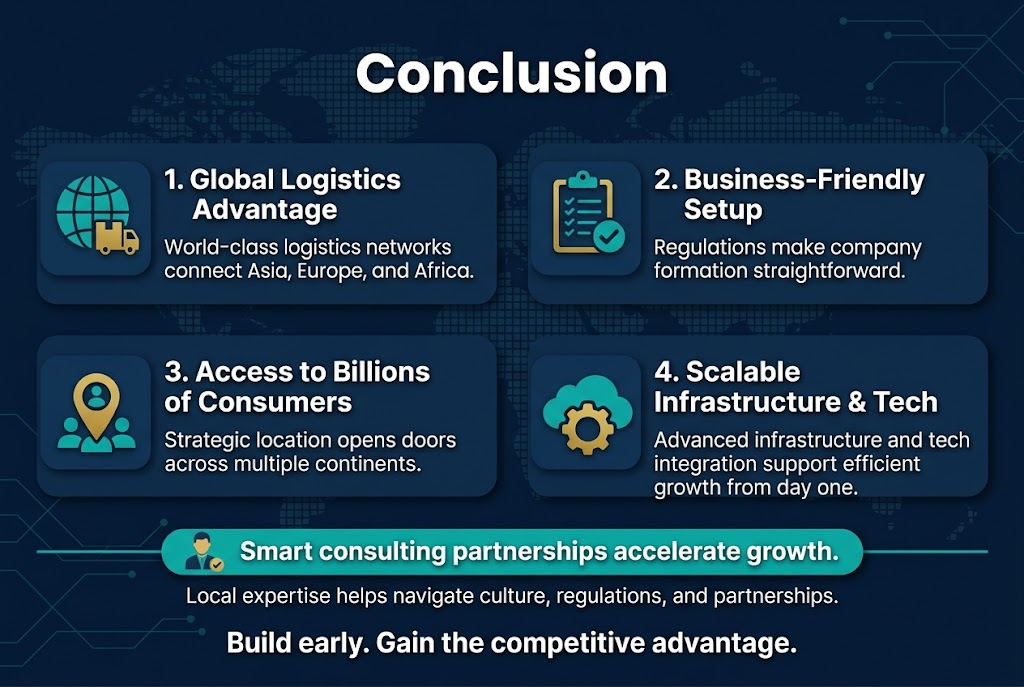
GCC markets offer unmatched opportunities for businesses ready to expand their reach. From world-class logistics networks that connect Asia, Europe, and Africa to business-friendly regulations that make setup surprisingly straightforward, the region has built itself into a global commerce powerhouse. The strategic location alone gives companies access to billions of consumers across multiple continents, while advanced infrastructure and tech integration capabilities mean your operations can scale efficiently from day one.
Smart consulting partnerships make all the difference when entering these dynamic markets. Local expertise helps you navigate cultural nuances, regulatory requirements, and partnership opportunities that can accelerate your growth timeline significantly. Don’t just think of the GCC as another expansion target – view it as your gateway to reaching emerging markets worldwide. Start building relationships with regional consultants and logistics partners now, because the businesses that establish their presence early will have the strongest competitive advantage as these economies continue their rapid transformation.
FAQs: Business, Logistics & Consulting in GCC
1. What does GCC stand for and which countries are included?
GCC stands for Gulf Cooperation Council. It includes six countries: Saudi Arabia, United Arab Emirates, Qatar, Kuwait, Bahrain, and Oman.
2. Why is the GCC region attractive for business expansion?
The GCC region offers strategic location between Europe, Asia, and Africa, strong economies driven by oil revenues, modern infrastructure, business-friendly policies, and growing consumer markets. Many countries also offer tax advantages and free trade zones.
3. What are the main logistics challenges in the GCC region?
Common challenges include extreme weather conditions affecting transportation, complex customs procedures across different countries, varying regulations between GCC states, and the need for specialized equipment for certain goods in desert climates.
4. Do I need local partners to start a business in GCC countries?
Requirements vary by country and business type. Some GCC countries allow 100% foreign ownership in certain sectors, while others require local partners or sponsors. It’s best to check specific regulations for each country and industry.
5. What types of consulting services are most in demand in the GCC?
Popular consulting services include business setup and legal compliance, digital transformation, supply chain optimization, government relations, market entry strategies, and regulatory consulting for industries like finance, healthcare, and construction.
6. How do customs and trade regulations differ between GCC countries?
While GCC countries have some unified trade agreements, each nation has its own customs procedures, import restrictions, and documentation requirements. Products may need different certifications or approvals depending on the destination country.
7. What are the peak business seasons in the GCC region?
Business activity typically slows during summer months (June-August) due to extreme heat and Ramadan period. Peak seasons are usually October to April when weather is milder and business activities are most active.
8. How important is cultural understanding when doing business in the GCC?
Cultural understanding is very important. This includes respecting local customs, understanding Islamic business practices, appropriate dress codes, meeting etiquette, and the significance of building personal relationships before conducting business.
9. What logistics infrastructure should I expect in GCC countries?
The GCC has modern ports, airports, and road networks. Major hubs include Dubai and Abu Dhabi ports, Hamad Port in Qatar, and King Abdulaziz Port in Saudi Arabia. Most countries have invested heavily in logistics infrastructure and technology.
10. How can consultants help with GCC market entry?
Consultants provide local market knowledge, help navigate legal requirements, identify suitable business partners, assist with licensing and permits, provide cultural training, and offer ongoing compliance support to ensure smooth business operations.